
Starlink's Exploding Satellite: A Red Flag for the New Space Economy
A single Starlink satellite failure signals systemic risk for LEO megaconstellations, impacting regulation, investment, and the future of the space economy.
The Lede: More Than Just Space Junk
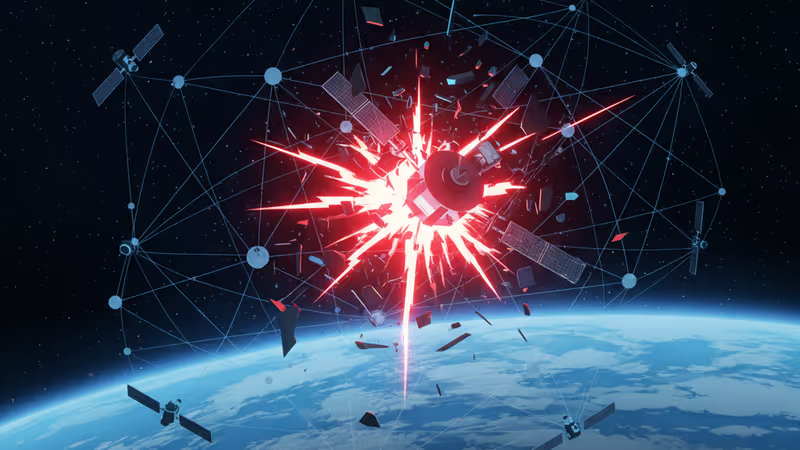
A single SpaceX Starlink satellite suffering a catastrophic failure and now tumbling back to Earth is more than a minor technical glitch. For any executive invested in or dependent on the burgeoning low Earth orbit (LEO) economy, this event is a critical data point. It’s a tangible demonstration of the systemic risk baked into the 'move fast and build constellations' model, transforming the abstract threat of space debris into an immediate strategic concern for regulators, insurers, and competitors.
Why It Matters: The Ripple Effects of a Single Failure
While SpaceX assures the satellite will burn up, the implications of its violent failure extend far beyond this single piece of hardware. This isn't a controlled de-orbit; it’s an uncontrolled, debris-shedding event. The 'why' and 'so what' are far more important than the 'what'.
- Regulatory Scrutiny Intensifies: The FCC and international bodies like the ITU will seize on this. Expect harder questions about satellite reliability, end-of-life disposal protocols, and the potential for chain-reaction failures (the Kessler syndrome). This gives ammunition to critics who argue SpaceX's rapid deployment outpaces safety and sustainability planning.
- Geopolitical Leverage: Coming just a week after a reported near-miss with a Chinese satellite, this incident will be weaponized. Nations developing competing constellations, particularly China with its GuoWang network, will use this to argue for stricter international oversight, potentially slowing SpaceX's operational cadence.
- The Insurance Market Shudders: The cost of insuring space assets is already climbing. Uncontrolled, kinetic failures like this one will push premiums higher for all LEO operators, increasing the capital expenditure required to enter or remain in the market.

The Analysis: The Cost of a Mass-Produced Sky
This incident marks a crucial turning point in the megaconstellation era. For decades, satellites were exquisite, long-lasting, and expensive pieces of bespoke hardware. Failures were rare but costly. SpaceX inverted this model with mass-produced, relatively inexpensive satellites designed with planned obsolescence—a feature, not a bug, that allows for rapid technological upgrades across the network.
This is the trade-off in action. The benefit is unprecedented launch velocity and network capability. The inherent risk, now realized, is that with tens of thousands of units, failures are not a possibility but a statistical certainty. A 0.1% annual failure rate on a 42,000-satellite constellation means 42 failures per year. If even a fraction of those are explosive, uncontrolled events, the orbital environment becomes significantly more hazardous.
Competitors like Amazon's Project Kuiper and the recapitalized OneWeb will be dissecting this failure. They can now position themselves as the 'safer' or 'more responsible' alternative, even if their deployment schedules lag behind. This isn't just a hardware failure for SpaceX; it's a potential crack in their competitive moat.
PRISM's Take: The Sky is Not Self-Cleaning
SpaceX's assertion that the satellite poses 'no threat' and will 'burn up' is a tactical PR statement that masks a larger strategic vulnerability. The core issue is not this one satellite, but the operational doctrine it represents. The LEO environment cannot absorb an endless stream of uncontrolled, explosive failures, no matter how small the initial fragments.
We are witnessing the industrialization of space, and with it comes industrial-scale accidents. The critical question is no longer whether megaconstellations are technologically feasible, but whether we can build the equivalent of air traffic control, maritime salvage, and roadside assistance for orbit before a catastrophic, cascade failure grinds the LEO economy to a halt. This Starlink satellite isn't just falling; it's a warning shot.
Authors
Related Articles
American Airlines just signed Starlink for 500+ aircraft. It's not just about faster inflight internet — it's a calculated move in the run-up to what could be the largest IPO in history.

SpaceX's upgraded Starship V3 completed its first test flight, deploying 20 Starlink simulators but losing the Super Heavy booster. With an IPO weeks away, the stakes just got higher.

SpaceX's IPO filing puts AI at the center, claiming a $26.5 trillion market opportunity. But can Grok compete with OpenAI and Anthropic for enterprise customers?
SpaceX filed a nearly 400-page S-1 with the SEC, targeting an IPO as early as June 12. Here's what the filing reveals—and what it doesn't.
American Airlines just signed Starlink for 500+ aircraft. It's not just about faster inflight internet — it's a calculated move in the run-up to what could be the largest IPO in history.
SpaceX's upgraded Starship V3 completed its first test flight, deploying 20 Starlink simulators but losing the Super Heavy booster. With an IPO weeks away, the stakes just got higher.
SpaceX's IPO filing puts AI at the center, claiming a $26.5 trillion market opportunity. But can Grok compete with OpenAI and Anthropic for enterprise customers?
SpaceX filed a nearly 400-page S-1 with the SEC, targeting an IPO as early as June 12. Here's what the filing reveals—and what it doesn't.
Thoughts
Share your thoughts on this article
Sign in to join the conversation