
Why a Nuclear Fuel Startup Just Raised $140M
As AI drives nuclear power demand, Standard Nuclear raises $140M Series A for TRISO fuel production. But can nuclear startups deliver on their promises?
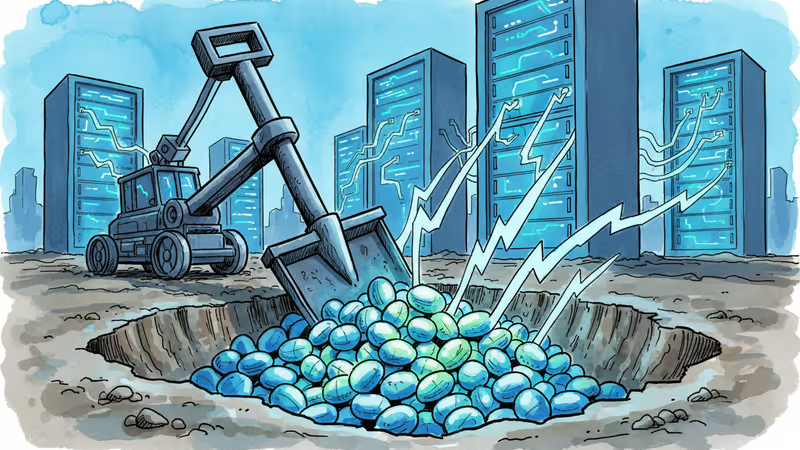
AI doesn't just consume data—it devours electricity. A single ChatGPT query uses 10 times more power than a Google search. As tech giants scramble for clean energy to feed their AI ambitions, the companies selling "picks and shovels" to this digital gold rush are cashing in big.
From Bankruptcy to $140M Bonanza
Standard Nuclear just closed a $140 million Series A led by Decisive Point, with participation from Andreessen Horowitz, Chevron Technology Ventures, and others. The round completed in two $70 million tranches after the company hit milestones faster than expected, boosted by President Trump's nuclear-friendly executive orders.
Here's the twist: Standard Nuclear literally rose from the ashes. The company is built on assets from Ultra Safe Nuclear Corporation (USNC), which went bankrupt in October 2024. Decisive Point's founder Thomas Hendrix swooped in at the bankruptcy auction, buying USNC's fuel-related assets for $28 million. Seven months later, that investment looks prescient.
The 70-Year-Old "New" Technology
Standard Nuclear makes TRISO fuel—a technology first conceived in the 1950s but suddenly hot again. Picture uranium particles the size of poppy seeds, coated in ceramic and carbon, then packed into larger spheres. The design makes the fuel pellets far more resistant to melting down than traditional fuel rods.

TRISO isn't widely used today, yet nearly every nuclear startup claims they'll use it in their reactors. Standard Nuclear already has $100 million in non-binding orders for 2027 from customers including Radiant Energy and Nano Nuclear Energy—the latter bought USNC's reactor assets, creating a neat circular ecosystem.
The Chicken-and-Egg Dilemma
But here's the rub: nuclear startups face steep challenges scaling manufacturing. By 2025's end, these companies raised $1.1 billion collectively, all betting on small modular reactors (SMRs). Yet none have delivered commercial reactors at scale.
Standard Nuclear's experience could give it an edge—it inherited years of TRISO development from USNC. But if nuclear startups can't deliver on their ambitious timelines, the fuel company might find itself, like its predecessor, too far ahead of the market.
The Bigger Energy Equation
This isn't just about nuclear nostalgia. AI companies are desperate for reliable, carbon-free power. Microsoft signed a deal to restart Three Mile Island. Google and Amazon are backing SMR developers. The math is simple: data centers already consume 4% of global electricity, and AI could triple that by 2030.
Traditional renewables can't solve this alone—they're intermittent, and batteries at grid scale remain expensive. Nuclear offers baseload power without carbon emissions, making it attractive despite higher upfront costs and regulatory hurdles.
Authors
Related Articles
NRC approves first nuclear reactor in a decade. TerraPower's sodium-cooled design could reshape energy, but faces steep cost challenges.
US Space Force shifts $24B R&D focus from rockets to space sensors and payloads, signaling major industry transformation and new opportunities for startups
Thrive Capital raised its largest-ever $10B fund, nearly doubling its previous size. What does this mega-fund tell us about the current state of venture investing?

While Silicon Valley chases mega-rounds, former Google exec Stacy Brown-Philpot built a 2,000-company pipeline in just one year. Her contrarian bet on overlooked founders is paying off.
NRC approves first nuclear reactor in a decade. TerraPower's sodium-cooled design could reshape energy, but faces steep cost challenges.
US Space Force shifts $24B R&D focus from rockets to space sensors and payloads, signaling major industry transformation and new opportunities for startups
Thrive Capital raised its largest-ever $10B fund, nearly doubling its previous size. What does this mega-fund tell us about the current state of venture investing?
While Silicon Valley chases mega-rounds, former Google exec Stacy Brown-Philpot built a 2,000-company pipeline in just one year. Her contrarian bet on overlooked founders is paying off.
Thoughts
Share your thoughts on this article
Sign in to join the conversation