
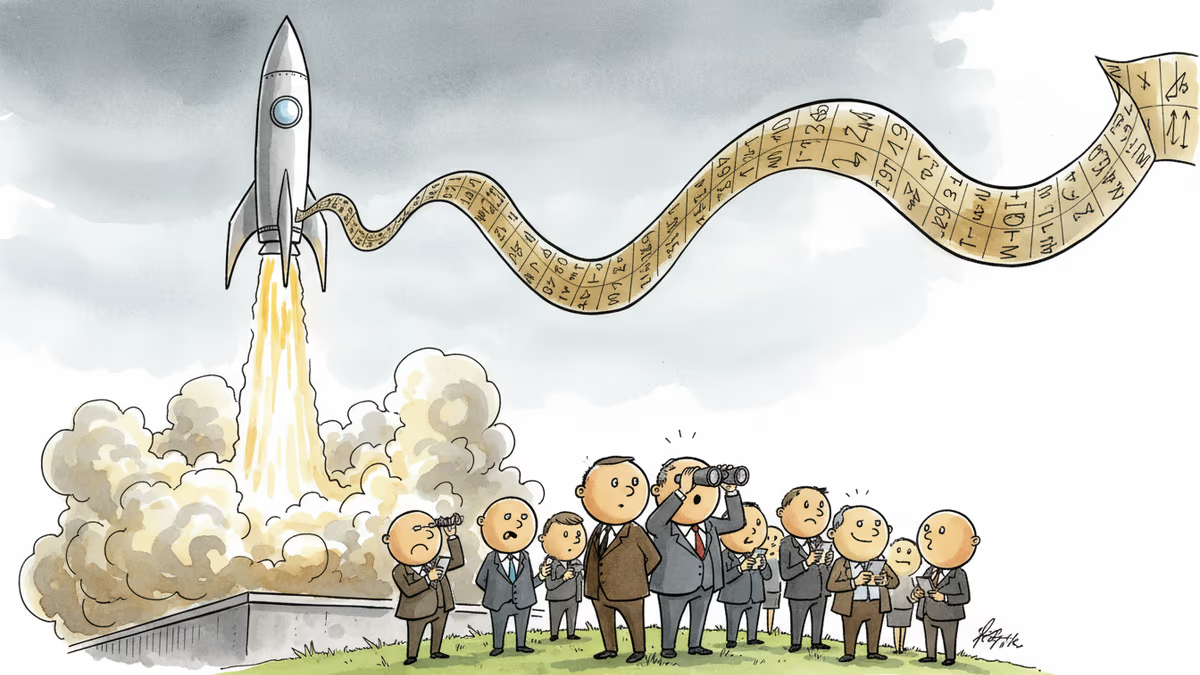
SpaceX's Starship Flew. But Did It Fly Well Enough?
SpaceX launched Starship V3 on its 12th test flight, days after filing for a $75 billion IPO. Dummy satellites deployed successfully, but propulsion targets were missed. What does that mean for investors?
The world's largest rocket launched on Friday. It didn't fully succeed. And yet, a $75 billion IPO is still on track for next month.
SpaceX lifted off its Starship V3 at 6:30 p.m. ET from its Starbase facility in Texas — the opening second of a 90-minute launch window. The flight came one day after a scrub due to technical issues, and seven months after a string of explosions in early 2025 grounded the program and disrupted commercial air traffic with falling debris.
What Happened Up There
This was Starship's 12th test flight, and it delivered a mixed scorecard. On the positive side, SpaceX successfully deployed dummy Starlink satellites into orbit and beamed live video of rocket operations from space — a meaningful demonstration of the vehicle's core commercial utility. On the other side, the company missed propulsion targets it has identified as prerequisites for safe crewed flights and landings. Those targets aren't optional. Until they're hit, Starship isn't cleared to carry people.
The vehicle itself is unlike anything currently flying. Comprising the Starship upper stage, the Super Heavy booster, and Raptor engines, the system is designed to be fully reusable — with turnaround times SpaceX compares to commercial aviation. According to its IPO prospectus filed this week, Starship is built to deliver 100 metric tons to Earth orbit per flight in reusable configuration. For context, SpaceX's existing Falcon 9 launched over 3,000 satellites across 122 missions last year. Starship is meant to do more of that work with fewer flights.
The IPO in the Room
The timing here is deliberate. Three days before the launch, SpaceX publicly disclosed its IPO prospectus. The company is targeting roughly $75 billion in its public market debut next month — potentially one of the largest IPOs in U.S. history. This follows a February valuation of $1.25 trillion after SpaceX merged with xAI, Elon Musk's artificial intelligence company.

Starship is the load-bearing wall of that valuation. The rocket's reusability is the mechanism by which SpaceX plans to dramatically lower the cost of launching Starlink satellites — expanding coverage into dense urban markets and growing what is already the company's largest revenue stream. NASA is also in the picture: the agency is counting on Starship to land astronauts on the moon in 2028, a contract that adds institutional credibility to the program.
NASA Administrator Jared Isaacman flew to Starbase ahead of the launch and appeared in a flight suit during the livestream. Before leading the agency, Isaacman personally funded and commanded two private SpaceX missions in 2021 and 2024 — his presence was less a bureaucratic formality and more a signal of how tightly the government's lunar ambitions are now bound to SpaceX's commercial trajectory.
Two Ways to Read a Partial Success
Depending on where you sit, Friday's flight looks quite different.
For prospective IPO investors, the satellite deployment is the headline — it shows Starlink's expansion engine can work at Starship scale. But the missed propulsion targets are a reminder that the fully reusable, human-rated system SpaceX is selling in its prospectus is still a work in progress. A pre-IPO showcase that falls short of its own stated goals is an unusual position to be in.
For SpaceX's launch competitors — Blue Origin, ULA, and emerging players — every month of Starship delays is a month of breathing room. The fully reusable model, if it works at scale, restructures the economics of the entire launch industry. A Starship that can't yet hit its propulsion benchmarks is a Starship that hasn't yet made that disruption inevitable.
For NASA and its international partners, the 2028 lunar landing timeline is now carrying visible technical risk. The agency has no backup vehicle for the crewed lunar lander role. That's a dependency that congressional overseers have flagged before — and Friday's partial success won't quiet those concerns.
This content is AI-generated based on source articles. While we strive for accuracy, errors may occur. We recommend verifying with the original source.
Related Articles

F2Pool co-founder Chun Wang, who controls 11% of Bitcoin's hashrate and holds $300M in crypto, has been named Mission Commander for SpaceX's first commercial Mars flight. What does it mean when crypto capital funds humanity's next frontier?
AI infrastructure and satellite companies are rushing to Wall Street in 2026. What's driving the IPO wave, and what should investors watch for?
AI chipmaker Cerebras is going public on Nasdaq, targeting up to $3.5B in its IPO. With an OpenAI deal and real profits, the pitch is compelling—but the risks are hiding in plain sight.
SpaceX has poured over $15 billion into Starship, betting on airline-like reusability. Who wins, who loses, and what happens if the bet pays off?
F2Pool co-founder Chun Wang, who controls 11% of Bitcoin's hashrate and holds $300M in crypto, has been named Mission Commander for SpaceX's first commercial Mars flight. What does it mean when crypto capital funds humanity's next frontier?
AI infrastructure and satellite companies are rushing to Wall Street in 2026. What's driving the IPO wave, and what should investors watch for?
AI chipmaker Cerebras is going public on Nasdaq, targeting up to $3.5B in its IPO. With an OpenAI deal and real profits, the pitch is compelling—but the risks are hiding in plain sight.
SpaceX has poured over $15 billion into Starship, betting on airline-like reusability. Who wins, who loses, and what happens if the bet pays off?
Thoughts
Share your thoughts on this article
Sign in to join the conversation