
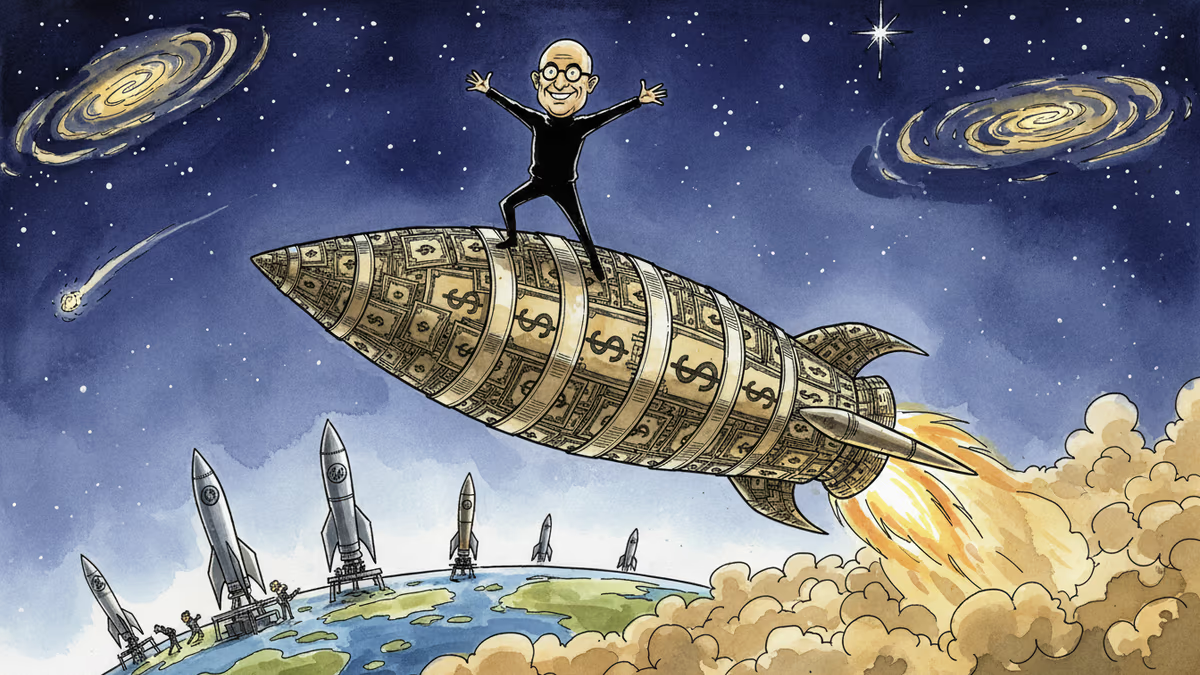
SpaceX Has Spent $15B on Starship. Now What?
SpaceX has poured over $15 billion into Starship, betting on airline-like reusability. Who wins, who loses, and what happens if the bet pays off?
Fifteen billion dollars. That's not a government space program budget — that's one private company's tab for a single rocket.
According to a Reuters exclusive, SpaceX has spent more than $15 billion developing Starship, its fully reusable super-heavy launch system. To put that in perspective: it's roughly the entire annual GDP of Iceland, and more than five times what NASA paid SpaceX to build the Artemis lunar lander. The number is staggering. But the more interesting question isn't how much has been spent — it's why this number is surfacing now, and what it means for everyone else.
The Bet Behind the Bill
Elon Musk's core thesis with Starship has always been simple to state and brutally hard to execute: make rockets behave like airplanes. Not reusable in the sense of refurbishing a booster after a few flights, but truly airline-like — rapid turnaround, hundreds of missions, dramatically lower cost per launch.
Right now, getting a kilogram of payload to low Earth orbit costs somewhere between $2,000 and $3,000. SpaceX's internal targets for a fully operational Starship put that figure below $100 per kilogram — a reduction of 96%. If that holds, it doesn't just change the launch industry. It restructures the economics of everything that depends on access to space: satellite internet, Earth observation, space tourism, lunar logistics, and eventually, Musk's stated endgame of Mars colonization.
The money to fund this ambition hasn't come from venture capital rounds or public markets — SpaceX remains private. The bulk of it has flowed from Starlink, the satellite internet constellation that now serves millions of subscribers globally. In a very real sense, every household paying a monthly Starlink bill has been quietly subsidizing Starship's development. The rest comes from NASA contracts (including a $2.9 billion Human Landing System deal) and a small circle of institutional investors.
Why This Number, Why Now

The timing of this disclosure deserves scrutiny. Starship's development has been anything but smooth. The first integrated flight test in April 2023 ended in a spectacular explosion minutes after launch. Subsequent tests showed incremental progress — booster catch maneuvers, improved heat shield performance — but full reusability hasn't been demonstrated at operational scale.
So why leak $15 billion to Reuters in May 2026? A few readings are plausible.
One: SpaceX may be laying groundwork for a capital raise or a partial IPO of the Starship program itself. Signaling the depth of investment already made can anchor valuation expectations and signal commitment to potential investors. Two: it functions as a competitive moat declaration. Blue Origin, ULA, and Europe's Arianespace are all developing next-generation vehicles, but none are close to this level of capital deployment. Three: it could be aimed at Washington. With ongoing debates about NASA's direction and commercial space contracts, demonstrating $15 billion in private investment strengthens SpaceX's argument that it deserves continued government partnership.
Stakeholders Doing the Math
For satellite operators and anyone who launches payloads, a successful Starship is a gift. Dramatically lower launch costs would unlock constellations that are currently uneconomical, expand Earth observation coverage, and make in-space manufacturing viable in ways it simply isn't today.
For SpaceX's competitors, the picture is bleaker. Rocket Lab, Relativity Space, and a dozen other launch startups built their business models around a world where SpaceX dominates heavy lift but leaves room for smaller, nimbler players. If Starship captures the small-sat market too — by offering cheap rideshare at scale — the competitive math shifts dramatically.
For national space agencies, including NASA, ESA, and emerging programs in Asia and the Middle East, the $15 billion figure raises an uncomfortable question: can any government-funded program compete on cost with a vertically integrated private operator willing to absorb losses at this scale? The answer may be no — which means the future of space access could hinge on whether one company's engineering bet actually pays off.
For investors watching from the outside, the calculus is asymmetric. If Starship works as advertised, the return on SpaceX's $15 billion could be extraordinary — the company that controls cheap access to space controls the infrastructure layer of the next economic frontier. If it doesn't, or if timelines slip another five years, the opportunity cost of that capital is enormous.
This content is AI-generated based on source articles. While we strive for accuracy, errors may occur. We recommend verifying with the original source.
Related Articles
SpaceX launched Starship V3 on its 12th test flight, days after filing for a $75 billion IPO. Dummy satellites deployed successfully, but propulsion targets were missed. What does that mean for investors?
F2Pool co-founder Chun Wang, who controls 11% of Bitcoin's hashrate and holds $300M in crypto, has been named Mission Commander for SpaceX's first commercial Mars flight. What does it mean when crypto capital funds humanity's next frontier?

Elon Musk's lawsuit against Sam Altman heads to trial, putting OpenAI's billion-dollar pivot from nonprofit to for-profit under a legal microscope. Here's what's really at stake.
SpaceX swung from $8B profit to a $5B loss in 2025, yet kept its 8,285 BTC position untouched. With an IPO looming, what does that signal about corporate treasury strategy?
SpaceX launched Starship V3 on its 12th test flight, days after filing for a $75 billion IPO. Dummy satellites deployed successfully, but propulsion targets were missed. What does that mean for investors?
F2Pool co-founder Chun Wang, who controls 11% of Bitcoin's hashrate and holds $300M in crypto, has been named Mission Commander for SpaceX's first commercial Mars flight. What does it mean when crypto capital funds humanity's next frontier?
Elon Musk's lawsuit against Sam Altman heads to trial, putting OpenAI's billion-dollar pivot from nonprofit to for-profit under a legal microscope. Here's what's really at stake.
SpaceX swung from $8B profit to a $5B loss in 2025, yet kept its 8,285 BTC position untouched. With an IPO looming, what does that signal about corporate treasury strategy?
Thoughts
Share your thoughts on this article
Sign in to join the conversation