
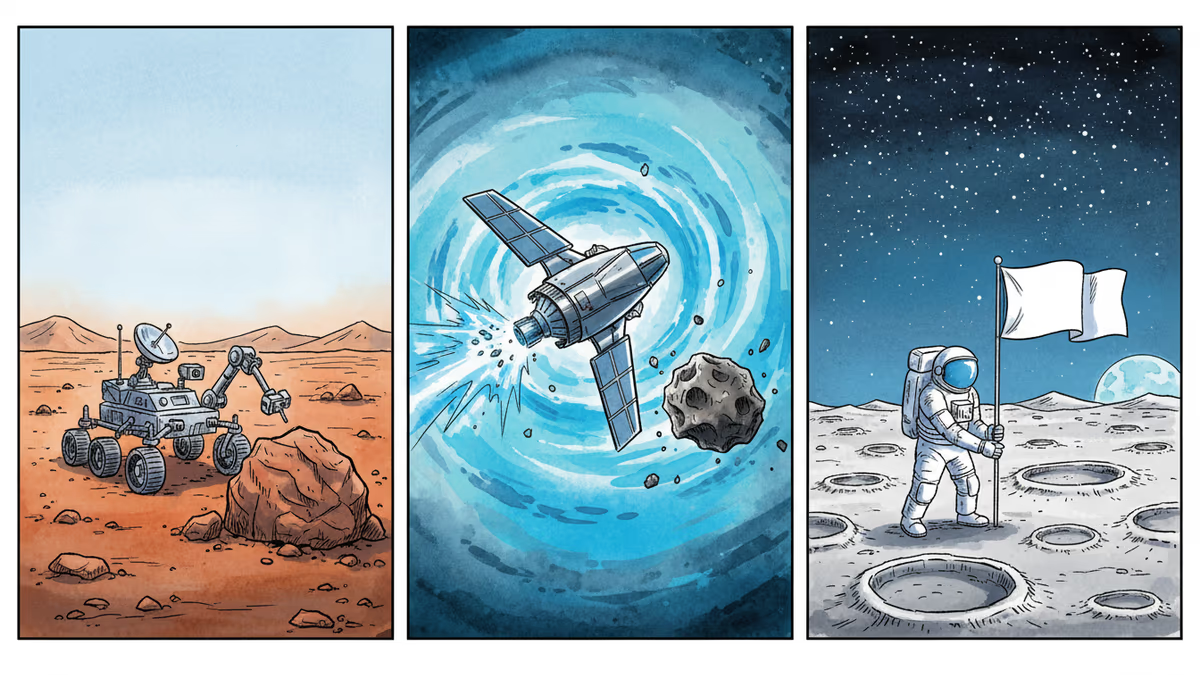
Mars, Asteroids, the Moon—Space Is Asking Us a Hard Question
The hunt for Martian life, asteroid defense, and permanent lunar bases are accelerating simultaneously. What does this convergence mean for humanity's future—and who gets to decide?
Somewhere above the Andes, a telescope the size of a small building is about to spend the next decade photographing the entire visible sky—over and over again. It's looking for things we haven't found yet. Some of those things could kill us.
That's the Vera C. Rubin Observatory, and it's just one piece of a much larger puzzle snapping into place right now. Simultaneously, rovers are sifting through Martian soil for signs of ancient life, engineers are refining the physics of knocking asteroids off course, and space agencies from Washington to Beijing are quietly arguing over who gets to build the first permanent base on the Moon. These aren't separate stories. They're chapters of the same one.
The Race for Mars Just Got a New Competitor
For decades, Mars was essentially an American project. NASA's Perseverance rover has been methodically collecting rock samples from Jezero Crater—an ancient lakebed considered one of the most promising sites for fossilized microbial life. The plan was always to bring those samples back to Earth, where labs could analyze them with tools no rover could carry. That mission, Mars Sample Return, was the crown jewel.
Then the budget got complicated. And while NASA's timeline for sample return grew murky, China quietly landed its own rover, Zhurong, on Mars in 2021—becoming only the second country ever to do so successfully on the first attempt. China's lunar and Mars programs are moving faster than most Western analysts predicted five years ago.
This matters beyond national pride. Scientific competition has historically accelerated discovery. The Apollo program didn't happen because the Moon was scientifically urgent in 1961—it happened because Sputnik scared Washington into action. The question now is whether a similar dynamic produces breakthroughs, or whether it produces fragmentation: parallel programs that don't share data, racing toward the same answers but refusing to compare notes.
'Armageddon' Was a Movie. The Physics Is Real.
In September 2022, NASA's DART spacecraft slammed into a small asteroid called Dimorphos and changed its orbit by 32 minutes. It was the first time humanity had deliberately altered the path of a celestial body. The test worked. The uncomfortable follow-up question: what happens when the asteroid is bigger, and the warning time is shorter?
The Rubin Observatory is designed to help answer that. Over its 10-year survey, it's expected to catalog hundreds of thousands of previously unknown near-Earth objects. Some will be harmless. A small number will require closer attention. The point isn't to manufacture fear—it's to replace ignorance with data. You can't deflect what you haven't found.

Asteroid defense is one of the few domains in space where international cooperation has genuinely outpaced geopolitical rivalry. The math is simple: an impactor doesn't check passports. ESA, NASA, and other agencies have established coordination frameworks precisely because this threat has no flag. There's a lesson somewhere in that.
The Moon Is Back—But Not Just for Science
NASA's Artemis program wants to return humans to the Moon and keep them there. Not for a few days of flag-planting, but for extended stays—eventually a permanent presence. ESA, JAXA, and commercial partners including SpaceX and Blue Origin are all part of the architecture.
The lunar south pole is the prize. Permanently shadowed craters there are believed to contain water ice—which means drinking water, oxygen for breathing, and hydrogen for rocket fuel. Whoever establishes infrastructure at those sites first gains a logistical advantage that compounds over time. Scientists call it a research platform. Strategists call it a chokepoint.
China and Russia have their own lunar program, the International Lunar Research Station, with a separate set of partner nations. The Moon is increasingly being divided not by craters but by alliance structures.
For the average person watching from Earth, this might feel abstract. It isn't. The satellite networks that run GPS, weather forecasting, internet connectivity, and financial transactions are already space infrastructure. Whoever shapes the next layer of that infrastructure—on the Moon, around Mars—shapes the terms of 21st-century civilization.
Why All Three Frontiers Matter Right Now
The timing of this convergence isn't accidental. Launch costs have dropped dramatically as SpaceX's reusable rockets matured—what once cost $54,000 per kilogram to orbit is approaching $1,500. AI is accelerating the analysis of planetary data that would have taken decades to process manually. And governments worldwide have reclassified space as a national security domain, unlocking funding streams that pure science budgets never could.
This is the first moment in history where scientific ambition, commercial incentive, and geopolitical competition are all pulling in the same direction at the same time. The result is acceleration. But acceleration without governance is just speed.
The 1967 Outer Space Treaty—still the foundational legal document for space—was written when only two countries had meaningful space programs. It prohibits national sovereignty over celestial bodies but says nothing coherent about resource extraction, private enterprise, or military infrastructure on the Moon. That gap is growing faster than the diplomatic machinery to fill it.
Authors
Related Articles
NASA's Artemis III has been redesigned as an Earth-orbit mission. SpaceX and Blue Origin say their landers won't be ready until late 2027. What does this mean for the future of lunar exploration?
Flying to Mars means navigating without trees, wind, or GPS. Here's the surprisingly elegant physics behind how spacecraft measure their own velocity in the void.

Artemis II splashed down successfully in the Pacific, marking humanity's first crewed deep space mission in over 50 years. But the harder question isn't whether we can go back — it's why we should.

NASA's Orion capsule splashed down safely after humanity's first crewed lunar voyage in 54 years. The mission succeeded. Now the harder questions begin.
NASA's Artemis III has been redesigned as an Earth-orbit mission. SpaceX and Blue Origin say their landers won't be ready until late 2027. What does this mean for the future of lunar exploration?
Flying to Mars means navigating without trees, wind, or GPS. Here's the surprisingly elegant physics behind how spacecraft measure their own velocity in the void.
Artemis II splashed down successfully in the Pacific, marking humanity's first crewed deep space mission in over 50 years. But the harder question isn't whether we can go back — it's why we should.
NASA's Orion capsule splashed down safely after humanity's first crewed lunar voyage in 54 years. The mission succeeded. Now the harder questions begin.
Thoughts
Share your thoughts on this article
Sign in to join the conversation