
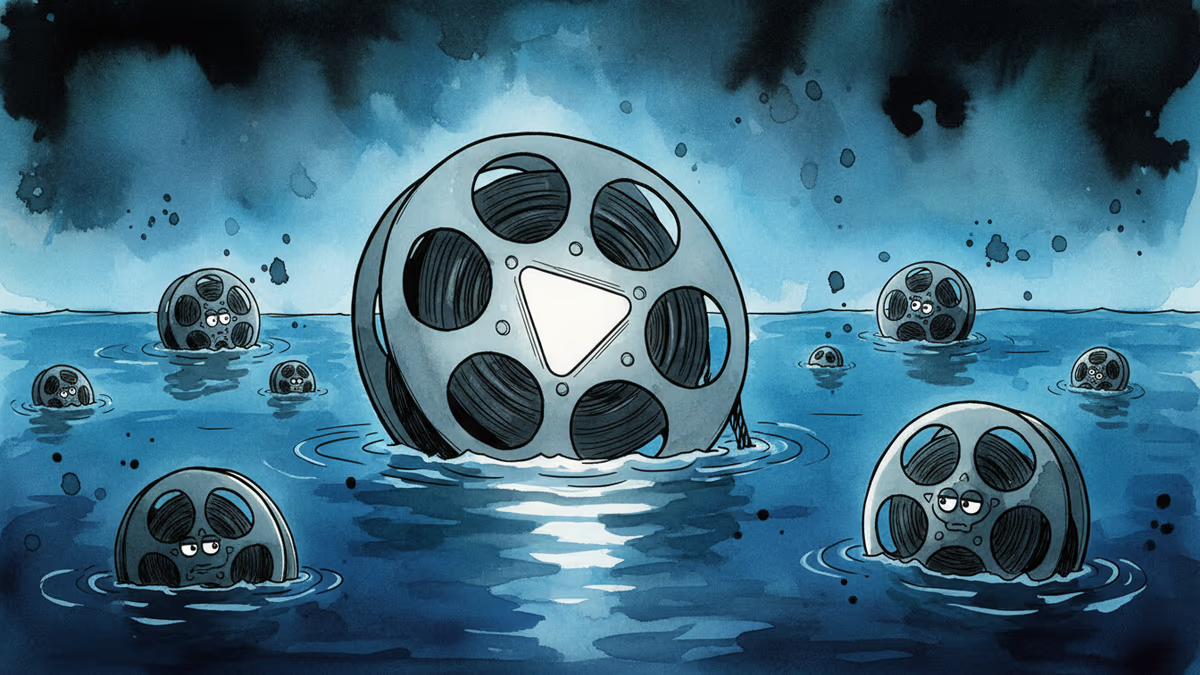
Sora Is Shutting Down — What That Says About AI's Hype Cycle
OpenAI is closing its Sora video generation app less than two years after its splashy debut. The move raises hard questions about AI product longevity, creator trust, and where the video AI race is really headed.
It arrived like a thunderclap. It's leaving with a thank-you note.
OpenAI announced Tuesday that it is shutting down Sora, its text-to-video generation app that stunned the internet when it debuted in early 2024 and launched to the public later that year. The company posted the news on social media shortly after The Wall Street Journal broke the story — a sequencing that itself felt a little unceremonious for a product that once made Hollywood directors nervous.
"To everyone who created with Sora, shared it, and built community around it: thank you," OpenAI wrote. "What you made with Sora mattered, and we know this news is disappointing."
The company said it will share more soon on "timelines for the app and API and details on preserving your work." That last phrase — preserving your work — is doing a lot of heavy lifting for the creators who built workflows around the platform.
What Sora Was, and What It Promised
When OpenAI first showed Sora to the world in February 2024, the reaction was immediate and visceral. Realistic footage of waves crashing, people running through city streets, cinematic sequences that looked like they cost real money — all generated from a text prompt in seconds. The demos circulated widely, and the conversation quickly turned to what this meant for filmmakers, advertisers, and the broader creative economy.
The public launch later that year brought Sora to a wider audience. Creators, marketers, and hobbyists began experimenting, sharing outputs, and building a genuine community around the tool. For a moment, it looked like Sora might anchor OpenAI's presence in the fast-growing video AI market the same way DALL-E had staked a claim in image generation.
That moment, it turns out, was brief.
Three Reasons This Happened Now

The shutdown isn't happening in a vacuum. A few forces converged to make Sora expendable.
Resource prioritization.OpenAI is simultaneously preparing a major GPT release, expanding its agentic AI capabilities, and pushing hard into enterprise contracts. Video generation — computationally expensive and difficult to monetize at scale — may simply have lost the internal argument for continued investment. Companies at OpenAI's stage of growth make these bets constantly, and not every product survives the portfolio review.
The competition caught up fast. When Sora debuted, it had a clear lead. By the time it launched publicly, that lead had narrowed considerably. Google's Veo 2, Runway's Gen-3, and Kling from Chinese developer Kuaishou had all made significant strides. The video AI market that Sora helped define is now crowded, and OpenAI may have calculated that winning it wasn't worth the cost.
The unit economics of video AI are brutal. Generating a few seconds of high-quality video consumes far more compute than generating text or even images. Without a large enough base of paying users willing to absorb those costs, the math gets difficult quickly. OpenAI hasn't disclosed Sora's user numbers or revenue, but the shutdown suggests the product wasn't pulling its weight.
Who Gets Hurt — and Who Benefits
For creators who built real workflows around Sora, this is genuinely disruptive. The vague promise to help "preserve your work" will need to become something concrete, and fast. The broader lesson — that building a creative practice on a single AI platform carries real risk — is one the creative community is learning the hard way, repeatedly.
For investors and analysts watching OpenAI, the shutdown is a mixed signal. On one hand, pruning underperforming products to focus resources is rational management. On the other, shutting down a flagship consumer product in under 18 months raises questions about how OpenAI evaluates product-market fit before committing to a public launch. The gap between the demo and the sustainable product was never fully closed.
For competitors, the opportunity is obvious. Sora's displaced users will look for alternatives, and Runway, Kling, and others are well-positioned to absorb them. Google, with Veo 2 embedded across its ecosystem, may be the biggest beneficiary — it never had to beat Sora in a head-to-head; it just had to outlast it.
The Bigger Pattern
This isn't the first time a high-profile AI product has launched to fanfare and quietly faded. The gap between what generative AI can do in a demo and what it can sustain as a product — reliably, affordably, at scale — remains wide. Sora is a case study in that gap.
There's also a trust dimension worth sitting with. The AI industry has spent the last two years asking creators, businesses, and developers to integrate these tools deeply into their work. Every shutdown, pivot, or deprecation chips away at the credibility of that ask. The more dependent workflows become on AI platforms, the higher the cost when those platforms disappear.
Authors
Related Articles

OpenAI has reorganized for the second time in a month, merging ChatGPT and Codex into a single agentic platform under president Greg Brockman's unified product leadership.
After two weeks of witnesses calling him a liar, OpenAI CEO Sam Altman testified in his own defense, claiming Elon Musk tried to kill the company twice.
Sam Nelson, 19, died after following ChatGPT's advice to mix Kratom and Xanax. His parents are suing OpenAI for wrongful death, raising urgent questions about AI trust, liability, and design.
OpenAI's new Daybreak initiative uses the Codex AI agent to find and patch security vulnerabilities before attackers do—putting it in direct competition with Anthropic's secretive Claude Mythos.
OpenAI has reorganized for the second time in a month, merging ChatGPT and Codex into a single agentic platform under president Greg Brockman's unified product leadership.
After two weeks of witnesses calling him a liar, OpenAI CEO Sam Altman testified in his own defense, claiming Elon Musk tried to kill the company twice.
Sam Nelson, 19, died after following ChatGPT's advice to mix Kratom and Xanax. His parents are suing OpenAI for wrongful death, raising urgent questions about AI trust, liability, and design.
OpenAI's new Daybreak initiative uses the Codex AI agent to find and patch security vulnerabilities before attackers do—putting it in direct competition with Anthropic's secretive Claude Mythos.
Thoughts
Share your thoughts on this article
Sign in to join the conversation