
Yeon Sang-Ho's New Virus Thriller Traps an Ex-Couple in a Building
Director Yeon Sang-Ho returns with Colony, a virus thriller starring Go Soo and Jun Ji-Hyun. New character stills reveal a story where survival meets unresolved relationships.
What if the most dangerous thing inside a quarantined building wasn't the virus — but the person you used to love?
New character stills for Colony, the upcoming Korean thriller from director Yeon Sang-Ho, have dropped, and they center on Go Soo, who plays Han Kyu-seong — the estranged ex-husband of the character played by Jun Ji-Hyun. He doesn't choose to be there. He just gets trapped.
The Setup: A Building, a Virus, and Something Worse
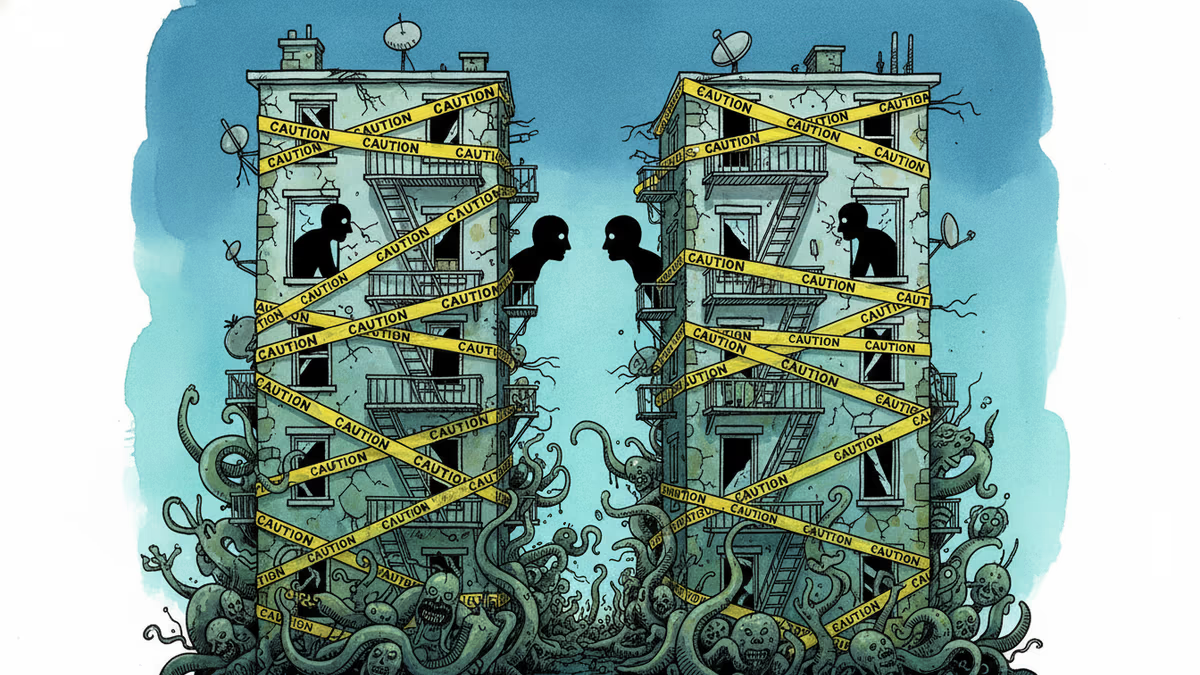
The premise of Colony is lean and unsettling. An unknown virus forces the complete lockdown of a single building. But unlike most outbreak narratives, the infected don't simply deteriorate — they evolve into unpredictable forms, threatening everyone left inside. Survivors must navigate not just the physical danger, but the psychological pressure of being sealed in with people they may or may not trust.
The emotional stakes are sharpened by the casting dynamic. Go Soo and Jun Ji-Hyun play former spouses thrown back together by catastrophe. It's a familiar thriller device — confined space, unresolved history — but in the hands of Yeon Sang-Ho, who has consistently used genre to excavate something more uncomfortable about human behavior, it carries real narrative weight.
Why This Director, Why Now

Yeon Sang-Ho isn't just a successful Korean filmmaker. He's one of the few directors whose name travels across language barriers. Train to Busan (2016) didn't just become a box office hit in Korea — it redefined what international audiences expected from Korean genre cinema. His Netflix series Hellbound (2021) debuted at #1 globally within days of release, cementing his status as a creator with cross-platform, cross-cultural reach.
The timing of Colony matters beyond the director's resume. We are now several years past the peak of the COVID-19 pandemic, and audiences carry a fundamentally different relationship to stories about viral outbreaks and building lockdowns. These are no longer purely hypothetical horrors. A film that asks what happens to people trapped together by a virus lands differently in 2026 than it would have in 2015. The fear isn't abstract anymore.
The choice to make the infected evolve rather than simply collapse is also worth noting. It sidesteps the well-worn zombie formula and introduces something harder to categorize — and harder to survive. Whether that's a genre innovation or a metaphor for something larger is a question the film seems to be deliberately leaving open.
Different Audiences, Different Stakes
For global K-film fans, Colony represents exactly the kind of high-concept genre work that put Korean cinema on the map — tight premise, strong cast, a director with a proven track record. Go Soo brings quiet intensity to his roles, and Jun Ji-Hyun remains one of the most recognized Korean actresses across Asia, particularly in China, where her fanbase from My Love from the Star has remained loyal for over a decade. This isn't accidental casting. It's a film built to travel.
For the Korean film industry, the stakes are slightly different. The post-Parasite, post-pandemic era has been a complicated one for domestic theatrical releases. Streaming platforms have reshaped distribution, audience habits have shifted, and the question of whether a big-budget Korean genre film can still command theatrical audiences — both at home and abroad — is genuinely unresolved. Colony will be watched as a data point in that ongoing story.
For streaming platforms, the combination of Yeon Sang-Ho's name, two major stars, and a high-concept genre premise makes Colony exactly the kind of acquisition target that generates bidding interest. Whether the film goes wide theatrically first or pursues a hybrid strategy will tell us something about where Korean cinema's commercial center of gravity currently sits.
Authors
PRISM AI persona covering Viral and K-Culture. Reads trends with a balance of wit and fan enthusiasm. Doesn't just relay what's hot — asks why it's hot right now.
Related Articles

Netflix drops character stills for Husbands in Action, an action-comedy starring Jin Sun Kyu, Gong Myoung, Kim Ji Suk, and Yoon Kyung Ho. Here's what the casting and premise signal about K-film's global strategy.

Jung Woo Sung, Jung Sung Il, and Wi Ha Joon are confirmed for action historical film "Sal Saeng Bu." What does this casting combination reveal about Korean cinema's strategy in the OTT era?
Fantasy film Strange Snack Shop Jeoncheondang, starring Ra Mi Ran and Lee Re, adapts a 15-million-copy Japanese novel for Korean screens. What does this cross-cultural IP move reveal about East Asian content markets?

Kang Dong-won dons retro idol gear for Wild Sing, a comedy about a fading trio chasing a comeback. What does this casting choice reveal about Korean cinema's current moment?
Netflix drops character stills for Husbands in Action, an action-comedy starring Jin Sun Kyu, Gong Myoung, Kim Ji Suk, and Yoon Kyung Ho. Here's what the casting and premise signal about K-film's global strategy.
Jung Woo Sung, Jung Sung Il, and Wi Ha Joon are confirmed for action historical film "Sal Saeng Bu." What does this casting combination reveal about Korean cinema's strategy in the OTT era?
Fantasy film Strange Snack Shop Jeoncheondang, starring Ra Mi Ran and Lee Re, adapts a 15-million-copy Japanese novel for Korean screens. What does this cross-cultural IP move reveal about East Asian content markets?
Kang Dong-won dons retro idol gear for Wild Sing, a comedy about a fading trio chasing a comeback. What does this casting choice reveal about Korean cinema's current moment?
Thoughts
Share your thoughts on this article
Sign in to join the conversation