
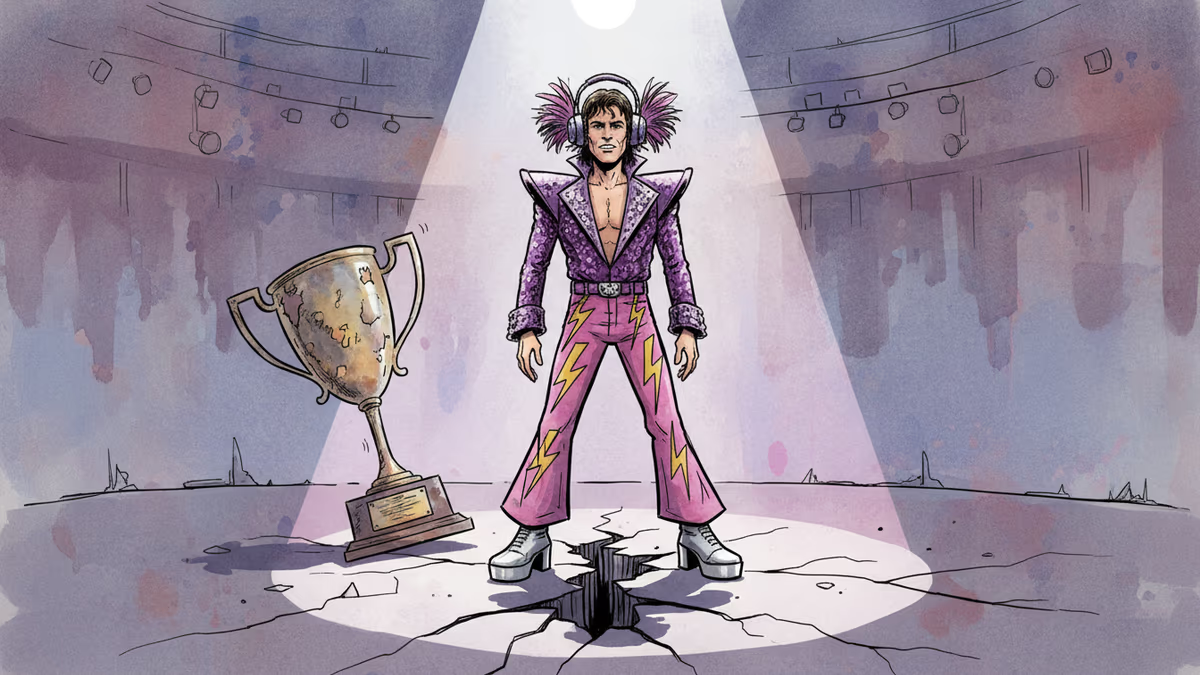
Kang Dong-won as a Washed-Up Idol: What Wild Sing Is Really Selling
Kang Dong-won dons retro idol gear for Wild Sing, a comedy about a fading trio chasing a comeback. What does this casting choice reveal about Korean cinema's current moment?
The most surprising thing about the Wild Sing teaser isn't the retro choreography — it's the man doing it.
What's Actually Happening
Wild Sing is an upcoming Korean comedy film centered on Triangle, a once-popular idol trio now well past their prime, scrambling for one last shot at relevance. Kang Dong-won plays Hwang Hyun-woo, one of the group's members — a role that requires him to wear sequined idol costumes and perform throwback dance routines that feel pulled straight from a 2002 music show archive.
This is notable because of who Kang Dong-won is. Over a career spanning more than two decades, he has built a persona defined by intensity and restraint: the brooding lead in A Werewolf Boy (2012), the morally complex figure in 1987: When the Day Comes (2017), the action-thriller anchor in Tempest (his most recent major release). Comedy — especially broad, physical, self-deprecating comedy — has been largely absent from his body of work. Wild Sing marks a deliberate departure.
The 'Faded Idol' Narrative and Why It Lands Now
Korean pop culture has been circling the 'fallen idol' story with increasing frequency. Castaway Diva (2023) built its entire arc around a talent-show reject's decade-late comeback. Documentaries like Idol: The Coup on Netflix have examined the industry's human cost from the inside. What's driving this?

The answer is partly generational math. K-pop's first and second generation idols — groups that dominated the early-to-mid 2000s — are now cultural history. For audiences in their 30s and 40s, those acts are memory; for audiences in their teens and 20s, they're retro aesthetic. A story about a group like Triangle can operate on both frequencies simultaneously: nostalgia and irony at once.
There's also an industrial logic at work. As HYBE, SM, and JYP aggressively mine legacy IP — repackaged anniversary albums, reunion tours, archival content drops — the broader entertainment ecosystem has already primed audiences to find emotional value in the 'what happened after the spotlight' question. Wild Sing is arriving into a market that has already done much of the emotional groundwork.
The Casting Bet
From a production standpoint, casting Kang Dong-won in a comedy is a calculated risk with a specific upside. His fanbase skews toward prestige drama and action — not the demographic that typically fills seats for lighthearted idol comedies. If the film draws them in anyway, it effectively expands the genre's audience ceiling.
The decision to lead the marketing with the dance sequence footage is telling. It functions less as a plot reveal and more as a proof of concept: yes, he actually did this. That surprise is the hook. Whether the film can sustain the premise beyond the visual gag is the question the trailer deliberately leaves open.
For international audiences, Kang Dong-won's profile outside Korea remains most associated with Tempest and his earlier genre work. Wild Sing offers a genuinely different entry point — which could either broaden his global appeal or confuse it, depending on execution.
This content is AI-generated based on source articles. While we strive for accuracy, errors may occur. We recommend verifying with the original source.
Related Articles

Netflix drops character stills for Husbands in Action, an action-comedy starring Jin Sun Kyu, Gong Myoung, Kim Ji Suk, and Yoon Kyung Ho. Here's what the casting and premise signal about K-film's global strategy.
Jung Woo Sung, Jung Sung Il, and Wi Ha Joon are confirmed for action historical film "Sal Saeng Bu." What does this casting combination reveal about Korean cinema's strategy in the OTT era?
Director Yeon Sang-Ho returns with Colony, a virus thriller starring Go Soo and Jun Ji-Hyun. New character stills reveal a story where survival meets unresolved relationships.
Colony" reunites Korean cinema's most selective actress with the director who put K-thrillers on the global map. Here's why this pairing matters beyond the hype.
Netflix drops character stills for Husbands in Action, an action-comedy starring Jin Sun Kyu, Gong Myoung, Kim Ji Suk, and Yoon Kyung Ho. Here's what the casting and premise signal about K-film's global strategy.
Jung Woo Sung, Jung Sung Il, and Wi Ha Joon are confirmed for action historical film "Sal Saeng Bu." What does this casting combination reveal about Korean cinema's strategy in the OTT era?
Director Yeon Sang-Ho returns with Colony, a virus thriller starring Go Soo and Jun Ji-Hyun. New character stills reveal a story where survival meets unresolved relationships.
Colony" reunites Korean cinema's most selective actress with the director who put K-thrillers on the global map. Here's why this pairing matters beyond the hype.
Thoughts
Share your thoughts on this article
Sign in to join the conversation