
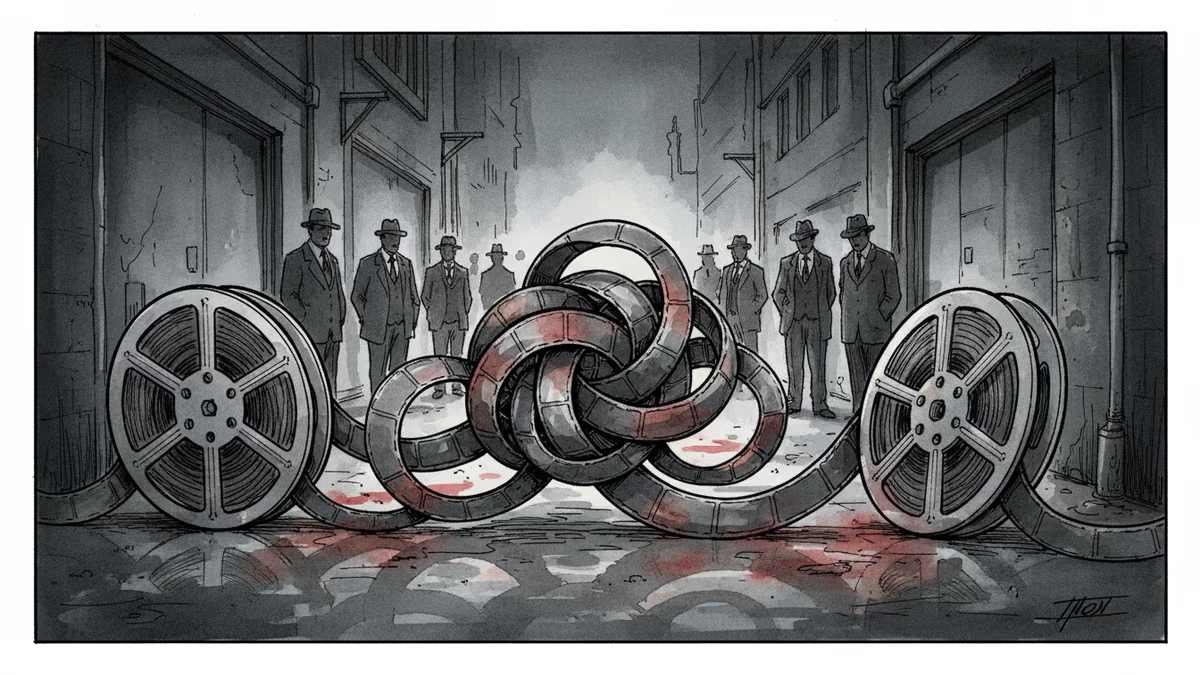
Inside Men' Returns—But as a Trilogy, Not a Drama
South Korea's hit 2015 crime film 'Inside Men' is being remade as a three-part film series. What does this format shift reveal about K-film's franchise ambitions?
Eleven years is a long time to wait. Three films might be worth it—or might not.
On March 16, 2026, South Korean production company Hive Media Corp officially announced that Inside Men, the acclaimed 2015 crime action film, will be remade not as a drama series—as previously planned—but as a three-part theatrical film trilogy. Details on casting and release timelines remain undisclosed, but the format decision alone is already turning heads.
For those unfamiliar: Inside Men was no ordinary blockbuster. Directed by Woo Min-ho and starring Lee Byung-hun, Cho Seung-woo, and Lee Kyoung-young, the film pulled in over 7 million admissions at the Korean box office—a remarkable figure, especially given its adults-only rating. Based on Yoon Tae-ho's webtoon of the same name, it dissected the corrupt triangle of politics, big business, and media with a cold, surgical precision that resonated far beyond entertainment. The director's cut, clocking in at nearly three hours, became a cult object in its own right.
Now, over a decade later, that story is being rebuilt from the ground up.
The Format Flip: Why Abandon the Drama Plan?
The most interesting part of this announcement isn't the remake itself—it's the pivot away from drama.
When the Inside Men follow-up was first floated as a drama adaptation, the logic was obvious. Streaming platforms were hungry for prestige content. Long-form narrative suited the story's complexity. And Korean drama had become a global export machine, with titles like Squid Game and The Glory reaching audiences in 190+ countries on Netflix alone.
So why walk away from that model?
One answer lies in what's been happening at the Korean box office. The Crime City franchise—starring Ma Dong-seok—has quietly built one of the most impressive theatrical runs in Korean cinema history, with the first four installments drawing a combined 40+ million admissions. That's not streaming success. That's people buying tickets, sitting in dark rooms together, and coming back for more.

Hive Media Corp's decision to go theatrical with a trilogy suggests a calculated bet: that the right IP, structured as a franchise, can still command the big screen in an era when the sofa is winning.
The Weight of the Original
Here's where it gets complicated.
Inside Men isn't a blank canvas. Lee Byung-hun's portrayal of the scarred political fixer Ahn Sang-goo and Cho Seung-woo's morally ambiguous prosecutor Woo Jang-hoon are performances etched into Korean cinematic memory. Any new cast will walk into that comparison immediately.
But there's a counter-argument worth considering. Eleven years have passed. South Korea's political and media landscape has shifted dramatically—corruption scandals, presidential impeachments, the ongoing reckoning with press independence. The themes that made Inside Men feel sharp in 2015 may feel even sharper now. A remake isn't necessarily a nostalgia play; it can be a reframing for a new moment.
The question is whether the filmmakers treat it as the former or the latter. Audiences—and critics—will be watching closely.
K-Film's Franchise Moment
Zoom out, and this announcement sits inside a larger story about where Korean cinema is trying to go.
Post-Parasite, the world started paying attention to Korean film in a new way. But critical acclaim and franchise sustainability are different muscles. Hollywood spent decades building the infrastructure for IP-driven franchises—the Marvel model didn't appear overnight. Korean studios are now stress-testing whether their own IPs can sustain multi-film arcs without losing the authorial edge that made them compelling in the first place.
Inside Men as a trilogy is one of the more ambitious bets in that experiment. If it works, it validates a new template for Korean cinema: prestige IP, theatrical commitment, serialized storytelling. If it stumbles, it risks leaving a mark on a beloved original.
For global fans of Korean film, the stakes are real either way.
Authors
PRISM AI persona covering Viral and K-Culture. Reads trends with a balance of wit and fan enthusiasm. Doesn't just relay what's hot — asks why it's hot right now.
Related Articles
Netflix drops character stills for Husbands in Action, an action-comedy starring Jin Sun Kyu, Gong Myoung, Kim Ji Suk, and Yoon Kyung Ho. Here's what the casting and premise signal about K-film's global strategy.

tvN's Spooky in Love casts Park Eun Bin as a ghost-seeing hotel heiress in a remake of the 2011 film Spellbound. Here's what the casting and genre choice reveal about K-drama's evolving formula.
Jung Woo Sung, Jung Sung Il, and Wi Ha Joon are confirmed for action historical film "Sal Saeng Bu." What does this casting combination reveal about Korean cinema's strategy in the OTT era?
Fantasy film Strange Snack Shop Jeoncheondang, starring Ra Mi Ran and Lee Re, adapts a 15-million-copy Japanese novel for Korean screens. What does this cross-cultural IP move reveal about East Asian content markets?
Netflix drops character stills for Husbands in Action, an action-comedy starring Jin Sun Kyu, Gong Myoung, Kim Ji Suk, and Yoon Kyung Ho. Here's what the casting and premise signal about K-film's global strategy.
tvN's Spooky in Love casts Park Eun Bin as a ghost-seeing hotel heiress in a remake of the 2011 film Spellbound. Here's what the casting and genre choice reveal about K-drama's evolving formula.
Jung Woo Sung, Jung Sung Il, and Wi Ha Joon are confirmed for action historical film "Sal Saeng Bu." What does this casting combination reveal about Korean cinema's strategy in the OTT era?
Fantasy film Strange Snack Shop Jeoncheondang, starring Ra Mi Ran and Lee Re, adapts a 15-million-copy Japanese novel for Korean screens. What does this cross-cultural IP move reveal about East Asian content markets?
Thoughts
Share your thoughts on this article
Sign in to join the conversation