
When a Japanese Bestseller Becomes a Korean Film
Fantasy film Strange Snack Shop Jeoncheondang, starring Ra Mi Ran and Lee Re, adapts a 15-million-copy Japanese novel for Korean screens. What does this cross-cultural IP move reveal about East Asian content markets?
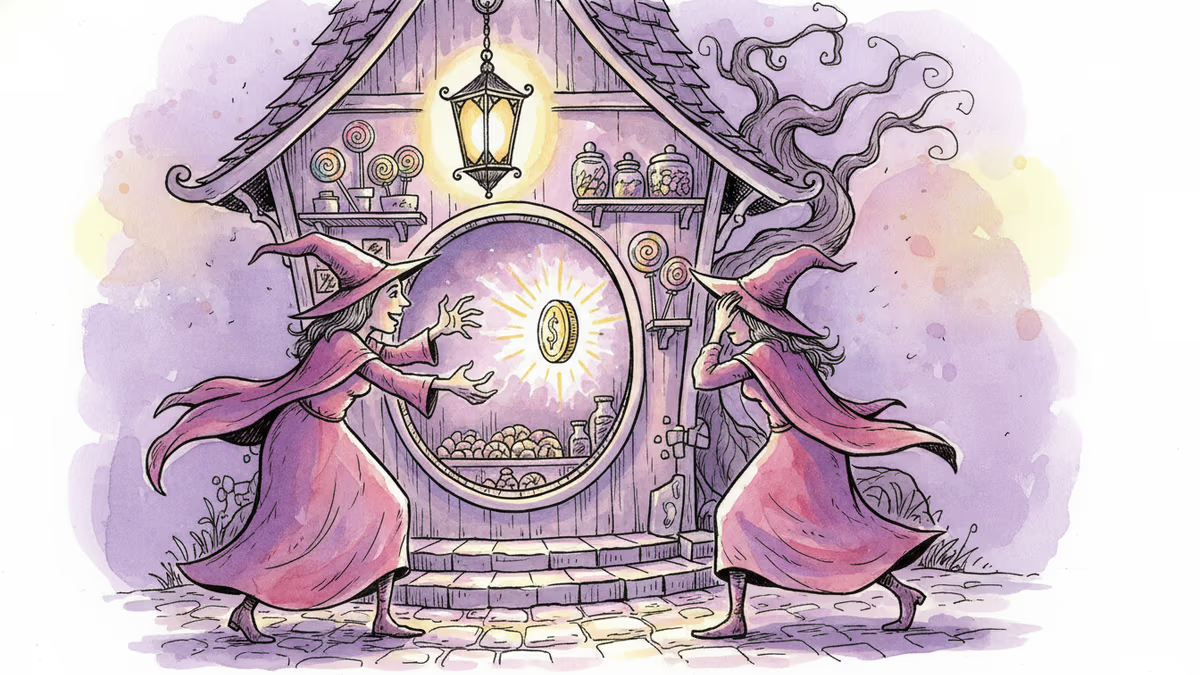
A wish-granting candy store. A lucky coin. And a price you didn't see coming.
The upcoming Korean fantasy film Strange Snack Shop Jeoncheondang has released 10 new production stills, offering the clearest look yet at the central tension of the story: two characters who hold fundamentally opposite beliefs about whether wishes should be made at all. Ra Mi Ran plays a believer. Lee Re plays the skeptic. Between them sits a magical snack shop that grants desires—but never for free.
The film is a live-action Korean adaptation of a Japanese young adult novel series that has sold over 15 million copies in Japan. That number alone makes this project worth watching closely.
From Tokyo Shelves to Korean Screens
The source material comes from author Hiroshi Hiroko's beloved fantasy series, already adapted into a Japanese drama and a fixture on school reading lists across Japan. The premise is deceptively simple: customers who arrive at Jeoncheondang carrying lucky coins can have their wishes granted. But every wish carries an unforeseen consequence—a moral architecture that gives the series its staying power beyond childhood.
Korean studios adapting Japanese IP is not new, but the pattern has shifted. The heavy wave of Japanese manga and novel adaptations in Korean drama—common through the mid-2010s—cooled considerably as the Korean Wave generated enough original IP to sustain itself. What's notable now is the return of cross-cultural adaptation, but with a different profile: rather than romance or thriller source material aimed at adult audiences, Jeoncheondang draws from children's and young adult literature with a built-in multi-generational fanbase.
This matters for how the film will be marketed. The original novel's readers in Japan skew young, but the themes—desire, consequence, the ethics of getting what you want—resonate well beyond that demographic. A Korean production that plays those themes straight has a legitimate shot at a broader audience than the source material's age bracket might suggest.

What the Casting Signals
Ra Mi Ran is one of Korean cinema's most reliable genre anchors. Her credits span social drama (Our Blues), crime comedy (Miss Baek), and ensemble work that consistently earns critical respect. Casting her in a fantasy film is a deliberate move to lower the barrier of entry for audiences who might otherwise skip the genre. She functions as a trust signal.
Lee Re made her debut in 2017 with I Can Speak, a film that required her to carry emotionally demanding scenes opposite veteran actors. Her casting as the wish-skeptic—the character who pushes back against the store's premise—suggests the film is positioning itself as something more than a straightforward wish-fulfillment narrative. A character who questions the central magic of the story forces the audience to question it too.
That dynamic is where Jeoncheondang could distinguish itself from the crowded field of family fantasy. If the film commits to the moral complexity embedded in the source material—that desires have costs, that what we think we want and what we actually need are rarely the same—it has the thematic weight to work for adults as well as the younger audiences the IP already commands.
The Broader Market Question
Korean theatrical fantasy has had a complicated decade. While genre-bending films from directors like Bong Joon-ho and Park Chan-wook have redefined what Korean cinema can do internationally, family-friendly fantasy has consistently underperformed at the domestic box office. The shift toward OTT consumption—accelerated sharply after 2020—has made it harder to justify bringing this type of film to theaters at all.
Jeoncheondang sits at an intersection that's genuinely uncertain: a beloved IP with proven audience loyalty, in a genre that struggles theatrically, adapted from a foreign source at a moment when Korean original content is what global platforms are hungry for. Netflix, Disney+, and Tving have all leaned heavily into Korean originals precisely because they can own the IP. A Japanese-origin adaptation complicates that calculus—the rights structure is different, the platform appeal is different, and the international rollout strategy has to account for audiences who may already know the source material.
Whether Jeoncheondang lands as a theatrical release or finds its primary home on a streaming platform will likely say as much about the current state of Korean fantasy film economics as it does about the project itself.
This content is AI-generated based on source articles. While we strive for accuracy, errors may occur. We recommend verifying with the original source.
Related Articles

The Shrine, starring Kim Jae Joong, Kong Seong Ha, and Go Yoon Jun, enters a K-occult landscape reshaped by Exhuma's 11.9M ticket milestone. What does the film's Japan setting signal?
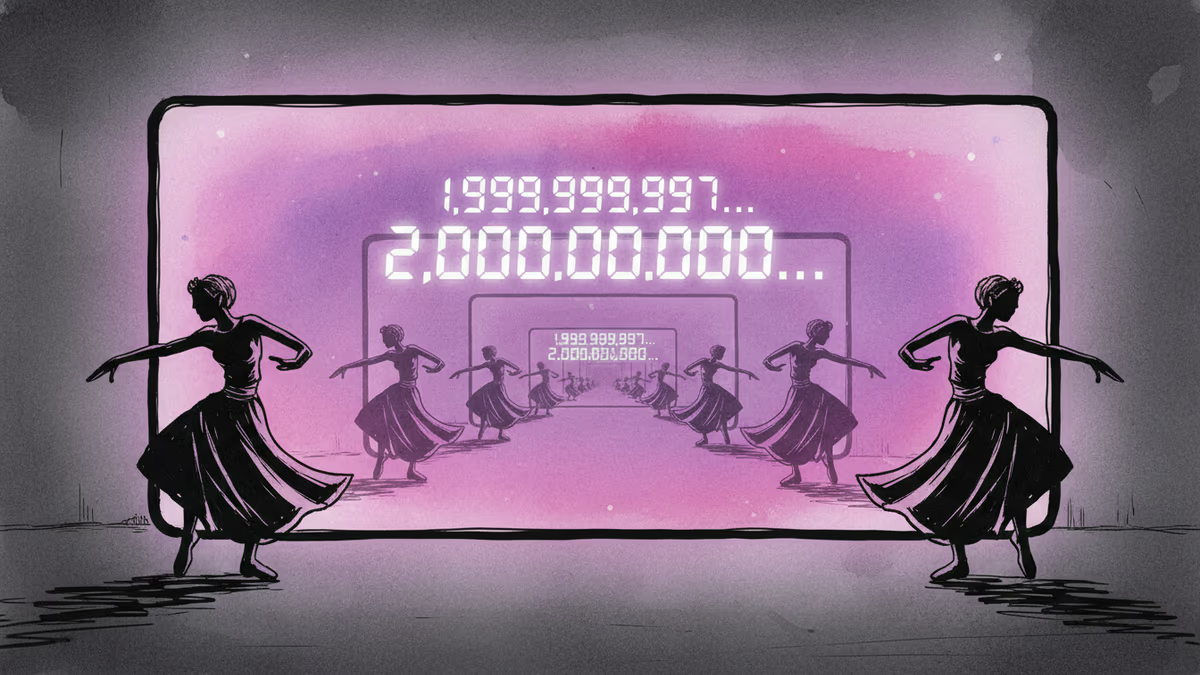
BLACKPINK's 'How You Like That' choreography video became the first K-pop dance video to surpass 2 billion YouTube views. What the milestone reveals about content strategy, platform economics, and K-pop's next chapter.

Jae Seok's B&B Rules!" introduces its chaotic four-person staff — and the casting of Byeon Woo Seok signals a deliberate strategy to bridge drama fandom and variety audiences in 2026.

MBC's Perfect Crown held the No. 1 spot on Korea's buzz rankings even in its final week on air, with Park Ji Hoon topping the actor chart. Here's what the numbers reveal about the K-drama market right now.
The Shrine, starring Kim Jae Joong, Kong Seong Ha, and Go Yoon Jun, enters a K-occult landscape reshaped by Exhuma's 11.9M ticket milestone. What does the film's Japan setting signal?
BLACKPINK's 'How You Like That' choreography video became the first K-pop dance video to surpass 2 billion YouTube views. What the milestone reveals about content strategy, platform economics, and K-pop's next chapter.
Jae Seok's B&B Rules!" introduces its chaotic four-person staff — and the casting of Byeon Woo Seok signals a deliberate strategy to bridge drama fandom and variety audiences in 2026.
MBC's Perfect Crown held the No. 1 spot on Korea's buzz rankings even in its final week on air, with Park Ji Hoon topping the actor chart. Here's what the numbers reveal about the K-drama market right now.
Thoughts
Share your thoughts on this article
Sign in to join the conversation