
Sal Saeng Bu": Can a Hard-Boiled Period Film Fill Korean Cinema's Blind Spot?
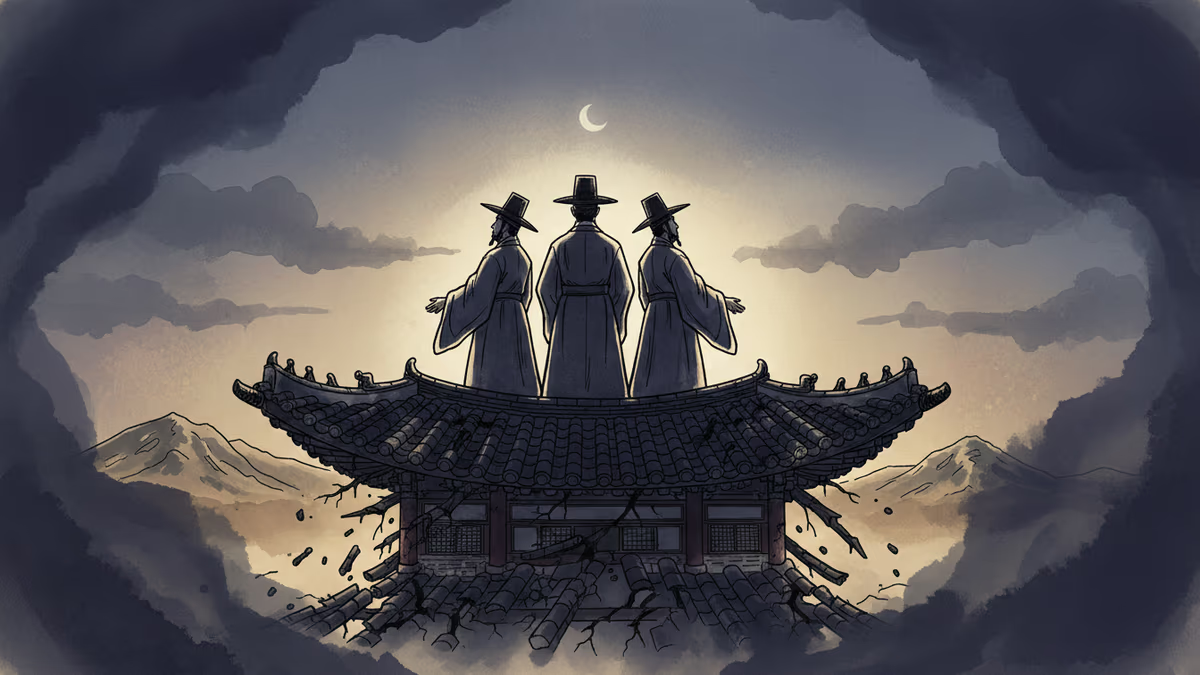
Jung Woo Sung, Jung Sung Il, and Wi Ha Joon are confirmed for action historical film "Sal Saeng Bu." What does this casting combination reveal about Korean cinema's strategy in the OTT era?
When was the last time a big-screen Korean period action film genuinely moved the box office needle? The answer is more elusive than it should be.
The production team behind Sal Saeng Bu (literal title: "Kill List") has officially confirmed the film is in development, announcing the casting of Jung Woo Sung, Jung Sung Il, and Wi Ha Joon in the same breath. An earlier report naming Bae Sung Woo as part of the lineup was not included in the official confirmation. Beyond the title and cast, details — director, synopsis, release window — remain undisclosed.
Three Actors, Three Different Orbits
What makes this casting announcement worth parsing is the specific career logic each actor brings to the table.
Jung Woo Sung is the anchor. A fixture of Korean cinema since the 1990s noir wave — Beat (1997), A Bittersweet Life-adjacent masculinity — he has spent the last decade in prestige theatrical releases like Asura: The City of Madness (2016) and the Steel Rain duology. He is, almost by definition, a screen actor rather than a streaming one. His presence signals that Sal Saeng Bu is positioning itself as a theatrical event, not an OTT commission.
Jung Sung Il carries a different kind of weight. His role as the calculating villain Jo Hak-joo in Netflix's Kingdom series gave him global recognition within a genre — the prestige Korean period drama — that has become one of the most reliable export formats in the industry. His casting here implicitly signals international ambition. Producers don't cast Kingdom alumni in purely domestic-facing projects.
Wi Ha Joon is the most commercially volatile element of the three. Post-Squid Game (2021), he became one of the fastest-rising names in the Korean industry's global tier, a status reinforced by Squid Game Season 2 (2024). His pivot to a theatrical period action film reads as a deliberate portfolio move — diversifying away from Netflix dependency at precisely the moment his streaming leverage is highest.

The Market Gap This Film Is Targeting
Korean period drama in 2026 operates on two distinct tracks. The upper tier belongs to high-budget OTT productions: Netflix's Kingdom opened the template, and the format has since proliferated across Disney+, Tving, and even back into broadcast television. The lower tier is low-budget streaming filler. What has quietly disappeared is the middle: the prestige theatrical period film.
Since The Tiger (2015) and The Throne (2015), the Korean box office has seen very few hard action sageuk — period dramas driven by physical conflict rather than political intrigue or melodrama — perform at scale in cinemas. The Battle: Roar to Victory (2019) and The Divine Move franchise worked within nationalist historical frameworks. But a hard-boiled, morally ambiguous period action film — closer to a samurai noir than a patriotic epic — remains largely uncharted territory in Korean commercial cinema.
That gap is precisely where Sal Saeng Bu appears to be planting its flag.
What "Hard-Boiled" Means in a Period Setting
The descriptor "hard-boiled" is doing real work here. The term originates in 1930s American pulp fiction — Raymond Chandler, Dashiell Hammett — and carries specific DNA: protagonists operating in moral gray zones, violence as routine rather than spectacle, emotional restraint bordering on coldness. Transposing that sensibility onto a Korean historical setting is a genuine creative gamble.
The closest reference points are external: Akira Kurosawa's samurai noir lineage, the Hong Kong wuxia crime crossovers of the 1980s–90s. Domestically, the Crime City franchise has demonstrated that audiences will turn out in enormous numbers for stripped-down, genre-faithful male action — Crime City 4 crossed 10 million admissions in 2023. If Sal Saeng Bu is attempting to transplant that formula into a period setting, the upside is real. So is the risk: the Crime City formula works partly because of its contemporary recognizability. A historical setting introduces friction.
The OTT Question Nobody's Asking Yet
Noticeably absent from the announcement is any mention of a streaming partner. In the current Korean film market, that silence is itself a data point. Major theatrical releases increasingly pre-sell OTT rights to fund production — Netflix's involvement in Ballerina (2023) and Seoul Spring (2023) being recent examples. A film with three high-profile leads and a period action budget will require substantial financing. Whether Sal Saeng Bu goes to market independently or attaches a platform partner before cameras roll will say a great deal about its actual scale and ambition.
This content is AI-generated based on source articles. While we strive for accuracy, errors may occur. We recommend verifying with the original source.
Related Articles

Netflix drops character stills for Husbands in Action, an action-comedy starring Jin Sun Kyu, Gong Myoung, Kim Ji Suk, and Yoon Kyung Ho. Here's what the casting and premise signal about K-film's global strategy.

Kang Dong-won dons retro idol gear for Wild Sing, a comedy about a fading trio chasing a comeback. What does this casting choice reveal about Korean cinema's current moment?

Director Yeon Sang-Ho returns with Colony, a virus thriller starring Go Soo and Jun Ji-Hyun. New character stills reveal a story where survival meets unresolved relationships.

tvN's 'Siren's Kiss' wrapped with a 4.5% rating, topping all cable channels. But in an era of streaming fragmentation, what does a cable No. 1 actually tell us about K-drama's future?
Netflix drops character stills for Husbands in Action, an action-comedy starring Jin Sun Kyu, Gong Myoung, Kim Ji Suk, and Yoon Kyung Ho. Here's what the casting and premise signal about K-film's global strategy.
Kang Dong-won dons retro idol gear for Wild Sing, a comedy about a fading trio chasing a comeback. What does this casting choice reveal about Korean cinema's current moment?
Director Yeon Sang-Ho returns with Colony, a virus thriller starring Go Soo and Jun Ji-Hyun. New character stills reveal a story where survival meets unresolved relationships.
tvN's 'Siren's Kiss' wrapped with a 4.5% rating, topping all cable channels. But in an era of streaming fragmentation, what does a cable No. 1 actually tell us about K-drama's future?
Thoughts
Share your thoughts on this article
Sign in to join the conversation