

Snap's Quick Cut: The New Weapon in the TikTok War is Effortless Creation
Snapchat's new Quick Cut tool is more than a feature. It's a strategic move against TikTok, aiming to lock users into its ecosystem and fuel its content engine.
The Lede: Beyond the Feature Drop
Snap's launch of 'Quick Cut' is not merely another feature to crowd the Snapchat interface. For executives and investors, this is a critical strategic maneuver in the high-stakes war for user attention. By embedding an automated, beat-synced video editor directly into the app, Snap is weaponizing convenience to solve its biggest challenge: turning millions of passive users into active creators and keeping them locked within its ecosystem, away from the gravitational pull of TikTok and CapCut.
Why It Matters: Commoditizing Creativity to Fuel the Feed
The introduction of Quick Cut has significant second-order effects for the social media landscape:
- Lowering the Barrier to Entry: The primary bottleneck for content creation isn't ideas; it's execution. Quick Cut removes the friction of editing, timing, and music selection, transforming a multi-step process into a one-tap action. This empowers the average user, not just seasoned creators, to produce polished-looking videos, dramatically increasing the potential volume of content for Snap's Spotlight platform.
- Ecosystem Lock-In: By making video creation seamless within Snapchat, Snap disincentivizes users from exporting their clips to third-party apps like CapCut. This is a classic walled-garden strategy, designed to keep the entire content lifecycle—capture, edit, publish, consume—inside Snap's domain, maximizing data collection and user retention.
- Competitive Pressure: This move puts direct pressure on Meta's Reels and Google's YouTube Shorts to further simplify their own native editing tools. The new baseline for competition is no longer just having editing features, but making them invisible and instantaneous.

The Analysis: The Battle for the Creation-to-Consumption Loop
Historically, Snapchat has excelled at ephemeral, person-to-person communication. However, the rise of TikTok proved that the most dominant platforms own the entire creator pipeline. TikTok's success is inseparable from the power of its easy-to-use editing tools and its sister app, CapCut, which together created a powerful and seamless loop from creation to viral consumption.
Snap is now directly challenging this model. While Instagram has been bolting on more professional-grade editing features to Reels, Snap is taking the opposite approach. Quick Cut is not for the professional creator; it’s for the everyday user who wants to compile a weekend's worth of photos and videos into a shareable, energetic story for their friends without learning how to be a video editor. It’s a bet on low-effort, high-reward creation to keep its core Gen Z audience engaged and posting natively.
PRISM's Take: A Necessary Move in an Existential Fight
This is a smart, defensive, and fundamentally necessary upgrade for Snap. It is not a revolutionary feature, but it is critical infrastructure for survival in the creator economy war. The success of Quick Cut won't be measured by its technical prowess, but by its cultural impact. The key question is whether it can generate a wave of authentic, 'day-in-the-life' video montages that feel native to Snapchat's close-friends ethos, rather than just another platform for polished TikTok-style trends. This is Snap's attempt to arm its massive user base, turning passive consumers into casual creators and betting that the path to victory lies not in complex tools, but in effortless storytelling.
Authors
Related Articles

Snap, YouTube, and TikTok settled a landmark school district lawsuit over social media addiction. With 1,000+ similar cases pending, this could reshape Big Tech's liability landscape.

New Mexico already won $375 million from Meta. Now it wants something harder to give: a court order forcing Facebook, Instagram, and WhatsApp to redesign themselves. A three-week trial starts Monday.

A small pro-Iran team is racking up millions of views with AI-generated Lego videos that mock Trump — and Americans are sharing them. What does that tell us about information warfare?
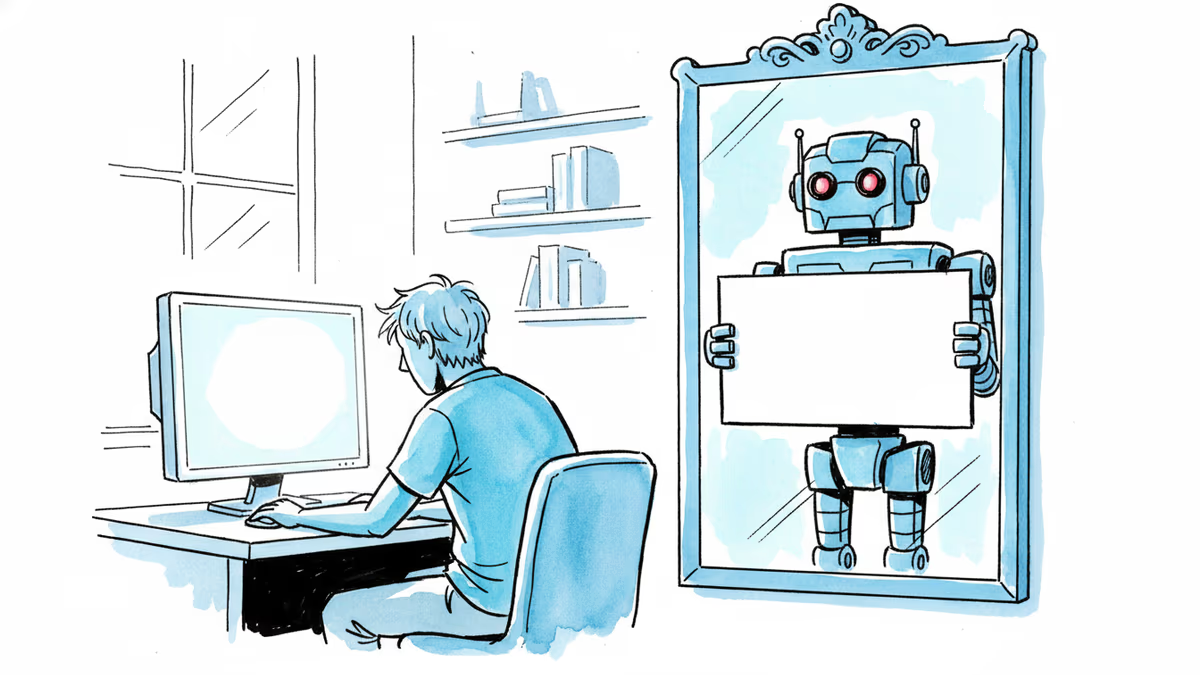
Reddit CEO Steve Huffman announced human verification for suspicious accounts. As AI bots flood the internet, one platform is drawing a line — but the line keeps moving.
Snap, YouTube, and TikTok settled a landmark school district lawsuit over social media addiction. With 1,000+ similar cases pending, this could reshape Big Tech's liability landscape.
New Mexico already won $375 million from Meta. Now it wants something harder to give: a court order forcing Facebook, Instagram, and WhatsApp to redesign themselves. A three-week trial starts Monday.
A small pro-Iran team is racking up millions of views with AI-generated Lego videos that mock Trump — and Americans are sharing them. What does that tell us about information warfare?
Reddit CEO Steve Huffman announced human verification for suspicious accounts. As AI bots flood the internet, one platform is drawing a line — but the line keeps moving.
Thoughts
Share your thoughts on this article
Sign in to join the conversation