

Snap Spins Off AR Glasses Unit to Court Fresh Investment
Snapchat parent Snap creates separate subsidiary for its Specs AR glasses business, signaling push for external funding ahead of consumer launch this year.
$10 billion—that's how big the AR glasses market could become by 2030. And Snap just made a bold bet on claiming its share.
The social media giant announced it's spinning off its upcoming Specs AR glasses into a separate subsidiary called "Specs Inc." The move comes ahead of the long-awaited consumer launch of Specs glasses later this year, marking a significant shift in how Snap approaches its hardware ambitions.
Why Split Now?
Snap's rationale is refreshingly direct. The company says the subsidiary structure "provides greater operational focus and alignment, enables new partnerships and capital flexibility including the potential for minority investment, allows us to grow a distinct brand, and supports clearer valuation of the business."
Translation: they want outside money, and they want it bad.
AR hardware is brutally expensive to develop. Meta has burned through $20+ billion on its Reality Labs division, while Apple reportedly spent over a decade developing the Vision Pro. For Snap—whose core business remains social media advertising—the capital demands of cutting-edge hardware present a fundamental mismatch.
By creating a separate entity, Snap can court hardware-focused investors, strategic partners, or even sovereign wealth funds looking to stake claims in the next computing platform. It's a recognition that AR glasses might need different financial backing than disappearing photo apps.
The Broader AR Arms Race

Specs isn't operating in a vacuum. Meta continues pouring resources into its Ray-Ban partnership, while Apple's$3,500Vision Pro has reset expectations around premium AR/VR devices. Meanwhile, startups like Brilliant Labs are targeting the sub-$500 market that could drive mass adoption.
Snap's spin-off strategy reflects a broader industry trend: the recognition that AR requires specialized focus, dedicated capital, and potentially different business models than traditional tech companies. It's not enough to bolt AR onto existing platforms—the technology demands its own ecosystem.
The timing also matters. With AI capabilities advancing rapidly, AR glasses are becoming more viable as everyday devices rather than tech demos. The question isn't whether AR glasses will mainstream—it's who will own that transition.
Consumer Reality Check
The current developer version of Specs costs around $1,500 and offers limited functionality compared to what consumers might expect. For mass adoption, industry analysts suggest the price needs to drop below $500 while dramatically improving battery life, display quality, and social acceptability.
That last point might be the biggest hurdle. Google Glass famously failed partly due to social stigma, and even Apple's sleek Vision Pro faces questions about when and where people will actually wear it. Snap's advantage might be its younger user base, which could be more willing to embrace face-worn computing.
Investment Implications
For investors, Specs Inc. represents both opportunity and risk. On one hand, it offers direct exposure to what could be the next major computing platform. On the other, it's entering a market where even tech giants have struggled to find product-market fit.
The subsidiary structure also raises questions about Snap's confidence in its core business. Is this a strategic diversification, or a hedge against potential decline in traditional social media?
Authors
Related Articles

Xreal's Project Aura debuted at Google I/O with OLED displays, hand tracking, and an IPO on the horizon. The industry has burned billions for a decade. So why does it feel like something has actually shifted?
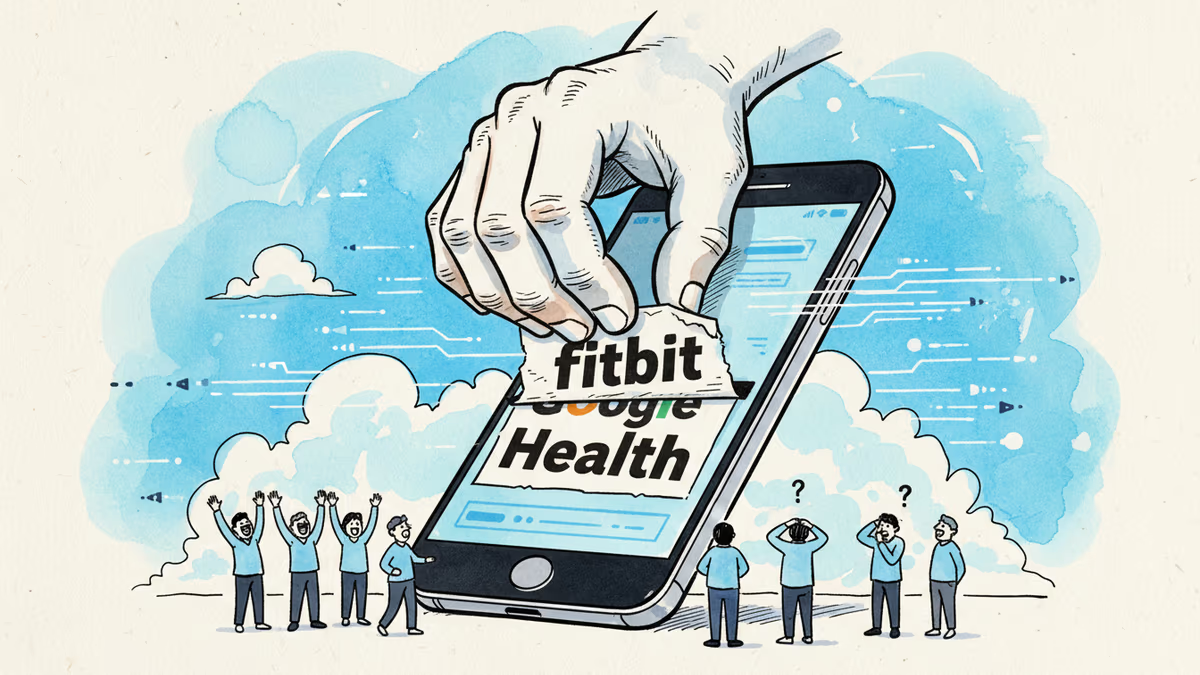
Google is rebranding the Fitbit app as Google Health on May 19, launching an AI Health Coach powered by Gemini. What does this mean for your data, your doctor, and Apple?

Two ex-Apple engineers built an AI puck that only listens when you press it. At $179, Button is a deliberate bet that dedicated AI hardware beats the Swiss Army knife approach of smartphones.

Meta Ray-Ban smart glasses sold 8 million units in 2025 alone. Now a black market for disabling their recording indicator lights is thriving—and lawmakers are alarmed about what comes next.
Xreal's Project Aura debuted at Google I/O with OLED displays, hand tracking, and an IPO on the horizon. The industry has burned billions for a decade. So why does it feel like something has actually shifted?
Google is rebranding the Fitbit app as Google Health on May 19, launching an AI Health Coach powered by Gemini. What does this mean for your data, your doctor, and Apple?
Two ex-Apple engineers built an AI puck that only listens when you press it. At $179, Button is a deliberate bet that dedicated AI hardware beats the Swiss Army knife approach of smartphones.
Meta Ray-Ban smart glasses sold 8 million units in 2025 alone. Now a black market for disabling their recording indicator lights is thriving—and lawmakers are alarmed about what comes next.
Thoughts
Share your thoughts on this article
Sign in to join the conversation