

OpenAI Sweet Pea 2026: Jony Ive-Designed AI Earbuds Target 40M Sales
OpenAI's first hardware device, the 'Sweet Pea' earbuds designed with Jony Ive, is set for a 2026 launch. Featuring custom 2nm chips and a 40M unit sales target, OpenAI aims to disrupt the wearable market.
40 million units in year one. That's the ambitious target OpenAI has set for its first foray into consumer electronics. During a Davos panel hosted by Axios, Chris Lehane, OpenAI's Chief Global Affairs Officer, confirmed the startup is on track to announce its debut hardware device in the second half of 2026.
OpenAI Sweet Pea Earbuds 2026: The Post-Smartphone Vision
Codenamed 'Sweet Pea', the device is rumored to be a pair of AI-powered earbuds with a design unlike anything currently on the market. Developed in collaboration with legendary former Apple designer Jony Ive, the hardware aligns with CEO Sam Altman's vision of a 'peaceful and calm' alternative to the distraction-heavy iPhone. It's expected to be screen-free and pocketable, focusing entirely on voice and contextual interaction.
Custom 2nm Silicon and Edge AI

To ensure lightning-fast responses without cloud latency, OpenAI is reportedly leveraging a custom 2-nanometer (nm) processor. This allows the device to handle complex AI tasks locally, a move that enhances privacy and performance. Manufacturing discussions are allegedly centered on Foxconn and Luxshare, with an initial production goal of 40 to 50 million units.
Taking Control of the AI Distribution
Currently, OpenAI relies on platforms like iOS and Android to reach its users. By launching Sweet Pea, the company takes a significant step toward owning the interface between the user and the AI assistant. However, the challenge is steep: replacing established ecosystem favorites like AirPods requires more than just smart software—it requires seamless OS-level integration that OpenAI currently lacks.
Authors
Related Articles
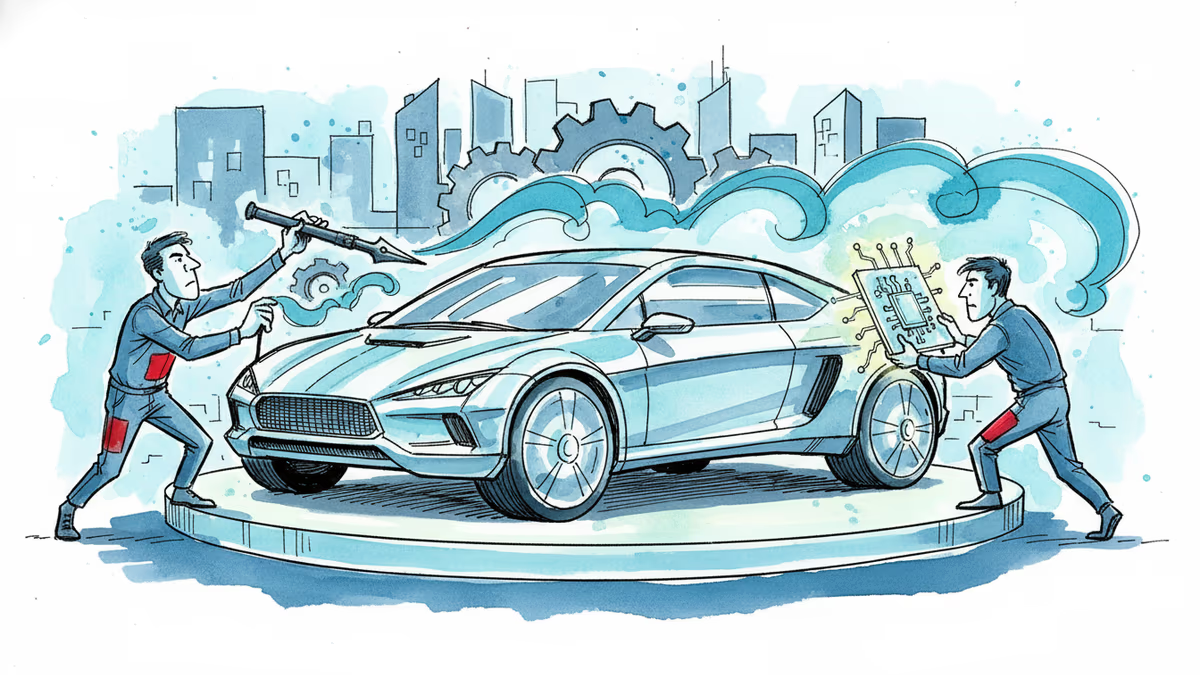
Ferrari's first EV, the Luce, starts at €550,000 in Italy. Designed inside and out by Jony Ive and Mark Newson's studio LoveFrom, it's Ferrari's first five-seater and a bold bet on design over performance specs.

Xreal's Project Aura debuted at Google I/O with OLED displays, hand tracking, and an IPO on the horizon. The industry has burned billions for a decade. So why does it feel like something has actually shifted?

OpenAI has reorganized for the second time in a month, merging ChatGPT and Codex into a single agentic platform under president Greg Brockman's unified product leadership.

After two weeks of witnesses calling him a liar, OpenAI CEO Sam Altman testified in his own defense, claiming Elon Musk tried to kill the company twice.
Ferrari's first EV, the Luce, starts at €550,000 in Italy. Designed inside and out by Jony Ive and Mark Newson's studio LoveFrom, it's Ferrari's first five-seater and a bold bet on design over performance specs.
Xreal's Project Aura debuted at Google I/O with OLED displays, hand tracking, and an IPO on the horizon. The industry has burned billions for a decade. So why does it feel like something has actually shifted?
OpenAI has reorganized for the second time in a month, merging ChatGPT and Codex into a single agentic platform under president Greg Brockman's unified product leadership.
After two weeks of witnesses calling him a liar, OpenAI CEO Sam Altman testified in his own defense, claiming Elon Musk tried to kill the company twice.
Thoughts
Share your thoughts on this article
Sign in to join the conversation