
How One YouTuber Is Reshaping US Immigration Policy
A 23-year-old right-wing YouTuber's viral video led to federal immigration raids and frozen childcare funding. The case reveals social media's growing influence on government policy.
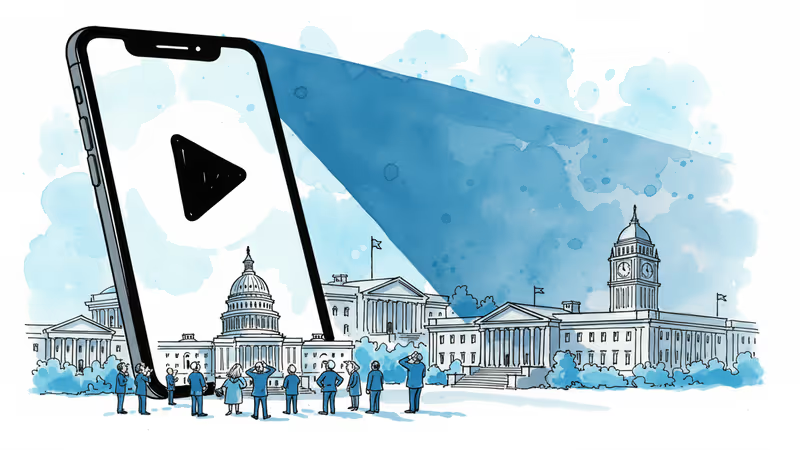
A 23-year-old YouTuber's video just moved the federal government. After right-wing content creator Nick Shirley posted a viral clip alleging fraud at Minnesota daycares operated by Somali residents, the Trump administration responded with immediate action: flooding the state with federal immigration agents and freezing childcare funding.
A judge has since ruled that the government must continue funding childcare subsidies, at least temporarily. But Shirley isn't slowing down. He's now in California, posting photos with the caption "Hello California I've arrived," apparently ready to repeat his playbook.
The Power of Unverified Sources
The "source" featured in Shirley's Minnesota video was later identified by The Intercept as someone with a history of spreading false information. Yet by then, the video had already gone viral, and real policy consequences had followed.
This pattern is becoming disturbingly common: unverified claims spread on social media platforms directly translate into government action. Immigration-related content seems particularly susceptible to this phenomenon, where emotional appeals often override fact-checking processes.
When Algorithms Drive Policy
Shirley's case isn't just about one rogue content creator. YouTube's algorithm rewards controversy and emotional engagement with higher view counts and broader reach. This creates perverse incentives for creators to produce increasingly sensational, often unverified content.

The platform's recommendation system can amplify these videos to millions of viewers within hours, creating a feedback loop where the most inflammatory content gets the most visibility—and potentially the most policy impact.
The New Influence Economy
Traditional policy-making involved established players: think tanks, lobbyists, major media outlets, and interest groups. Now YouTubers and influencers have joined this ecosystem, often with more direct access to public opinion than traditional gatekeepers.
Unlike established media, these individual creators operate without editorial oversight, fact-checking protocols, or professional journalism standards. Their personal biases and unverified claims can reach policymakers and the public simultaneously, compressed into viral moments that demand immediate response.
Democracy's Digital Dilemma
This shift raises fundamental questions about democratic governance in the social media age. Should platforms bear responsibility for content that influences policy? How do we balance free speech with the need for accurate information in democratic decision-making?
The traditional "marketplace of ideas" assumes that truth emerges through debate and competition. But algorithmic amplification doesn't necessarily favor truth—it favors engagement, which often means controversy, outrage, and polarization.
Authors
Related Articles
Indonesia introduces age-tiered social media restrictions, allowing 13+ for low-risk platforms and 16+ for high-risk ones. How does this compare to Australia's blanket ban?
From Australia's $34M fines to France's parliamentary vote, 10 countries are restricting teen social media access. A global experiment in digital parenting begins.
Middle East missile strikes trigger global doomscrolling epidemic. Neuroscience reveals why we can't stop scrolling through bad news and how to break free.
Instagram's new suicide search alerts for parents raise questions about whether surveillance-based solutions truly protect teens or simply push their struggles underground.
Indonesia introduces age-tiered social media restrictions, allowing 13+ for low-risk platforms and 16+ for high-risk ones. How does this compare to Australia's blanket ban?
From Australia's $34M fines to France's parliamentary vote, 10 countries are restricting teen social media access. A global experiment in digital parenting begins.
Middle East missile strikes trigger global doomscrolling epidemic. Neuroscience reveals why we can't stop scrolling through bad news and how to break free.
Instagram's new suicide search alerts for parents raise questions about whether surveillance-based solutions truly protect teens or simply push their struggles underground.
Thoughts
Share your thoughts on this article
Sign in to join the conversation