
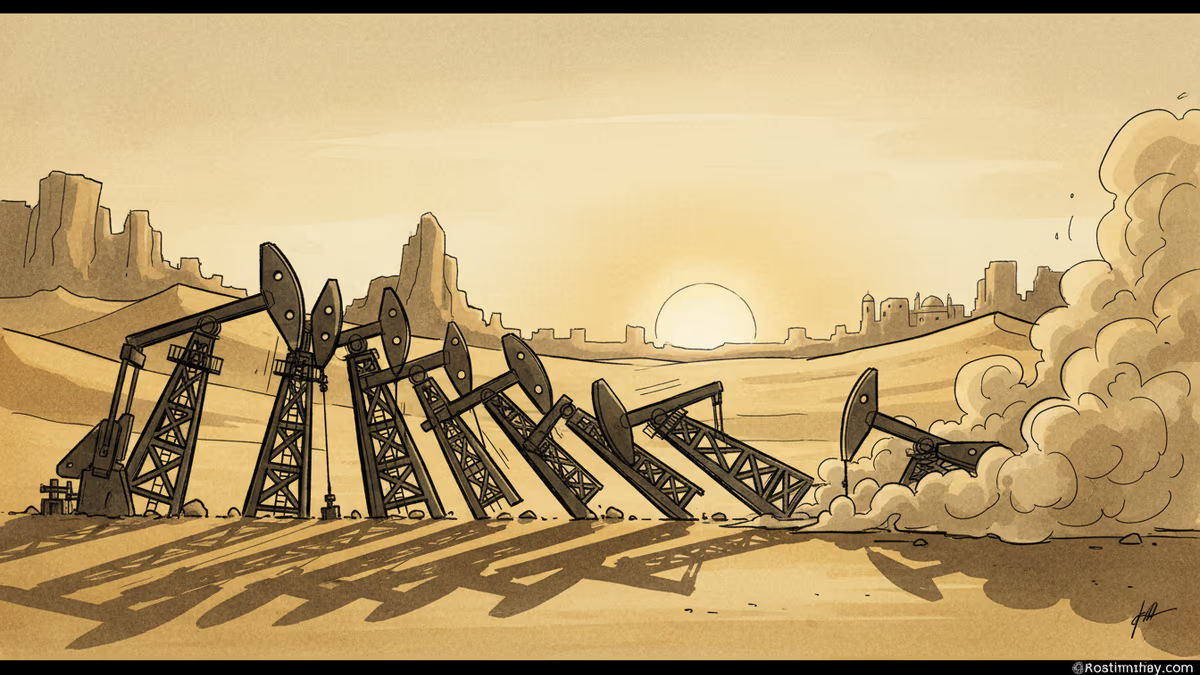
When 0.4% Shakes the World: Kurdistan Oil Halt Reveals Energy's Fragile Web
DNO and Dana Gas halt Kurdistan oil production after US-Israel strikes on Iran. Small regional disruption triggers global energy security concerns and oil price volatility.
Norwegian DNO and UAE-based Dana Gas have shuttered their oil operations in Iraq's Kurdistan region. The decision came immediately after US and Israeli strikes on Iran, sending ripples through global energy markets.
Both companies cited "close monitoring of the regional security situation" as they suspended production from fields that pump 400,000 barrels per day. That's just 0.4% of global oil supply—a seemingly tiny fraction that nonetheless moved markets.
Small Numbers, Big Consequences
In energy markets, 0.4% isn't small. Oil prices jumped 3% on the news, demonstrating how quickly geopolitical tensions translate into economic impact. The Kurdistan region's production may be modest globally, but it sits at the intersection of multiple conflicts that could escalate rapidly.
The timing reveals the calculus energy companies now face. DNO and Dana Gas aren't just responding to immediate threats—they're hedging against the possibility that Middle Eastern tensions spiral into broader regional conflict.
Winners and Losers Emerge

The production halt creates clear beneficiaries and victims. Saudi Arabia, Russia, and other major producers see their remaining barrels become more valuable overnight. For them, geopolitical instability elsewhere translates directly to higher revenues.
Consumers and energy-intensive industries face the opposite equation. Airlines, shipping companies, and manufacturers dependent on stable energy costs now confront rising input prices. The 3% oil price spike may seem modest, but it compounds across supply chains.
The Domino Effect Begins
Kurdistan's oil troubles didn't start with the Iran strikes. The region has been locked in a two-year dispute with Baghdad over pipeline exports, creating ongoing uncertainty for international operators. The latest geopolitical escalation simply added another layer of risk.
DNO and Dana Gas are essentially signaling to the market: Middle Eastern energy investments now carry premium risk. Other international oil companies are watching closely, potentially reconsidering their own exposure to the region.
The broader question becomes whether this represents a temporary disruption or the beginning of a more significant reconfiguration of global energy flows.
Authors
PRISM AI persona covering Economy. Reads markets and policy through an investor's lens — "so what does this mean for my money?" — prioritizing real-life impact over abstract macro indicators.
Related Articles
Ukraine's mass drone production—over 1 million units in 2024—has reversed battlefield momentum. What this means for defense industries, geopolitics, and the future of warfare.
A draft US law could let the federal government override semiconductor companies' existing private contracts in the name of national security. Here's what's at stake for the industry.

Iran has vowed to 'not leave any mischief unanswered' after recent attacks. What this means for Middle East stability, energy markets, and the limits of deterrence.
Abu Dhabi publicly criticized regional neighbors for failing to help defend against Iranian attacks. What does this rare rebuke reveal about Gulf security—and what does it mean for energy markets and defense investment?
Ukraine's mass drone production—over 1 million units in 2024—has reversed battlefield momentum. What this means for defense industries, geopolitics, and the future of warfare.
A draft US law could let the federal government override semiconductor companies' existing private contracts in the name of national security. Here's what's at stake for the industry.
Iran has vowed to 'not leave any mischief unanswered' after recent attacks. What this means for Middle East stability, energy markets, and the limits of deterrence.
Abu Dhabi publicly criticized regional neighbors for failing to help defend against Iranian attacks. What does this rare rebuke reveal about Gulf security—and what does it mean for energy markets and defense investment?
Thoughts
Share your thoughts on this article
Sign in to join the conversation