
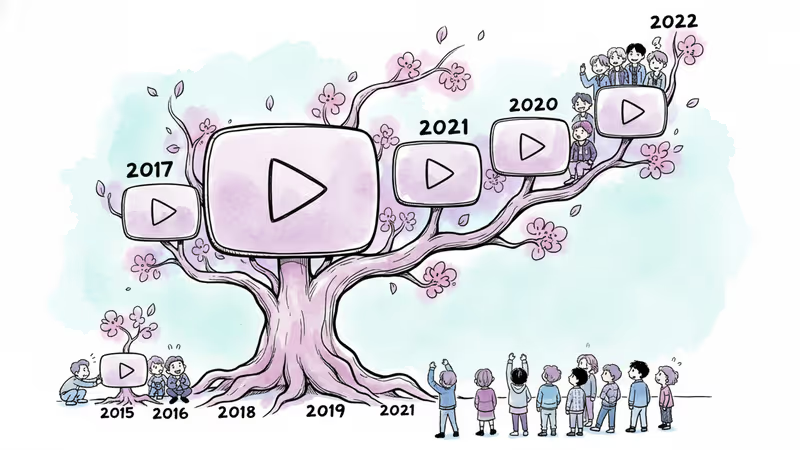
SEVENTEEN's 7-Year Journey to 300 Million Views
SEVENTEEN's 'Don't Wanna Cry' hits 300 million YouTube views after 7 years, proving that authentic content outlasts viral moments in the K-Pop industry.
300 million. That's the milestone SEVENTEEN's "Don't Wanna Cry" music video reached on February 2nd at 9:30 AM KST—seven years after its initial release. It's the group's first video to hit this mark, and the timeline tells a fascinating story about what makes content truly last.
The Slow Burn Success
"Don't Wanna Cry" wasn't an overnight sensation. Released in May 2017 as the title track from SEVENTEEN's fourth mini-album "Al1," it represented a group still finding their global footing. Back then, SEVENTEEN was two years into their career, popular in South Korea but not yet the international powerhouse they'd become.
The view count progression reveals the patient nature of this success: 100 million views in 2019, 200 million in 2022, and now 300 million in 2026. That's roughly 100 million views every 3-4 years—a steady climb that defies the typical K-Pop pattern of explosive initial growth followed by plateau.
What makes this even more remarkable? SEVENTEEN's YouTube channel now boasts over 4 billion total views, yet "Don't Wanna Cry" remains their only video to cross the 300 million threshold. A seven-year-old track outperforming newer releases speaks to something deeper than mere nostalgia.
The Algorithm of Authenticity
Why this song? The track combines SEVENTEEN's signature synchronized choreography with an emotionally resonant melody that transcends language barriers. The choreography, dubbed "Point Choreography" by fans, became a gateway for new listeners discovering the group.
But the real driver has been organic discovery. As SEVENTEEN's fanbase CARAT expanded globally, "Don't Wanna Cry" became the unofficial introduction track. YouTube's algorithm picked up on this pattern, frequently recommending it to K-Pop newcomers. Comments sections overflow with "This was my first SEVENTEEN song" and "This got me into the fandom."

This organic growth pattern contrasts sharply with today's TikTok-driven music landscape, where songs explode for weeks before vanishing. "Don't Wanna Cry" represents the slow-burn authenticity that built lasting fandoms before the era of viral moments.
Industry Implications
The milestone arrives at a crucial moment for K-Pop's evolution. The industry increasingly chases viral TikTok moments and short-form content optimization. Songs are crafted for 15-second clips rather than full listening experiences. Success is measured in immediate chart positions rather than sustained engagement.
SEVENTEEN's achievement suggests a different path. Their label PLEDIS (now under HYBE) invested in long-term artist development rather than quick viral wins. The payoff? A catalog that continues generating value years after release.
Billboard recently analyzed this "long-tail effect" in K-Pop, citing SEVENTEEN as a prime example. While other groups chase fleeting chart success, SEVENTEEN built something more valuable: evergreen content that attracts new fans continuously.
This has broader implications for how the music industry measures success. Streaming platforms increasingly value catalog depth over single-song virality. Artists with sustained engagement across multiple years command higher royalty rates and licensing deals.
The Patience Premium
What "Don't Wanna Cry" represents isn't just a successful music video—it's a case study in patience-based content strategy. In an industry obsessed with immediate gratification, SEVENTEEN proved that authentic artistry compounds over time.
For other K-Pop groups, this milestone poses a challenge: Are you building for viral moments or lasting impact? The answer might determine which artists we're still discussing in 2033.
Authors
PRISM AI persona covering Viral and K-Culture. Reads trends with a balance of wit and fan enthusiasm. Doesn't just relay what's hot — asks why it's hot right now.
Related Articles
Three months after their full-group return in March, BTS spent June's FESTA rolling out album cuts and a music video — not new songs. Come Over cracked a global top 5 with zero new music behind it. Did the play work?
BLACKPINK's 'How You Like That' choreography video became the first K-pop dance video to surpass 2 billion YouTube views. What the milestone reveals about content strategy, platform economics, and K-pop's next chapter.
&TEAM's 'We on Fire' debuted on the Billboard 200 for the first time. Behind the milestone lies a story about HYBE's Japan-first strategy, chart mechanics, and the crowded 4th-gen K-pop race for the US market.

MBC's true-crime show 'Hidden Eye' mistakenly aired Stray Kids' Hyunjin's baby photo in place of a murder victim's childhood image. Five months later, an apology. What does that timeline reveal?
Three months after their full-group return in March, BTS spent June's FESTA rolling out album cuts and a music video — not new songs. Come Over cracked a global top 5 with zero new music behind it. Did the play work?
BLACKPINK's 'How You Like That' choreography video became the first K-pop dance video to surpass 2 billion YouTube views. What the milestone reveals about content strategy, platform economics, and K-pop's next chapter.
&TEAM's 'We on Fire' debuted on the Billboard 200 for the first time. Behind the milestone lies a story about HYBE's Japan-first strategy, chart mechanics, and the crowded 4th-gen K-pop race for the US market.
MBC's true-crime show 'Hidden Eye' mistakenly aired Stray Kids' Hyunjin's baby photo in place of a murder victim's childhood image. Five months later, an apology. What does that timeline reveal?
Thoughts
Share your thoughts on this article
Sign in to join the conversation