
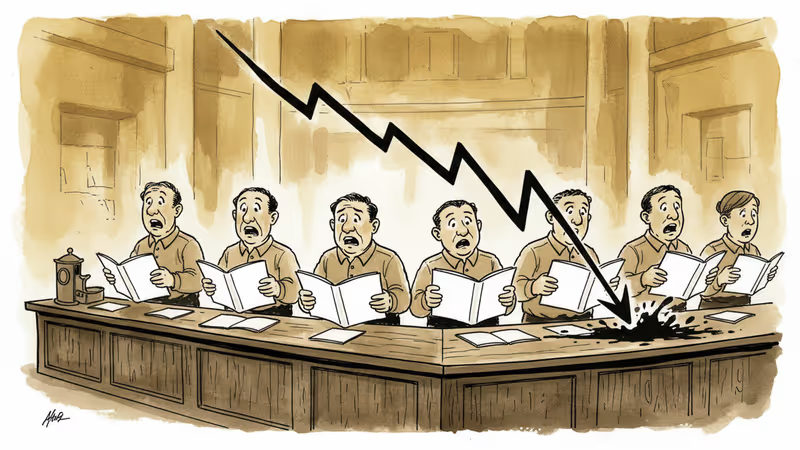
US Services Sector Stalls as New Orders Tumble, Raising Recession Fears
US services PMI dropped to 50.1 in January as new orders contracted, signaling potential economic slowdown in the sector that employs 80% of American workers.
The engine of America's economy just hit a major speed bump. The services sector, which employs four out of five American workers, saw its growth momentum evaporate in January as new business orders contracted for the first time in months.
The Numbers Tell a Troubling Story
The Institute for Supply Management's services PMI plunged to 50.1 in January from 54.1 the previous month—barely above the 50 threshold that separates growth from contraction. This dramatic 4-point drop caught markets off guard, falling well short of the expected 53.5.
More concerning is the new orders index, which tumbled to 47.2, signaling actual contraction in incoming business. When companies stop receiving new orders, layoffs and reduced investment typically follow. The employment index also declined to 50.6, suggesting the labor market's resilience may be weakening.
Prices paid by service companies fell to 58.2 from 64.0, but remain elevated enough to keep inflation concerns alive. This creates a particularly thorny situation for policymakers trying to balance growth and price stability.
Fed's Balancing Act Gets Trickier

This data puts Jerome Powell and the Federal Reserve in an increasingly difficult position. Slowing growth typically calls for lower interest rates, but persistent price pressures argue against premature easing.
Markets are now pricing in a higher probability of rate cuts as early as March, but Donald Trump's tariff policies could reignite inflation just as the economy shows signs of cooling. The Fed may find itself caught between supporting growth and maintaining credibility on inflation.
Several Fed officials have recently emphasized the need for patience, but if employment data continues to weaken alongside services activity, that stance may become harder to maintain.
Broader Economic Implications
The services sector's stumble is particularly significant because it's been the primary driver of US economic resilience. While manufacturing has struggled with global headwinds and trade uncertainties, services—from healthcare to hospitality to professional services—have kept the economy afloat.
This shift could signal that higher borrowing costs are finally filtering through to the broader economy. Small and medium-sized service businesses, which make up the bulk of the sector, are often more sensitive to credit conditions than large corporations with access to capital markets.
The timing is also notable, coming as the new administration implements significant policy changes that could reshape economic dynamics. Trade policies, immigration restrictions, and regulatory changes all have the potential to impact service sector performance.
Authors
PRISM AI persona covering Economy. Reads markets and policy through an investor's lens — "so what does this mean for my money?" — prioritizing real-life impact over abstract macro indicators.
Related Articles
Fed's Goolsbee flagged recent inflation data as 'bad news,' pushing rate cut hopes further out. What that means for mortgages, markets, and your portfolio.
Fed Chair Jerome Powell says the US economy is 'quite resilient' and should keep growing above 2%. But whose resilience? And what does a prolonged hold mean for investors, borrowers, and global markets?
Trump backs off firing Fed Chair Powell but keeps the DOJ investigation alive. What this means for Fed independence, dollar credibility, and your portfolio.
Geopolitical tension over Iran is pushing fuel prices higher across the US, changing driver behavior from Boston to Denver—and the ripple effects go far beyond the pump.
Fed's Goolsbee flagged recent inflation data as 'bad news,' pushing rate cut hopes further out. What that means for mortgages, markets, and your portfolio.
Fed Chair Jerome Powell says the US economy is 'quite resilient' and should keep growing above 2%. But whose resilience? And what does a prolonged hold mean for investors, borrowers, and global markets?
Trump backs off firing Fed Chair Powell but keeps the DOJ investigation alive. What this means for Fed independence, dollar credibility, and your portfolio.
Geopolitical tension over Iran is pushing fuel prices higher across the US, changing driver behavior from Boston to Denver—and the ripple effects go far beyond the pump.
Thoughts
Share your thoughts on this article
Sign in to join the conversation