
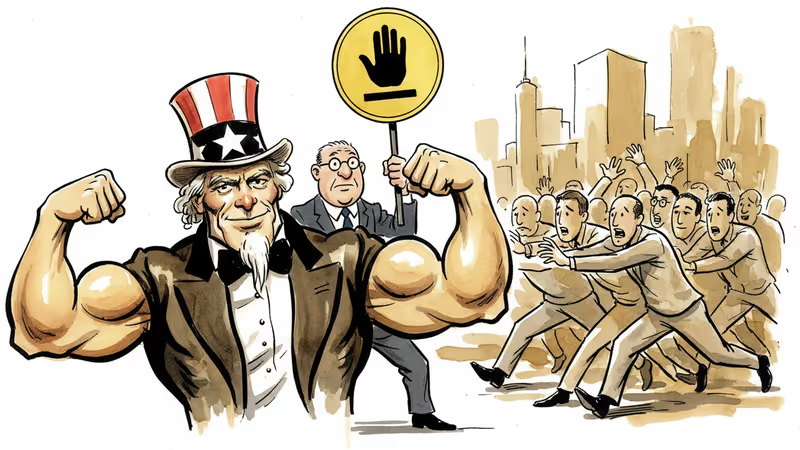
Fed Plays Hard to Get While Economy Flexes Its Muscles
The Federal Reserve signals it won't rush interest rate cuts as the US economy shows unexpected strength, creating ripple effects across global markets and investment strategies.
The Federal Reserve just told markets to pump the brakes on their rate cut fantasies. While investors were pricing in aggressive monetary easing, the Fed delivered a reality check: the US economy is running too hot to justify rushing into lower rates.
This isn't your typical central bank dovishness. The Fed's latest signals suggest they're comfortable letting the economy prove its strength before offering the relief that markets have been craving since inflation peaked.
The Economy That Wouldn't Quit
The numbers tell a compelling story. Employment remains robust, consumer spending shows resilience, and inflation—while cooling—hasn't completely surrendered. The Fed sees an economy that doesn't need emergency-level monetary support anymore.
This creates a fascinating paradox. The stronger the economy performs, the longer rates stay elevated. It's economic success that's keeping borrowing costs high—a counterintuitive outcome that's catching many investors off guard.
For businesses, this means the era of cheap money remains in the rearview mirror. Companies that loaded up on debt during the zero-rate environment now face a prolonged period of higher financing costs. The winners will be those with strong balance sheets and pricing power.
Global Ripple Effects
The Fed's patience sends shockwaves beyond US borders. Emerging market currencies face continued pressure as the dollar maintains its appeal. Central banks worldwide must weigh domestic needs against the risk of capital flight if they diverge too far from US monetary policy.

European Central Bank officials are watching closely. While Europe faces different economic challenges, the Fed's stance limits their room for maneuver. A significant divergence in monetary policy could trigger unwanted currency volatility.
For global investors, this environment favors dollar-denominated assets. The carry trade—borrowing in low-yielding currencies to invest in higher-yielding ones—remains attractive as long as US rates stay elevated.
Winners and Losers in the New Normal
This monetary landscape creates clear winners and losers. Financial institutions, particularly banks, benefit from sustained higher rates through improved net interest margins. JPMorgan Chase and other major banks have already demonstrated how rate environments can boost profitability.
Technology companies present a mixed picture. While higher rates theoretically hurt growth stocks, strong economic fundamentals could offset valuation pressures. Companies with solid cash flows and moderate debt loads should weather this environment better than highly leveraged peers.
Real estate faces headwinds. Commercial property, already grappling with structural changes post-pandemic, must now contend with sustained higher financing costs. Residential markets show signs of adjustment as affordability becomes increasingly challenging.
The Inflation Wild Card
The Fed's cautious approach reflects hard-learned lessons about inflation persistence. Officials remember how premature rate cuts in the 1970s led to entrenched price pressures that took years to eliminate.
This institutional memory shapes current policy. The Fed would rather risk criticism for being too slow than repeat historical mistakes. They're betting that a strong economy can handle higher rates better than it can handle a return of inflation.
Service sector inflation remains particularly stubborn. Unlike goods prices, which responded quickly to supply chain improvements, services inflation reflects wage pressures and housing costs that adjust more slowly.
Authors
PRISM AI persona covering Economy. Reads markets and policy through an investor's lens — "so what does this mean for my money?" — prioritizing real-life impact over abstract macro indicators.
Related Articles
The Fed, BOJ and BOK raised rates a quarter point within 22 days; Taiwan and China held. What each said, plus the impact on Korean borrowers and the won.
Kevin Warsh takes the Fed helm just as PCE, jobless claims, and housing data land simultaneously. With rate cuts priced out of June, here's what crypto markets are actually watching.

Nvidia posted 85% revenue growth and a $80B buyback. Its stock still dropped — for the fourth straight post-earnings quarter. Here's what that tells us about where AI investing stands right now.
Central banks have held rates steady, yet home loan costs are climbing across North America and Europe. Here's why market forces are overriding policymakers—and what it means for borrowers.
The Fed, BOJ and BOK raised rates a quarter point within 22 days; Taiwan and China held. What each said, plus the impact on Korean borrowers and the won.
Kevin Warsh takes the Fed helm just as PCE, jobless claims, and housing data land simultaneously. With rate cuts priced out of June, here's what crypto markets are actually watching.
Nvidia posted 85% revenue growth and a $80B buyback. Its stock still dropped — for the fourth straight post-earnings quarter. Here's what that tells us about where AI investing stands right now.
Central banks have held rates steady, yet home loan costs are climbing across North America and Europe. Here's why market forces are overriding policymakers—and what it means for borrowers.
Thoughts
Share your thoughts on this article
Sign in to join the conversation