
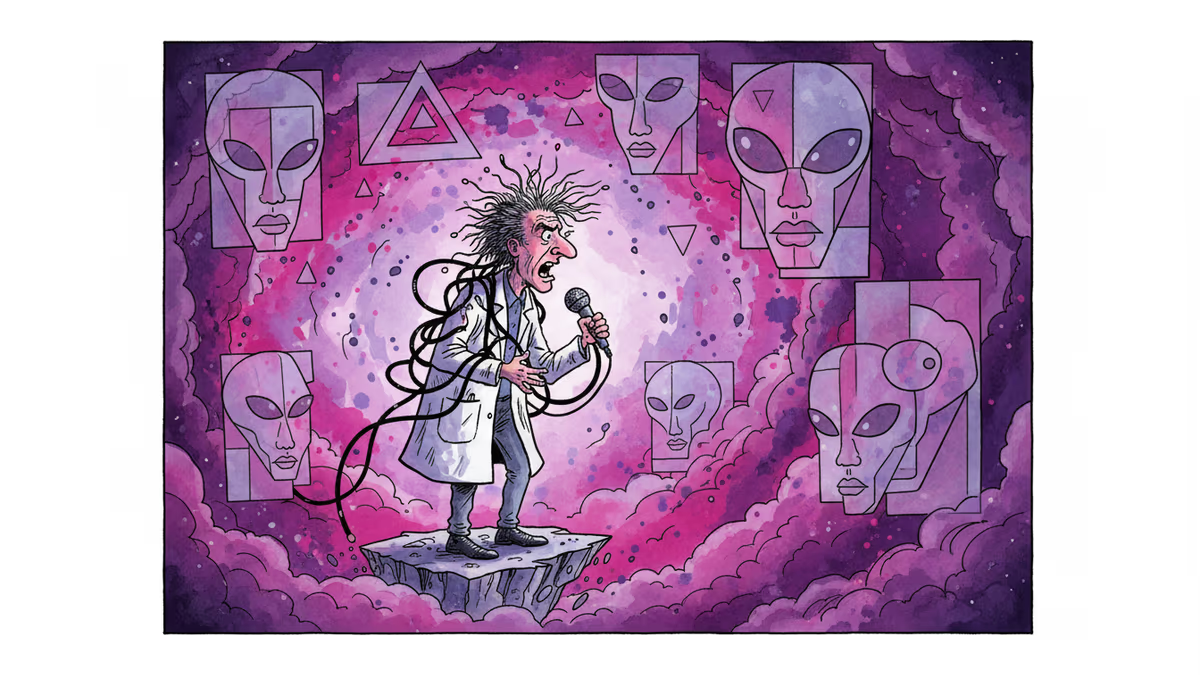
Scientists Want to Talk to the Aliens in Your Brain
A Caribbean research facility uses extended DMT trips to study encounters with otherworldly entities. Are they hallucinations or something more? The quest to decode consciousness takes a radical turn.
What if You Could Stay in Another Dimension for 30 Minutes?
Anton Bilton's scalp was covered in EEG electrodes like a jeweled headdress. DMT flowed through an IV into his bloodstream while he waited, feeling like he had "his head in a guillotine." Then, like a rocket ripping through Earth's atmosphere, he arrived. And he knew he was being watched—not just by humans in the hospital room, but by alien beings in the DMT realm itself.
This was 2022 at Imperial College London, the world's first clinical study with "extended DMT" or DMTx. While typical DMT trips last 10-15 minutes, Bilton's peak experience stretched for half an hour. The technology—originally designed to maintain steady anesthesia during surgery—had been repurposed to prolong the psychedelic state.
What Bilton encountered during those extended minutes would challenge everything we think we know about consciousness.
A "SETI for the Mind" Opens in the Caribbean
Neurobiologist Andrew Gallimore took the next logical step. On March 18, he launched Eleusis, a psychedelic research facility on the tiny Caribbean island of Bequia. The goal? Establish sustained, two-way communication with the entities that 94% of DMT users report encountering.
"A SETI for the mind," Gallimore calls it, referencing the Search for Extra Terrestrial Intelligence.
Guests pay from $9,500 for a four-day package including two DMTx sessions. Unlike ayahuasca—which can trap users in terrifying experiences for hours—DMTx can be dialed up or down. If things go wrong, the drug flow stops and effects wear off in minutes.
"Instead of sitting in your own personal hell for six hours on ayahuasca, you can actually dial that back," says co-owner Charles Patti.
The Entities: Hallucination or Higher Intelligence?

Ethnobotanist Terence McKenna famously described these beings as "self-transforming elf machines" and "jeweled, self-dribbling basketballs from hyperspace." Bilton met darker entities: "horrible things—dark, evil motherfuckers."
Yet they share common traits: overwhelming technological sophistication and godlike power. "I was confronted with what seemed to be the undeniable hand of some kind of intelligence," Gallimore said on Joe Rogan's podcast, "a supremely advanced, ancient, and yet highly technological intelligence."
But are they real?
Robin Carhart-Harris, a neurology researcher at UC San Francisco and co-author of the Imperial DMTx study, thinks not. "We're a very visual and very social animal, so we are already primed to process beings," he explains. "And lo and behold, what comes up out of the highly entropic DMT state is a 'sentient being.'" Basically, he argues, it's like seeing faces in clouds—just far more sophisticated.
The Scientific Challenge
Gallimore's counterargument is compelling: DMT entities are so radically unlike anything humans could encounter in waking life that they can't be dismissed as psychological projections. There's no ready-made blueprint for self-transforming elf machines in our unconscious.
His research approach is ambitious. Send mathematicians, linguists, and specialists from various fields into the DMT realm to study entities firsthand. "If you were going into the Amazon rainforest for the first time, you'd send biologists, primatologists, cartographers," he says. "The DMT space is no different."
Some suggest testing the entities' intelligence—asking them to factor large numbers into primes, for instance. But as Gallimore points out, they might not be interested in cooperating.
The Bigger Questions
Consciousness remains science's hardest problem. The rise of AI chatbots has shown how easily we mistake sophisticated responses for genuine awareness. How would we even recognize truly alien intelligence?
Yet maybe the entities' "independence" doesn't matter. Charles Patti, who credits DMT encounters with helping overcome years of addiction, puts it simply: "Whether they were real or not doesn't matter to me as much as the positive things I gained from the experience."
Authors
Related Articles

Middle East missile strikes trigger global doomscrolling epidemic. Neuroscience reveals why we can't stop scrolling through bad news and how to break free.
Computer scientists declared 'no obvious barriers' to building conscious AI. The fundamental question of human identity has begun.

New research shows DMT can treat depression in 15 minutes without hallucinations. Could this fast-acting psychedelic revolutionize mental healthcare and challenge Big Pharma's dominance?
A groundbreaking study of Buddhist monks reveals meditation dramatically increases brain complexity rather than calming it down, challenging everything we thought we knew about this ancient practice.
Middle East missile strikes trigger global doomscrolling epidemic. Neuroscience reveals why we can't stop scrolling through bad news and how to break free.
Computer scientists declared 'no obvious barriers' to building conscious AI. The fundamental question of human identity has begun.
New research shows DMT can treat depression in 15 minutes without hallucinations. Could this fast-acting psychedelic revolutionize mental healthcare and challenge Big Pharma's dominance?
A groundbreaking study of Buddhist monks reveals meditation dramatically increases brain complexity rather than calming it down, challenging everything we thought we knew about this ancient practice.
Thoughts
Share your thoughts on this article
Sign in to join the conversation