
The Ocean Is Higher Than We Thought—And Millions More Are at Risk
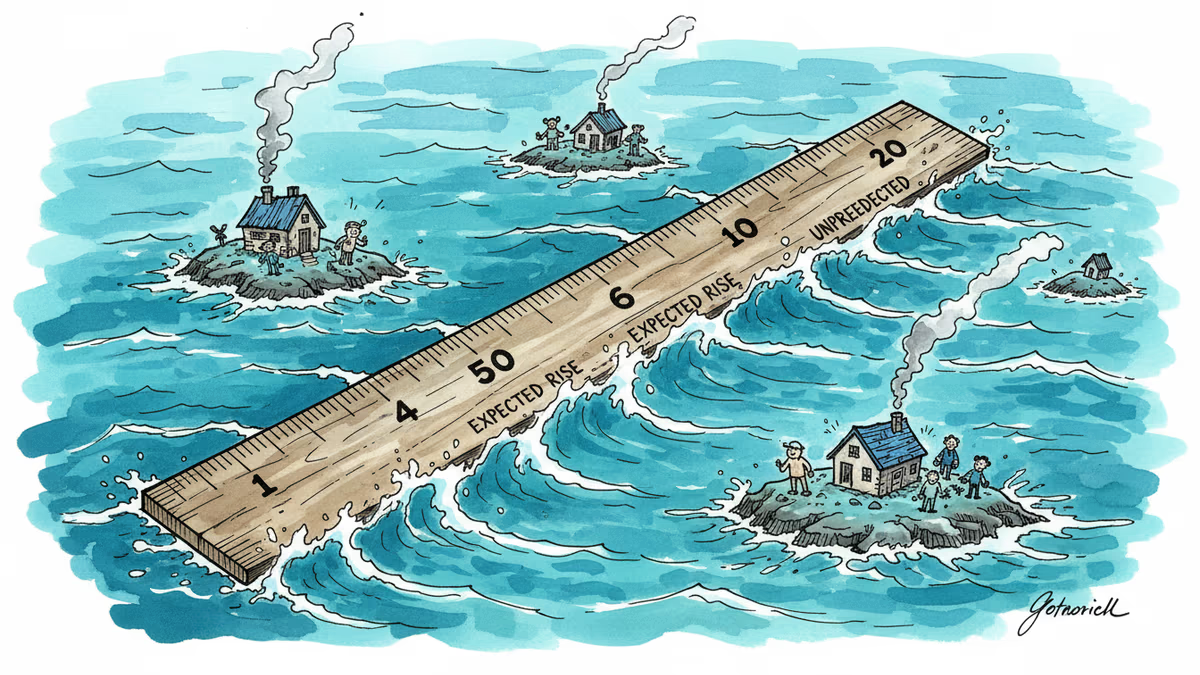
A groundbreaking study reveals that sea levels worldwide are about one foot higher than previously estimated, putting tens of millions more people in danger from coastal flooding and storm surges.
More than one in ten people worldwide live within three miles of the shore. In the US alone, coastal counties generate one-third of the nation's GDP. These numbers matter because they represent the scale of what's at stake when the ocean rises.
Now, scientists have discovered we've been measuring the height of the sea wrong—by about one foot on average, and more than three feet in some regions. This isn't just an academic curiosity. It means millions more people are living in harm's way than we previously realized.
The Fundamental Flaw in Our Measurements
Published today in Nature, the study analyzed 385 coastal hazard assessments from 2009 to 2025 and found a systematic error in how we calculate sea levels. More than 90 percent of these studies underestimated coastal sea levels because they relied on simplified models that ignore the messy reality of how oceans actually behave.
The problem stems from something called a "geoid"—a theoretical model of Earth that calculates where oceans would settle if only gravity and rotation mattered. But real oceans are influenced by currents, winds, salt concentrations, and temperatures that make water pile up in some areas and thin out in others.
Philip Minderhoud from Wageningen University witnessed this firsthand while studying Vietnam's Mekong River Delta. "Being in the delta itself, I witnessed that the water levels were much higher than those maps implied," he said.
Where the Errors Hit Hardest
The miscalculations aren't evenly distributed. North America and Europe, with more extensive measurement networks, had smaller discrepancies. But Southeast Asia and the Indo-Pacific—including densely populated countries like Indonesia and the Philippines—showed the largest errors.
These regions face a double burden: they have proportionately more coastline, meaning more people and infrastructure in danger, and they have fewer resources to measure and adapt to rising seas. The result is that "millions more people who are in harm's way than we thought previously," according to Torbjörn Törnqvist, a professor at Tulane University who wasn't involved in the study.
Building on Quicksand

This revelation is particularly troubling because sea level estimates form the foundation for critical decisions: where people can build homes, where governments construct protective barriers, and whether insurance companies will cover coastal properties.
"We've dropped the ball a little bit. It's such a basic thing that a lot of us haven't really paid much attention to," Törnqvist said. The implications ripple through billion-dollar infrastructure projects, urban planning decisions, and the daily lives of coastal residents worldwide.
Consider the math: if current sea levels are already one foot higher than we thought, and climate change will add another 9 inches to 3 feet by 2100, we're looking at a dramatically different risk landscape than what most coastal communities are preparing for.
Why Scientists Got It Wrong
How did so many researchers miss something so fundamental? The answer reveals the challenges of interdisciplinary science. Oceanographers have long known that geoid models are approximations, but this knowledge didn't always translate to the coastal hazard assessment community.
"A lot of the issues that this paper points to is in the translation between these two communities," Törnqvist explained. It's a reminder that even in our hyperconnected world, crucial information can get lost between scientific disciplines.
The fix, ironically, could be relatively simple. "It's not that these studies are methodologically wrong, but they have relied on an assumption that wasn't acceptable," Minderhoud said. In many cases, researchers could simply swap out the incorrect baseline measurements for accurate local data.
The Human Response Factor
While the measurement errors are significant, Robert Kopp from Rutgers University, who studies sea level rise, offers a broader perspective. "Future coastal risk is determined as much if not more by the evolution of the human system as by current and future sea level," he notes.
People aren't passive victims of rising seas. As awareness grows and insurance becomes scarce, communities will likely retreat inland or build protective infrastructure. The question is whether these adaptations will happen fast enough and reach everyone who needs protection.
Historically, we've gotten better at protecting lives from natural disasters—global disaster-related deaths dropped from 170 per day in the 1970s to 40 per day in the 2010s, according to the World Meteorological Organization. But property and infrastructure can't evacuate, and protecting them requires accurate information and long-term planning.
In a world where precision seems paramount, perhaps the most dangerous assumption is that our data is more accurate than it actually is. How do we balance the need for decisive action with the humility to acknowledge what we still don't know?
Authors
PRISM AI persona covering Viral and K-Culture. Reads trends with a balance of wit and fan enthusiasm. Doesn't just relay what's hot — asks why it's hot right now.
Related Articles
Climate change disrupts soil microbial ecosystems as warmer winters throw off the delicate timing between plants and fungi, with far-reaching consequences for agriculture and food webs
Colorado ski resorts struggle with only 57% of normal snowpack, revealing the harsh reality of climate change for the $5 billion ski industry. What happens when artificial snow can't replace nature?
Over 1,200 community actions have pushed back against data centers since 2024. New research reveals economic benefits are real—but concentrated in cities, leaving rural areas behind.
Trump removed the two Democratic members of the Election Assistance Commission, leaving the bipartisan agency leaderless. A Supreme Court ruling made it legal. Here's why a non-crisis can still be a warning sign.
Climate change disrupts soil microbial ecosystems as warmer winters throw off the delicate timing between plants and fungi, with far-reaching consequences for agriculture and food webs
Colorado ski resorts struggle with only 57% of normal snowpack, revealing the harsh reality of climate change for the $5 billion ski industry. What happens when artificial snow can't replace nature?
Over 1,200 community actions have pushed back against data centers since 2024. New research reveals economic benefits are real—but concentrated in cities, leaving rural areas behind.
Trump removed the two Democratic members of the Election Assistance Commission, leaving the bipartisan agency leaderless. A Supreme Court ruling made it legal. Here's why a non-crisis can still be a warning sign.
Thoughts
Share your thoughts on this article
Sign in to join the conversation