
Creative Communities Draw Battle Lines Against AI
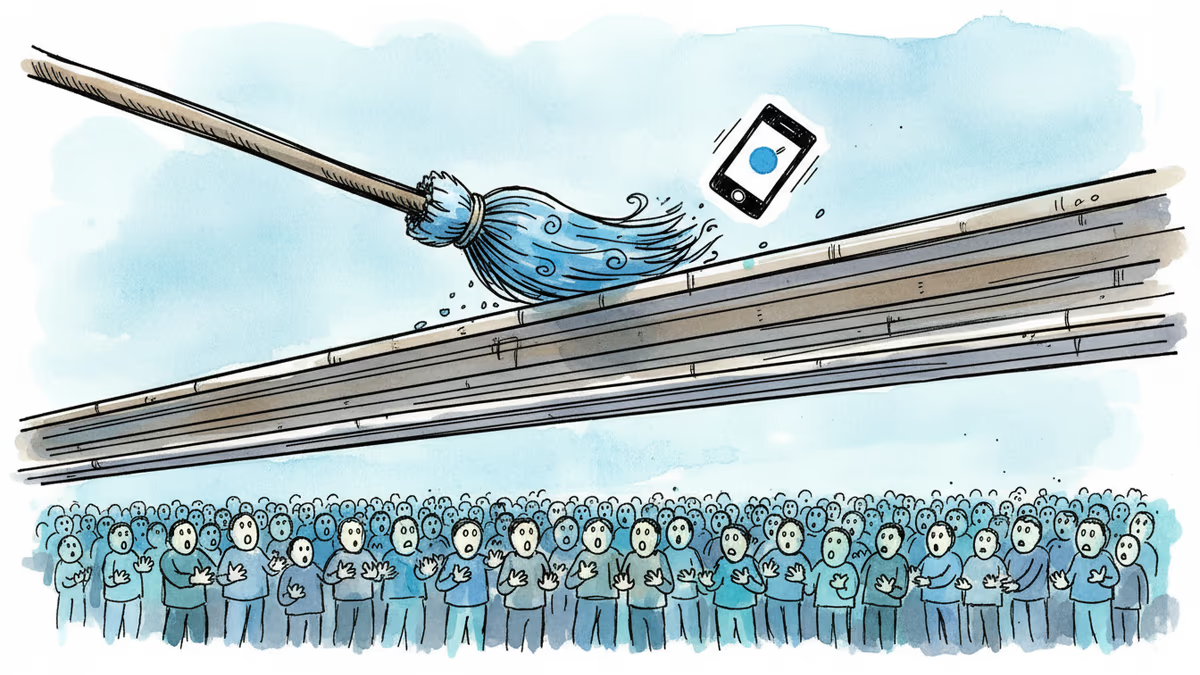
Major sci-fi and pop culture organizations ban AI-generated content, revealing deeper tensions about creativity, authenticity, and the future of human expression in the digital age.
When the Science Fiction and Fantasy Writers Association (SFWA) first announced its updated Nebula Awards rules in December, requiring authors to disclose any use of large language models, the backlash was swift and brutal. Within days, the organization issued a rare public apology and completely reversed course, now banning any work "written, either wholly or partially" by AI tools.
This wasn't just a policy hiccup—it was a glimpse into a cultural war brewing across creative communities.
The Great AI Purge Begins
The SFWA controversy unfolded like a cautionary tale about navigating uncharted territory. The initial compromise—allowing AI-assisted work with disclosure—seemed reasonable on paper. Let the voters decide, they thought. But members saw it differently: any opening for AI was too much.
San Diego Comic-Con faced a similar reckoning when artists discovered that AI-generated art could be displayed (though not sold) at the convention's art show. The rules had quietly allowed this for "a few years," according to art show head Glen Wooten, serving as a deterrent since no one had actually submitted AI art. But as the issue became "more of a problem," Comic-Con switched to absolute prohibition: "NO! Plain and simple."
Bandcamp, the beloved music platform, joined the movement by banning generative AI entirely—a decision that resonated deeply with independent musicians who view the platform as a sanctuary for authentic artistry.
Why Now? The Urgency Behind the Bans
These organizations aren't just reacting to hypothetical threats. They're responding to what critic Jason Sanford calls AI being "forced down everyone's throats by major corporations." The technology has become ubiquitous—embedded in search engines, word processors, and research tools—making it increasingly difficult to avoid entirely.

This ubiquity creates a paradox that Sanford highlighted: "If you use any online search engines or computer products these days, it's likely you're using something powered by or connected with an LLM." How do you ban AI assistance when it's woven into the basic tools of modern life?
The timing matters because these communities see themselves at a crossroads. Accept AI integration now, and risk normalizing what many consider theft of human creativity. Resist now, while they still can, and preserve spaces for purely human expression.
The Authenticity Question
For many artists and writers, this isn't primarily about economics—it's about the essence of creativity itself. Sanford's rejection of AI tools stems from his belief that "the tools are not actually creative and defeat the entire point of storytelling."
This philosophical stance reflects a deeper anxiety: if machines can generate stories, art, and music, what makes human creativity special? The bans represent an attempt to preserve not just jobs, but meaning—the irreplaceable value of human experience, struggle, and imagination in creative work.
Yet the boundaries remain murky. SFWA's struggle to define "LLM usage" reveals how complex these distinctions become. Is using AI-powered grammar checking acceptable? What about research tools that summarize sources? Where does assistance end and creation begin?
A Cultural Divide Emerges
These bans expose a fundamental split in how different communities view technological progress. While Silicon Valley celebrates AI as a democratizing force that makes creativity accessible to everyone, established creative communities see it as an existential threat to their craft and livelihood.
The resistance also reflects different cultural values around authenticity and effort. In communities that prize the struggle of creation—the years spent honing craft, the personal investment in each work—AI shortcuts feel like cheating, regardless of the output quality.
Meanwhile, younger creators and tech enthusiasts argue that these bans represent gatekeeping, preventing innovative hybrid approaches that could expand creative possibilities rather than replace human artists.
Authors
Related Articles
SpaceX's IPO filing puts AI at the center, claiming a $26.5 trillion market opportunity. But can Grok compete with OpenAI and Anthropic for enterprise customers?
AI is everywhere now—but is it helping or hurting? MIT Technology Review diagnoses a new mood: not excitement, not panic, just a creeping, uncomfortable uncertainty.
Suno's AI music platform claims to block copyrighted content, but researchers found its filters can be bypassed with minimal effort and free tools, generating near-identical imitations of Beyoncé, Black Sabbath, and more.
A federal judge dismissed Musi's lawsuit against Apple with prejudice after the free music app was pulled from the App Store. What does it mean for developers, users, and platform power?
SpaceX's IPO filing puts AI at the center, claiming a $26.5 trillion market opportunity. But can Grok compete with OpenAI and Anthropic for enterprise customers?
AI is everywhere now—but is it helping or hurting? MIT Technology Review diagnoses a new mood: not excitement, not panic, just a creeping, uncomfortable uncertainty.
Suno's AI music platform claims to block copyrighted content, but researchers found its filters can be bypassed with minimal effort and free tools, generating near-identical imitations of Beyoncé, Black Sabbath, and more.
A federal judge dismissed Musi's lawsuit against Apple with prejudice after the free music app was pulled from the App Store. What does it mean for developers, users, and platform power?
Thoughts
Share your thoughts on this article
Sign in to join the conversation