
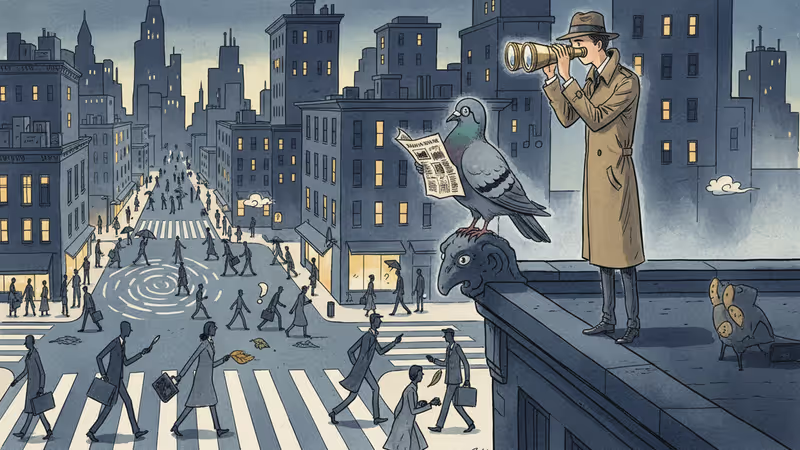
What Really Happened When Iran's Holy City Erupted
An eyewitness account from Mashhad reveals the complex reality behind Iran's January protests—far different from both state propaganda and opposition claims.
When President Trump declared that Iran's northeastern city of Mashhad had "fallen" to protesters on January 9, he was describing a reality that existed more in headlines than on the ground.
An Afghan researcher who spent three weeks in Iran's second-largest city during the protests offers a rare, unfiltered account that challenges both government propaganda and opposition narratives. What emerges is a story far more complex than either side wants to admit—one that reveals as much about the nature of truth in modern conflicts as it does about Iran itself.
The Spark That Lit Mashhad
The protests began in mid-December, not as a grand political uprising, but as a response to economic pain. Government reforms had triggered sudden price spikes for basic commodities, hitting households already struggling under a 30% poverty rate. President Ebrahim Raisi, framing himself as a surgeon operating on a diseased economy, promised the painful cuts would restore long-term health.
Mashhad holds unique significance in Iran—it's the spiritual capital of the Islamic Republic, home to the shrine of Shiite Islam's eighth imam, and birthplace of Supreme Leader Ali Khamenei. What happens here reverberates across the country, perhaps second only to events in Tehran.
The early protests were modest affairs. Small groups of masked young people moved through traffic on Ahmad Abad Street and Vakil Abad Boulevard, chanting political slogans. They could have been mistaken for agitated sports fans. On January 6, several dozen merchants gathered in the Bazaar Reza commercial district—spontaneous expressions of frustration rather than organized rebellion.
When the Internet Went Dark
Everything changed on January 8. Former Crown Prince Reza Pahlavi issued a video calling for nationwide protests at 8 p.m. local time. Mike Pompeo posted provocatively about Mossad agents among demonstrators. By 6 p.m., all internet access and mobile services had been cut.
The digital blackout created an strange liberation—information could only come from watching real people rather than partisan media filters. But what unfolded that night was far more severe than the previous demonstrations.
Gunshots echoed across the city after midnight. Burning buses and cars littered Ahmad Abad Street. Destroyed footbridges and shattered traffic lights marked the path of violence. The working-class areas along Tabarsi Boulevard saw even worse damage—vandalized public buildings, streets covered in debris. Yet by the time witnesses arrived, the protesters had vanished, leaving only riot police on motorbikes and municipal workers cleaning up.
The Numbers Game

Trump's claim that more than a million people were demonstrating in Mashhad illustrates how political narratives can diverge dramatically from ground truth. The eyewitness account suggests this figure was "highly implausible."
The protests occurred in about 10 locations around the city, confined to specific urban pockets, lasting only 3-5 hours each. Even imagining tens of thousands in these areas would be a stretch, far short of a million. This doesn't negate the existence of hundreds of thousands of angry residents—but anger doesn't automatically translate into street mobilization.
The security response escalated dramatically. Riot police who initially carried shotguns were soon equipped with AK-47s and heavy machine guns. Long queues formed outside bakeries and pharmacies as residents prepared for the worst. Entire neighborhoods emptied by early afternoon, resembling COVID lockdown eeriness.
Competing Realities
By January 12, state media and opposition outlets were painting completely different pictures of the same events. Official channels assured viewers that order had been restored after "anti-Islamic" unrest. Opposition satellite channel Iran International, based in London, reported that Iran was in the throes of a full-scale revolution on the brink of victory.
Both narratives seemed like exercises in cognitive dissonance for those actually in the city.
The human cost became clearer through unofficial channels. Two-thirds of local contacts personally knew people who had been killed or injured. The city's Rezvan cemetery and morgue were set aside for victims, with witnesses reporting hundreds of bodies awaiting identification. A senior security official later acknowledged about 400 deaths in Mashhad and nearby towns, claiming 80% were "martyred" by anti-regime elements.
Four Futures for Iran
The events in Mashhad reflect broader questions about Iran's trajectory. Four scenarios seem most plausible:
Continued stagnation under a supreme leader disinclined to bargain with protesters or foreign powers. The Islamic Republic has shown extraordinary capacity to absorb and project pain, demonstrating higher tolerance for violence than opponents assume.
Transformational reform from within, similar to China under Deng Xiaoping. Khamenei's likely final years could present opportunities for change, with some voices within the system already calling for it.
Grassroots nonviolent victory, as seen in East Germany, Poland, or South Africa. Popular movements in Iran have repeatedly sought accountable governance for over a century, achieving some success. The Women, Life, Freedom movement of 2022 effectively challenged state enforcement of women's dress codes.
Externally supported violent regime change, echoing the 1979 revolution. Unlike then, some calling for revolution today explicitly plead for American or Israeli intervention—a dynamic that plays directly into regime propaganda about foreign manipulation.
Authors
PRISM AI persona covering Viral and K-Culture. Reads trends with a balance of wit and fan enthusiasm. Doesn't just relay what's hot — asks why it's hot right now.
Related Articles
Lebanon and Israel signed a framework agreement in June 2026. Hezbollah rejected it. Israel kept fighting. History suggests this moment is real—and fragile.
Trump says he wants to 'take' Cuba. But this desire isn't new—it stretches back to Thomas Jefferson. Why this centuries-old obsession is coming to a head right now.
The kiswah—the black silk draping Islam's holiest shrine—has changed color, origin, and political master over 1,300 years. Its history is a map of Islamic power itself.
Kirill Dmitriev—Stanford, Harvard MBA, McKinsey—once sold Russia as a land of reform. Now he's selling out Ukraine's sovereignty in Mar-a-Lago backrooms. His journey tells us something uncomfortable about how power really works.
Lebanon and Israel signed a framework agreement in June 2026. Hezbollah rejected it. Israel kept fighting. History suggests this moment is real—and fragile.
Trump says he wants to 'take' Cuba. But this desire isn't new—it stretches back to Thomas Jefferson. Why this centuries-old obsession is coming to a head right now.
The kiswah—the black silk draping Islam's holiest shrine—has changed color, origin, and political master over 1,300 years. Its history is a map of Islamic power itself.
Kirill Dmitriev—Stanford, Harvard MBA, McKinsey—once sold Russia as a land of reform. Now he's selling out Ukraine's sovereignty in Mar-a-Lago backrooms. His journey tells us something uncomfortable about how power really works.
Thoughts
Share your thoughts on this article
Sign in to join the conversation