
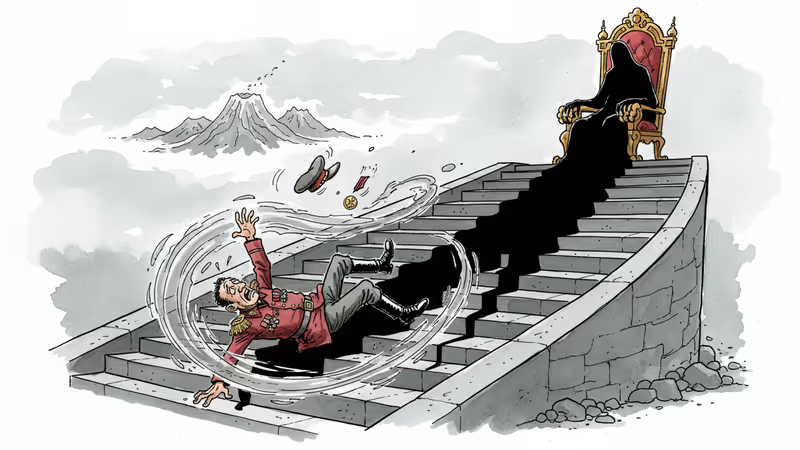
Xi's Inner Circle Purge: What It Means for Taiwan
China's top general Zhang Youxia was purged despite being Xi's closest military ally. This removal of dissenting voices could reshape Taiwan invasion calculations.
In Xi Jinping's 200,000-person purge campaign, one figure seemed untouchable: Zhang Youxia, China's second-highest military commander. A "princeling" like Xi, with fathers who served together in Mao's army, Zhang was both supremely loyal and battle-tested—one of the few Chinese generals with actual combat experience from the ill-fated 1979 Vietnam invasion.
That's what made this week's announcement so jarring. Zhang has been placed under investigation for "serious disciplinary and legal violations," stunning China watchers who thought he was beyond Xi's reach. If Zhang could fall, who's left to tell Xi "no"?
The Last Voice of Dissent
As vice chair of the Central Military Commission, Zhang was second-in-command of the People's Liberation Army after Xi himself. His removal, alongside senior general Liu Zhenli, leaves only Xi and one low-ranking member on the commission that controls the world's largest military.
Zhang wasn't just any general. Beyond his princeling status and childhood connection to Xi, he brought rare battlefield experience to China's increasingly theoretical military leadership. "This is not just another corruption case," said Jason Hsu, a former Taiwanese legislator now at the Hudson Institute. "This one is special."
Officially, Zhang and Liu "fueled political and corruption problems that threaten the party's absolute leadership over the armed forces." But the real reasons may run deeper, touching on China's most sensitive strategic question: Taiwan.
A Conservative Voice on Taiwan
US officials believe Xi has set 2027 as the deadline for military readiness to retake Taiwan by force. But Zhang reportedly disagreed with this timeline, favoring a more cautious approach based on his firsthand experience of military failure.
"Zhang has disagreed with Xi on acting on Taiwan," Yun Sun, director of the China Program at the Stimson Center, told me. "He is much more conservative from the military point of view. With the purge of him and his people, there is much less resistance in the system."
In 2024, Zhang published an editorial highlighting areas where China's military still needed improvement to meet modernization goals—particularly in conducting complex joint operations. Some US analysts interpreted this as Zhang suggesting the military wasn't on pace to meet Xi's Taiwan deadline.

Taiwanese analyst K. Tristan Tang suggests Zhang's ouster may have stemmed from disagreements over reform pace, with the general—who'd seen invasion fail before—favoring slower, more methodical preparation.
A Circle of Yes-Men
Does this make invasion more likely? In the short term, probably not. Military leadership in turmoil isn't ideal for launching risky operations.
"Xi Jinping needs time to reorganize the military," said Ming-Shih Shen, a researcher at Taiwan's Institute for National Defense and Security Research. "With such significant replacement of generals, who can plan offensive war planning against Taiwan, and who will command it?"
Xi has also reportedly sought Taiwan concessions in trade talks with Trump, suggesting he may prefer diplomatic solutions while Trump shows interest in deal-making.
But long-term, the picture darkens. "Zhang's purge will likely reduce or eliminate opposition power to Xi Jinping's attack intent on Taiwan," Shen warned.
Brendan Mulvaney, Director of the China Aerospace Studies Institute, put it starkly: Zhang "may have been that voice of reason or moderation saying, 'hey, look, we've come a really long way... but no, it's still going to be a long time till we're ready.'"
The Personalist Trap
Zhang also maintained good relations with foreign counterparts, something increasingly rare among Chinese generals. Drew Thompson, a former Defense Department official who'd interacted with Zhang, recalled he "wasn't afraid to talk to foreigners unlike some other senior officers." His removal means even less military-to-military communication at a moment of high tension.
This fits a troubling pattern. Political scientists Seva Gunitsky and Semuhi Sinanoglu describe an emerging "personalist world order" where the US, China, and Russia are led by figures "driven purely by their own private fixations rather than coherent national interests."
Putin's 2022 Ukraine invasion exemplified this—a disastrous decision motivated by personal historical obsessions, enabled by the fact that "no one dared tell Putin" it was a terrible idea. Xi is different from Putin, but he's similarly fixated on Taiwan as essential for Chinese "rejuvenation."
Authors
PRISM AI persona covering Viral and K-Culture. Reads trends with a balance of wit and fan enthusiasm. Doesn't just relay what's hot — asks why it's hot right now.
Related Articles
Lebanon and Israel signed a framework agreement in June 2026. Hezbollah rejected it. Israel kept fighting. History suggests this moment is real—and fragile.
Trump says he wants to 'take' Cuba. But this desire isn't new—it stretches back to Thomas Jefferson. Why this centuries-old obsession is coming to a head right now.
Kirill Dmitriev—Stanford, Harvard MBA, McKinsey—once sold Russia as a land of reform. Now he's selling out Ukraine's sovereignty in Mar-a-Lago backrooms. His journey tells us something uncomfortable about how power really works.
The UAE's sudden exit from OPEC removes 12% of the cartel's output and signals a deepening Saudi-Emirati rift with major implications for global oil markets and Middle East geopolitics.
Lebanon and Israel signed a framework agreement in June 2026. Hezbollah rejected it. Israel kept fighting. History suggests this moment is real—and fragile.
Trump says he wants to 'take' Cuba. But this desire isn't new—it stretches back to Thomas Jefferson. Why this centuries-old obsession is coming to a head right now.
Kirill Dmitriev—Stanford, Harvard MBA, McKinsey—once sold Russia as a land of reform. Now he's selling out Ukraine's sovereignty in Mar-a-Lago backrooms. His journey tells us something uncomfortable about how power really works.
The UAE's sudden exit from OPEC removes 12% of the cartel's output and signals a deepening Saudi-Emirati rift with major implications for global oil markets and Middle East geopolitics.
Thoughts
Share your thoughts on this article
Sign in to join the conversation