
Saudi Government Ordered to Pay $4.1M for Pegasus Spyware Hacking
London High Court awards Saudi satirist damages after finding compelling evidence of government-grade spyware attack. The ruling challenges state immunity and exposes the reality of transnational digital surveillance.
$4.1 million. That's what a London court ordered Saudi Arabia to pay a comedian whose phone was hacked with military-grade spyware. But this isn't just about money—it's the first time a court has officially recognized that governments can't hide behind sovereignty when they digitally stalk critics across borders.
When Comedy Becomes a National Security Threat
Ghanem Al-Masarir wasn't your typical target for government surveillance. The London-based Saudi satirist built a YouTube empire mocking his home country's leadership, earning millions of views with his political comedy. But in 2018, his iPhone became patient zero in what the court called a state-sponsored digital assault.
The weapon? Pegasus spyware, developed by Israel's NSO Group and sold exclusively to governments. This isn't your garden-variety malware—Pegasus can turn any smartphone into a complete surveillance device, accessing calls, messages, location data, cameras, and microphones without the owner ever knowing. Al-Masarir was also physically attacked in London around the same time, which he claimed was orchestrated by agents working for Saudi Crown Prince Mohammad bin Salman.
Justice Pushpinder Saini found "compelling evidence" that Al-Masarir's phones were hacked by Pegasus, and that the attack was "directed or authorized" by the Saudi government. The judge also concluded the Saudi government was likely behind the physical assault—a chilling reminder that digital surveillance often comes with real-world consequences.
The Cracking of State Immunity
Saudi Arabia tried its usual playbook: claiming state immunity from prosecution. This defense had worked before, notably in the case involving Jamal Khashoggi's murder, where Saudi leadership successfully avoided legal consequences in foreign courts. But this time was different.
The London High Court rejected Saudi's immunity claim outright. Faced with the prospect of actually defending their actions in court, the Kingdom simply walked away, refusing to participate in the proceedings. This legal precedent is significant—it suggests that cyber attacks, even when conducted by foreign governments, can pierce the traditional shield of state sovereignty.

The ruling establishes a new framework for accountability in the digital age. If a government uses commercial spyware to target individuals in other countries, they can be held legally and financially responsible. For activists, journalists, and dissidents worldwide, this offers a potential path to justice that didn't exist before.
The True Cost of Digital Silencing
The £3 million award reflects more than just compensation—it acknowledges the profound impact of digital surveillance on human lives. Al-Masarir stopped making videos after the attack, ending a career that had reached millions. He suffered severe depression, demonstrating how cyber attacks can be just as devastating as physical violence.
This case reveals the sophisticated ecosystem of modern authoritarianism. NSO Group provides the technology, claiming it's for fighting terrorism and serious crime. Governments buy access, often targeting not terrorists but critics, journalists, and human rights defenders. The victims suffer in silence, often unaware they've been compromised until it's too late.
The Global Pegasus Problem
Pegasus isn't just Saudi Arabia's tool—it's been sold to dozens of governments worldwide. From Mexico to Hungary, from India to Rwanda, the spyware has been used to target opposition politicians, investigative journalists, and civil society leaders. The technology democratizes surveillance capabilities that were once limited to major intelligence agencies.
What makes this particularly troubling is the commercial nature of the surveillance. Unlike traditional espionage, which required significant state resources and expertise, companies like NSO Group have made advanced surveillance accessible to any government willing to pay. This has fundamentally altered the power dynamics between states and citizens.
Questions Without Easy Answers
Whether Saudi Arabia will actually pay the damages remains unclear. The Kingdom could appeal, drag out proceedings, or simply ignore the judgment. But the legal precedent is now established, and other victims of state-sponsored cyber attacks are likely watching closely.
The case also raises uncomfortable questions about the technology companies that enable this surveillance. NSO Group maintains that Pegasus is used for legitimate law enforcement purposes, but mounting evidence suggests widespread abuse. Should companies be held liable when their surveillance tools are misused? How can democratic societies balance security needs with privacy rights?
Authors
Related Articles
UK Visa Portal, a private immigration service mistaken for an official government site, has been exposing passport scans and selfies of over 100,000 applicants. The breach remains unpatched.
Okta CEO Todd McKinnon on why AI agents need identity management, the SaaSpocalypse threat, and why the kill switch might be the most important button in enterprise tech.
Iran and Israel are hacking civilian security cameras for military reconnaissance. How consumer surveillance devices became weapons of war.
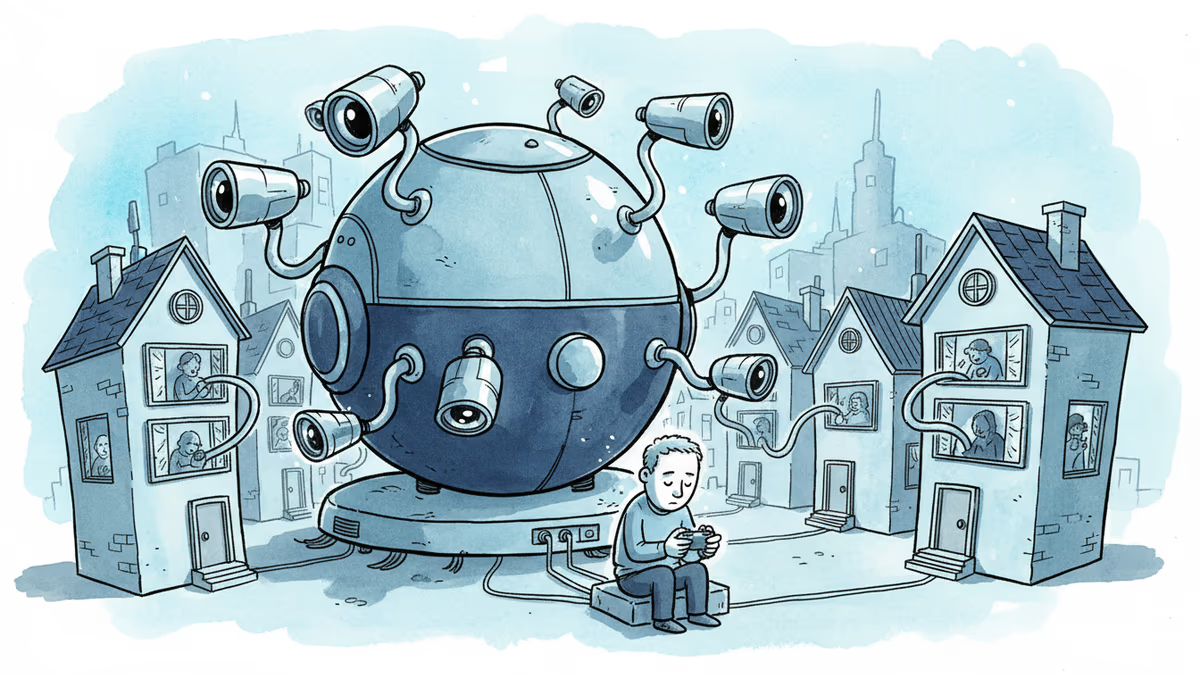
A security researcher discovered he could access 7,000 DJI robot vacuums and peek into strangers' homes. This Valentine's Day revelation exposes the hidden privacy risks of our smart home obsession.
UK Visa Portal, a private immigration service mistaken for an official government site, has been exposing passport scans and selfies of over 100,000 applicants. The breach remains unpatched.
Okta CEO Todd McKinnon on why AI agents need identity management, the SaaSpocalypse threat, and why the kill switch might be the most important button in enterprise tech.
Iran and Israel are hacking civilian security cameras for military reconnaissance. How consumer surveillance devices became weapons of war.
A security researcher discovered he could access 7,000 DJI robot vacuums and peek into strangers' homes. This Valentine's Day revelation exposes the hidden privacy risks of our smart home obsession.
Thoughts
Share your thoughts on this article
Sign in to join the conversation