

Einstein Desert Breakthrough: Gaia Telescope Finds Saturn-Sized Rogue Planet
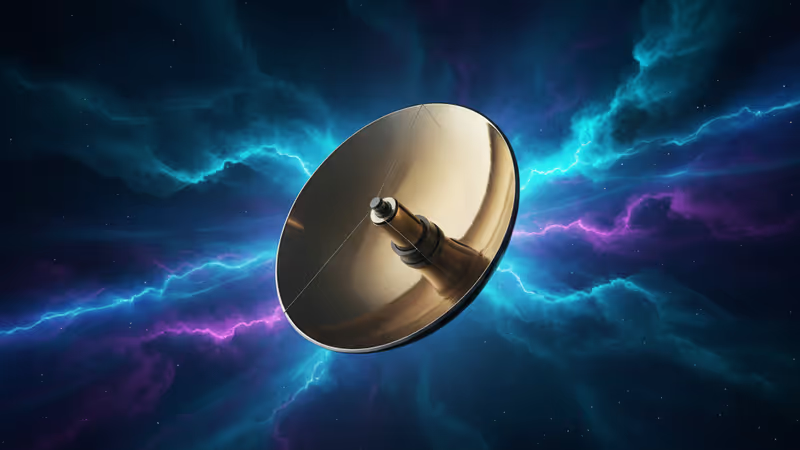
Gaia telescope discovers the first Saturn-sized rogue planet in the 'Einstein desert' via microlensing. This breakthrough offers new insights into the origin of starless worlds.
The cosmic void isn't as empty as we thought. Using the Gaia space telescope, researchers have detected a Saturn-sizedrogue planet wandering alone through interstellar space. It's a landmark discovery, marking the first time such an object has been found in the so-called Einstein desert, a region once considered a blind spot in our planetary census.
Microlensing Unlocks the Saturn-Sized Rogue Planet Secret
Most planets are anchored to a star, but rogue planets are the ultimate nomads. Since they don't orbit a sun, they don't emit or reflect light, making them nearly impossible to see. Scientists relied on a phenomenon called microlensing. This happens when a planet's gravity acts like a natural magnifying glass, bending and brightening the light of a distant star as it passes by.

The discovery in the Einstein desert is particularly significant. This specific area of parameter space was previously empty because the alignment required to catch a planet there is incredibly rare. Gaia's precise positioning and lucky timing made this Saturn-sized find possible.
Origins of the Orphan Worlds
Where do these orphans come from? There are two main theories. Some are born like stars, collapsing from clouds of gas and dust. Others are "exiled"—formed in solar systems but kicked out by the gravity of larger siblings. By finding planets in the Einstein desert, astronomers can better calculate which of these two paths is more common in our galaxy.
Authors
Related Articles

The third confirmed interstellar object, 3I/Atlas, carried up to four times the methanol of typical comets. What its strange chemistry tells us about the universe beyond our solar system.
Former Google CEO Eric Schmidt announces the Lazuli Space Observatory, a record-breaking 3.1-meter telescope funded entirely by private investment.

Samsung Electronics' union branch revealed that 84% of survey respondents oppose the government's roughly $290 billion (₩400 trillion) semiconductor megaproject in Gwangju. Government, management, the union and shareholders are all reading the same national project in sharply different ways.

Nvidia shipped roughly a billion RISC-V cores in 2024, then announced it would run CUDA on the open standard. We break down how royalty-free instruction sets and open software stacks are trying to route around CUDA's lock-in. Part 2 of the Semiconductor Sovereignty series.
The third confirmed interstellar object, 3I/Atlas, carried up to four times the methanol of typical comets. What its strange chemistry tells us about the universe beyond our solar system.
Former Google CEO Eric Schmidt announces the Lazuli Space Observatory, a record-breaking 3.1-meter telescope funded entirely by private investment.
Samsung Electronics' union branch revealed that 84% of survey respondents oppose the government's roughly $290 billion (₩400 trillion) semiconductor megaproject in Gwangju. Government, management, the union and shareholders are all reading the same national project in sharply different ways.
Nvidia shipped roughly a billion RISC-V cores in 2024, then announced it would run CUDA on the open standard. We break down how royalty-free instruction sets and open software stacks are trying to route around CUDA's lock-in. Part 2 of the Semiconductor Sovereignty series.
Thoughts
Share your thoughts on this article
Sign in to join the conversation