

Samsung's Galaxy XR Isn't Just a Flawed Headset—It's a Strategic Failure for Google's Next Big Bet
Samsung's Galaxy XR review reveals a deeper problem: Google's Android XR platform is a strategic failure, ceding the future of spatial computing to Apple.
The Bottom Line Up Front
The highly anticipated Samsung Galaxy XR, positioned as the Android ecosystem's answer to Apple's Vision Pro, has landed with a thud. But to dismiss this as merely a disappointing hardware launch is to miss the forest for the trees. The Galaxy XR's litany of software bugs, imprecise controls, and half-baked features isn't a Samsung problem; it's a damning early verdict on Google's entire "Android XR" platform. This clumsy debut doesn't just cede the premium spatial computing market to Apple—it fundamentally questions whether Google's classic open-ecosystem playbook can even compete in this new, intensely personal computing era.
Why It Matters: More Than Just a Buggy Gadget
For investors, developers, and tech strategists, the Galaxy XR's performance is a critical data point. It reveals a chasm between Apple's vertically integrated, polished-at-all-costs approach and the Google-Samsung alliance's attempt to replicate their smartphone success. The second-order effects are significant:
- The Developer Dilemma: Why would top-tier developers invest significant resources in a platform that can't even handle six Chrome tabs or a stable mouse cursor? This initial failure risks creating a developer confidence vacuum, leading to a barren app ecosystem—a death spiral for any new platform.
- The Narrative War is Lost (For Now): Apple has successfully defined the baseline for a premium mixed-reality experience: seamless, intuitive, and deeply integrated. At half the price, the Galaxy XR should have been the accessible alternative. Instead, its buggy nature reinforces the narrative that you get what you pay for, making the Vision Pro's $3,500 "integration tax" look justified.
- Competitive Opening: This stumble leaves a massive opening for Meta. With years of software refinement in the Quest platform, Meta can now position itself as the only viable, mature alternative to Apple's walled garden, sidelining the official Google-backed effort.

The Analysis: A Ghost in the New Machine
Hardware Promise, Platform Peril
Let's be clear: the hardware itself shows potential. The 4K micro-OLED displays are reportedly excellent, and the device is lighter than its Apple counterpart. These are not trivial achievements. However, they are completely undermined by the software layer. Reports of random app crashes, inconsistent gesture tracking that requires exaggerated movements, and a bizarrely literal Gemini assistant that recites its own internal commands expose a platform that is fundamentally unfinished. This isn't a device with a few launch-day bugs; it's a device whose core user experience is compromised, revealing a lack of deep integration between Samsung's hardware and Google's Android XR software.
The Android Playbook Falls Apart in Your Face
In the smartphone wars, Google's strategy was brilliant: create a good-enough, open-source OS, let hardware partners like Samsung innovate (and compete on price), and win through sheer volume. A few bugs or a clunky UI were acceptable trade-offs for choice and affordability. This strategy is proving toxic for spatial computing. When an interface is strapped to your face and directly mediated by your eyes and hands, the tolerance for friction is zero. A glitch isn't an annoyance; it's a reality-breaking, potentially nauseating experience. The Galaxy XR's reported flaws—from disappearing mouse cursors to unreliable eye-tracking—demonstrate that the "move fast and patch it later" ethos of mobile and web is a catastrophic liability in XR.
PRISM's Take
The launch of the Samsung Galaxy XR will be remembered not as a product debut, but as a strategic wake-up call for Google. It's a clear signal that the formula that conquered the mobile world is dangerously unsuited for the next frontier of computing. By shipping a product that feels more like a public beta, the Google-Samsung alliance has failed to present a credible challenge to Apple. More consequentially, they have damaged the brand of "Android XR" out of the gate, potentially alienating the very developers they need to build a thriving ecosystem. Unless Google fundamentally rethinks its approach to prioritize deep integration and flawless user experience over its traditional open-partner model, it risks being a permanent runner-up in a race it once seemed destined to co-lead.
Authors
Related Articles
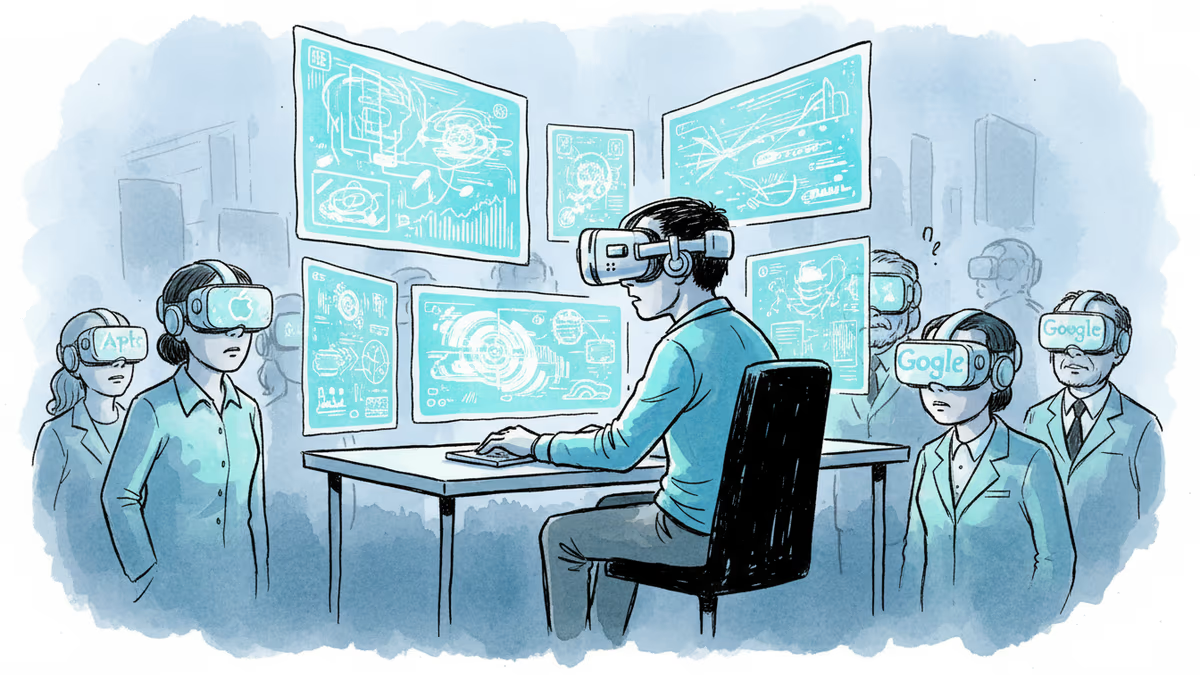
ByteDance's Pico unveils OS 6 and Project Swan to challenge Apple Vision Pro, but analysts question the timing in an increasingly crowded XR market.
YouTube's official Vision Pro app launches Thursday, ending a contentious two-year standoff. What does this mean for Apple's spatial computing ambitions?
Meta pauses its Horizon OS licensing, abandoning its 'Android for VR' strategy. This signals a major retreat from the open metaverse to a closed, Apple-style model.

Samsung Electronics' union branch revealed that 84% of survey respondents oppose the government's roughly $290 billion (₩400 trillion) semiconductor megaproject in Gwangju. Government, management, the union and shareholders are all reading the same national project in sharply different ways.
ByteDance's Pico unveils OS 6 and Project Swan to challenge Apple Vision Pro, but analysts question the timing in an increasingly crowded XR market.
YouTube's official Vision Pro app launches Thursday, ending a contentious two-year standoff. What does this mean for Apple's spatial computing ambitions?
Meta pauses its Horizon OS licensing, abandoning its 'Android for VR' strategy. This signals a major retreat from the open metaverse to a closed, Apple-style model.
Samsung Electronics' union branch revealed that 84% of survey respondents oppose the government's roughly $290 billion (₩400 trillion) semiconductor megaproject in Gwangju. Government, management, the union and shareholders are all reading the same national project in sharply different ways.
Thoughts
Share your thoughts on this article
Sign in to join the conversation