

Samsung's XR Gambit Fails: Why the Buggy Galaxy Headset Just Handed Apple the Future
Samsung's Galaxy XR headset was meant to challenge Apple's Vision Pro. Our analysis reveals why its buggy debut is a strategic failure for the entire Android ecosystem.
The Lede: A Strategic Failure, Not Just a Flawed Gadget
The first major salvo from the Google-Samsung alliance against the Apple Vision Pro has landed not with a bang, but with a series of software crashes, unsettling avatars, and a user experience so frustrating it serves as an expensive advertisement for Apple. The new Samsung Galaxy XR, priced at a hefty $1,800, was meant to be the Android ecosystem's powerful, more accessible answer to Apple's spatial computing ambitions. Instead, its deeply flawed debut reveals a hard truth: the 'move fast and break things' ethos that defined Android's mobile rise is dangerously unsuited for the intimate, high-stakes world of XR, ceding critical ground to Apple before the race has truly begun.
Why It Matters: The Second-Order Effects
For tech executives, investors, and developers, the Galaxy XR's shortcomings are more than just a bad review; they are a critical market signal. This launch was a litmus test for the viability of a multi-partner, Android-style ecosystem in the nascent spatial computing era. The initial results suggest this model is struggling badly.
- Validates Apple's Price Point: By releasing a buggy, uncomfortable product at $1,800, Samsung has inadvertently made the $3,500 Vision Pro look less like an extravagance and more like the price of admission for a truly polished experience. The reviewer's "newfound appreciation for the quality of Apple's mixed reality headset" says it all.
- Chills Developer Confidence: Developers considering which platform to build for now face a stark choice: Apple's stable, integrated (but closed) visionOS, or a fragmented Android XR ecosystem that, based on this initial evidence, is plagued by instability and a disjointed user experience.
- Resets Mainstream Adoption Clock: The hope was that a strong Samsung competitor would accelerate XR innovation and adoption. This stumble does the opposite, signaling to the market that a truly consumer-ready, high-end headset from anyone besides Apple is still years away.
The Analysis: A Familiar Story in a New Dimension

The Ghost of Android Past
We've seen this playbook before. In the late 2000s, the first Android phones were clunky, buggy alternatives to the iPhone, eventually winning on price and openness. Samsung and Google are attempting a similar strategy with XR, but they are critically misjudging the market. The tolerance for friction is near-zero for a device you strap to your face. While a smartphone app crashing is an annoyance, a spatial computing environment that causes physical discomfort, has imprecise controls, and breaks application workflows is a fundamental product failure. The bugs reported—from Chrome tabs crashing to a disappearing mouse cursor—are not minor glitches; they are deal-breakers that render the device unusable for its intended 'productivity' purpose.
Hardware Promise, Software Peril
The tragedy of the Galaxy XR is that its core hardware, particularly the sharp 4K micro-OLED displays, is reportedly excellent. The failure is squarely on the software and integration front—the very seams where multi-company collaborations are most likely to fray. The imprecise gesture controls, the unreliable iris unlock, and the bizarre, unfinished behavior of the integrated Gemini AI all point to a rushed product cycle and a lack of deep, unified polish. Apple's key advantage has always been its fanatical vertical integration of hardware, software, and services. The Galaxy XR is a case study in the opposite approach, where Samsung's hardware is let down by Google's unready Android XR platform.
The Unsettling 'Likeness' of an Unfinished Product
Perhaps nothing captures the product's half-baked nature more than the 'Likeness' avatar, Google's answer to Apple's Personas. Described as making the user look like they are "on drugs," with unnatural eyes and teeth, it’s a feature that should never have shipped in a consumer product. It transforms a professional video call into a bizarre, distracting experience. This isn't just a cosmetic flaw; it’s an erosion of trust. It tells the user that the companies behind this product are not respecting the intimacy and importance of digital human representation.
PRISM's Take
The Samsung Galaxy XR is not a serious competitor to the Apple Vision Pro. It is a cautionary tale. By rushing an unpolished, buggy, and uncomfortable device to market, Samsung and Google have done more to validate Apple's meticulous, high-cost strategy than any of Apple's own marketing could. They have demonstrated that creating a seamless spatial computer is monumentally difficult and that the software experience is paramount. This isn't just a loss for Samsung; it's a significant setback for the entire non-Apple XR ecosystem. The war for our virtual future is just beginning, but in this crucial opening battle, the Android alliance has fumbled, leaving the field wide open for Apple to define it.
This content is AI-generated based on source articles. While we strive for accuracy, errors may occur. We recommend verifying with the original source.
Related Articles
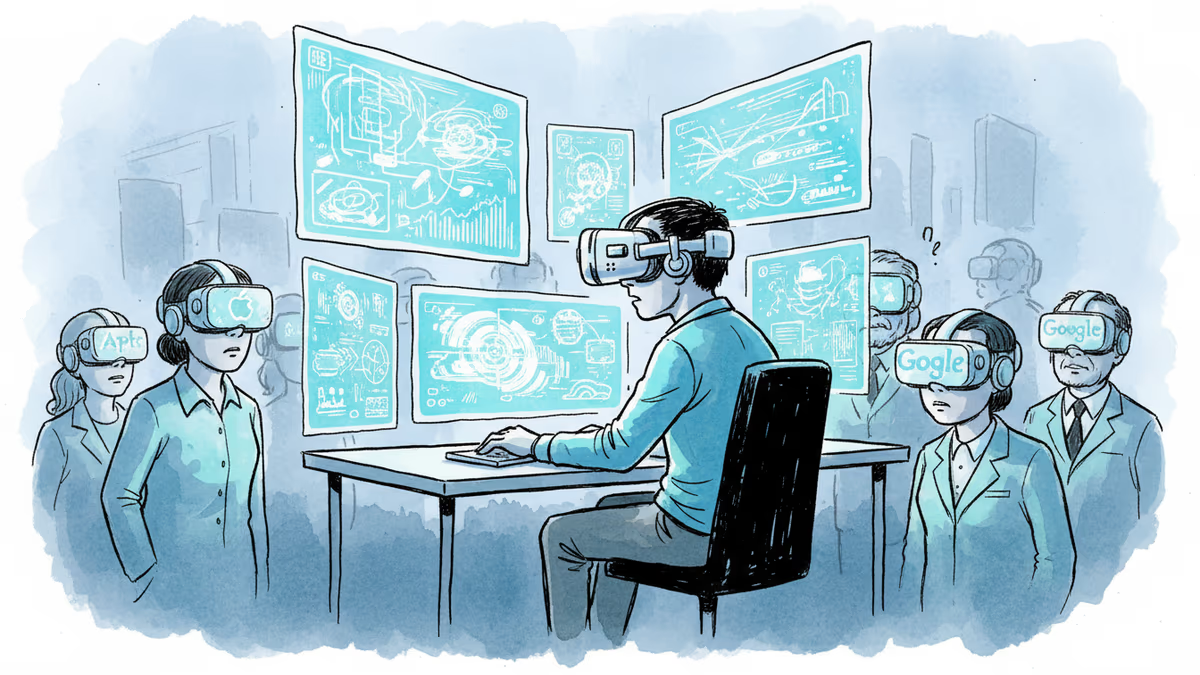
ByteDance's Pico unveils OS 6 and Project Swan to challenge Apple Vision Pro, but analysts question the timing in an increasingly crowded XR market.
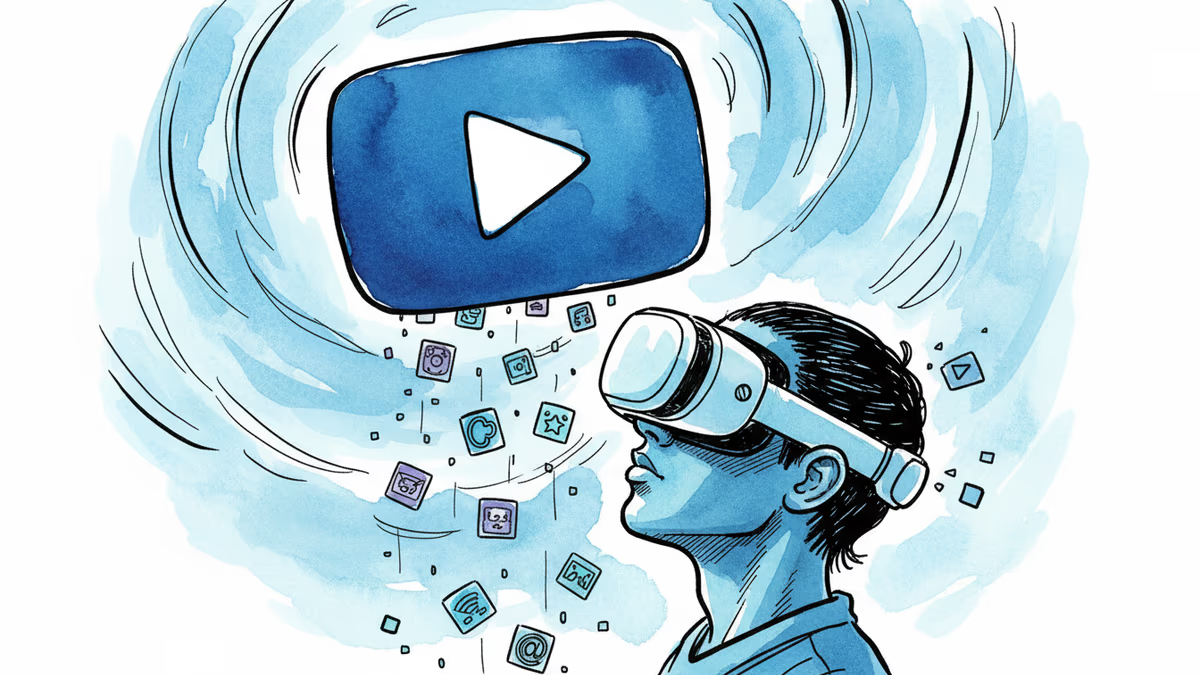
YouTube's official Vision Pro app launches Thursday, ending a contentious two-year standoff. What does this mean for Apple's spatial computing ambitions?
Meta pauses its Horizon OS licensing, abandoning its 'Android for VR' strategy. This signals a major retreat from the open metaverse to a closed, Apple-style model.

A Las Vegas VR attraction uses 'reality-bending' tech to solve the metaverse's biggest problems. PRISM analyzes why this is the key to mainstream adoption.
ByteDance's Pico unveils OS 6 and Project Swan to challenge Apple Vision Pro, but analysts question the timing in an increasingly crowded XR market.
YouTube's official Vision Pro app launches Thursday, ending a contentious two-year standoff. What does this mean for Apple's spatial computing ambitions?
Meta pauses its Horizon OS licensing, abandoning its 'Android for VR' strategy. This signals a major retreat from the open metaverse to a closed, Apple-style model.
A Las Vegas VR attraction uses 'reality-bending' tech to solve the metaverse's biggest problems. PRISM analyzes why this is the key to mainstream adoption.
Thoughts
Share your thoughts on this article
Sign in to join the conversation