
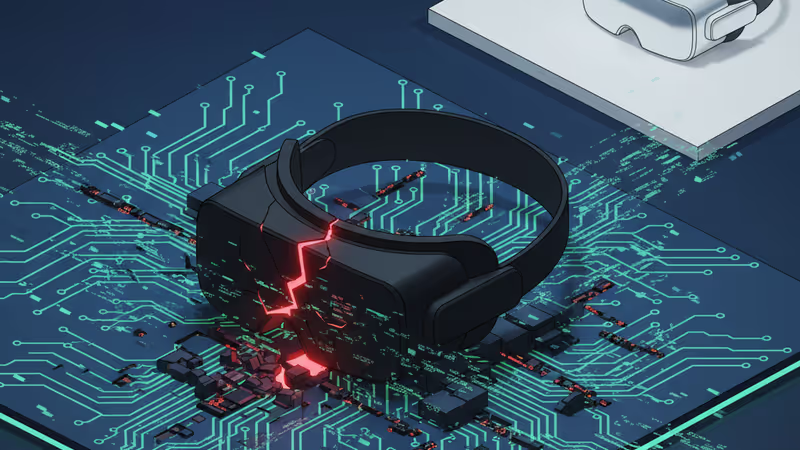
Samsung's Galaxy XR Isn't a Vision Pro Killer—It's a $1,800 Warning Sign for Google's Spatial Future
Samsung's $1,800 Galaxy XR is cheaper than Vision Pro, but our analysis reveals its deep software flaws are a major warning sign for Google's entire XR strategy.
The Lede: The High Cost of a Half-Baked Revolution
The first major battle in the spatial computing war has been fought, and the verdict is in. While Samsung's $1,800 Galaxy XR undercuts Apple's Vision Pro on price, it delivers a user experience so riddled with bugs, discomfort, and software failures that it does more than just disappoint early adopters—it exposes a fundamental flaw in the Google-Samsung strategy. This isn't just a flawed product; it's a strategic misfire that risks branding the entire Android XR ecosystem as the cheap, unreliable alternative from day one, potentially ceding the premium market to Apple for years to come.
Why It Matters: Déjà Vu in a New Dimension
For tech veterans, the Galaxy XR's launch feels eerily familiar. It mirrors the early days of the smartphone wars: Apple's expensive, polished, but closed iOS versus Google's open, affordable, but fragmented Android. While that playbook eventually led Android to global market dominance, the stakes are different in 2024. Spatial computing demands a level of immersion and reliability that a buggy experience shatters instantly. A crashing app or a disappearing cursor isn't a minor annoyance; it breaks the entire reality the device is trying to create. The key second-order effect isn't just a bad review, but the poisoning of the well for developers. Why would top-tier developers invest in creating premium experiences for a platform that can't even get its core functions—like gesture control or its own AI assistant—to work reliably?
The Analysis: The Anatomy of a Strategic Failure
A Familiar Playbook: Openness vs. Polish

The core value proposition of Android XR, as seen in the Galaxy XR, is its openness—access to the vast library of existing Android apps. Yet, this has become a liability. The source review highlights that most apps, like Slack, are simply not optimized for a spatial interface, creating a jarring and inconsistent experience. This is a classic Android problem: quantity over quality. While Apple curates a smaller, but purpose-built, visionOS app store, the Galaxy XR offers a sea of apps that weren't designed for the medium. The result is a powerful device running software that constantly reminds you of its limitations.
The $1,700 "Polish Gap"
The most damning indictment of the Galaxy XR isn't a missing feature, but the sheer volume of basic experience failures. From imprecise eye-tracking to poor ergonomics and a bizarrely broken Gemini AI integration that reveals its internal programming prompts to the user, the device feels less like a finished product and more like a public beta test. The Vision Pro costs a staggering $1,700 more, and this analysis makes it clear where that money went: into the seamless integration of hardware and software. Samsung and Google are asking a premium price for a demonstrably non-premium experience. In a nascent category, user experience isn't just a feature; it's everything. The "polish gap" is currently a chasm.
Ecosystem Promises, Hardware Realities
Features like PC Connect and Game Link promise to bridge the gap between devices and create a seamless ecosystem. In practice, they are unreliable and buggy, with the reviewer unable to even get the SteamVR integration to function. This failure to deliver on core ecosystem promises undermines the entire argument for an open platform. Apple's 'Mac Virtual Display' works because of its tight vertical integration. Google and Samsung are attempting to replicate this across a fragmented landscape of third-party hardware (PCs) and software (Windows, Steam), and the initial results are predictably messy. It shows that in spatial computing, the connective tissue of the ecosystem is just as important as the headset itself.
PRISM's Take
The Samsung Galaxy XR is a cautionary tale written in buggy code and poor ergonomics. It demonstrates that in the deeply personal and immersive world of spatial computing, a 'good enough' approach is a recipe for failure. By shipping a device that feels fundamentally unfinished, Samsung and Google have not merely launched a weak competitor; they have inadvertently validated Apple's painstaking, expensive, and vertically integrated strategy. They have shown the world that building the future of computing is not about being first or cheapest—it's about being seamless. The price tag on the Galaxy XR is $1,800, but the long-term cost to the credibility of the Android XR ecosystem could prove to be far higher.
This content is AI-generated based on source articles. While we strive for accuracy, errors may occur. We recommend verifying with the original source.
Related Articles
ByteDance's Pico unveils OS 6 and Project Swan to challenge Apple Vision Pro, but analysts question the timing in an increasingly crowded XR market.
YouTube's official Vision Pro app launches Thursday, ending a contentious two-year standoff. What does this mean for Apple's spatial computing ambitions?
Meta pauses its Horizon OS licensing, abandoning its 'Android for VR' strategy. This signals a major retreat from the open metaverse to a closed, Apple-style model.
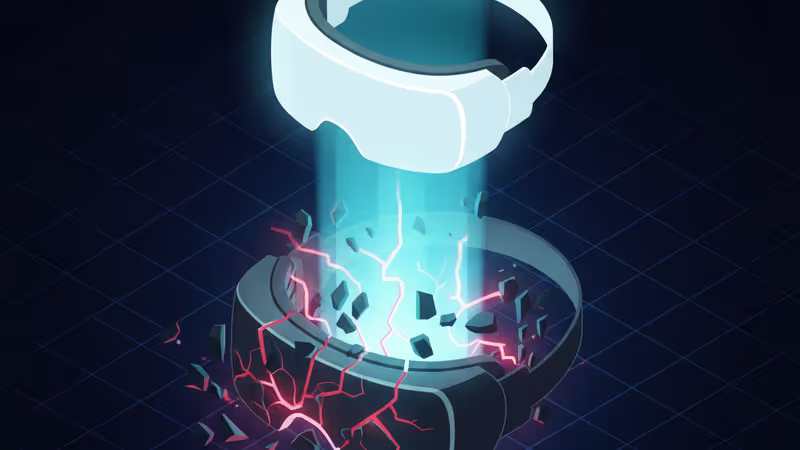
Samsung's Galaxy XR headset was meant to challenge Apple's Vision Pro. Our analysis reveals why its buggy debut is a strategic failure for the entire Android ecosystem.
ByteDance's Pico unveils OS 6 and Project Swan to challenge Apple Vision Pro, but analysts question the timing in an increasingly crowded XR market.
YouTube's official Vision Pro app launches Thursday, ending a contentious two-year standoff. What does this mean for Apple's spatial computing ambitions?
Meta pauses its Horizon OS licensing, abandoning its 'Android for VR' strategy. This signals a major retreat from the open metaverse to a closed, Apple-style model.
Samsung's Galaxy XR headset was meant to challenge Apple's Vision Pro. Our analysis reveals why its buggy debut is a strategic failure for the entire Android ecosystem.
Thoughts
Share your thoughts on this article
Sign in to join the conversation