
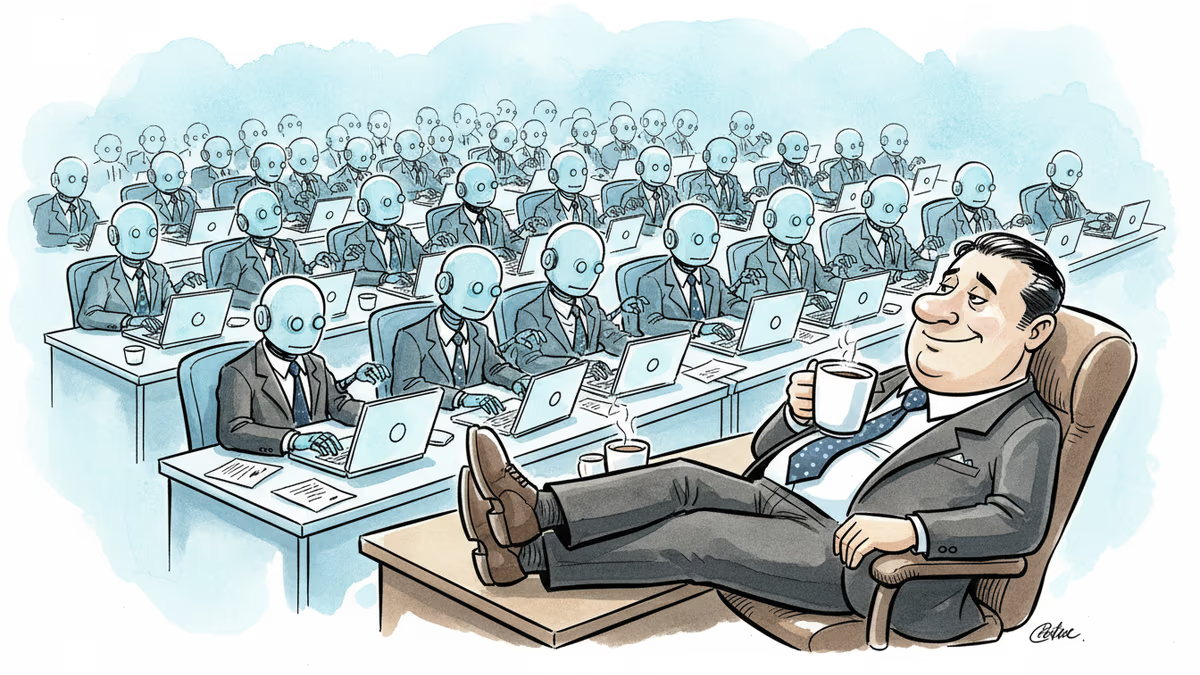
The $1.2B Bet That AI Can Replace Your Sales Team
Rox just hit a $1.2B valuation on $8M ARR. The AI sales agent startup thinks it can replace a dozen fragmented tools—and maybe a few salespeople. Here's what's actually at stake.
Somewhere in a San Francisco office, a sales team started their Monday without updating the CRM. The AI agent did it over the weekend.
That's the pitch from Rox—and apparently, it's worth $1.2 billion.
A Unicorn Built on $8M in Revenue
The numbers are striking. Rox, an AI sales agent startup founded in 2024, closed a new funding round last year at a $1.2 billion valuation, with General Catalyst returning as lead investor. At the time of the raise, the company was projected to finish 2025 with just $8 million in annual recurring revenue—implying a revenue multiple of roughly 150x.
That's not a typo. And it's not an anomaly in today's AI investment climate. It is, however, a signal worth examining.
Rox was founded by Ishan Mukherjee, the former Chief Growth Officer of New Relic, who joined the company after it acquired his software monitoring startup Pixie in 2020. His pitch is rooted in lived frustration: enterprise sales teams are drowning in fragmented tools—Salesforce, Zendesk, email platforms, call analytics—and spending more time managing software than actually selling.
Rox's answer is to deploy hundreds of AI agents that sit on top of a company's existing stack rather than replacing it. These agents monitor customer accounts for churn signals, research new prospects, and automatically update CRM records. Current customers include Ramp, MongoDB, and New Relic. GV investor Dave Munichiello described the product as agents that "work constantly behind the scenes to monitor customer activity, identify potential risks and opportunities, and even suggest the best course of action."
The company has now raised a total of $50 million, including a seed round led by Sequoia and a General Catalyst-led Series A with GV participation.

Why This Valuation Makes (Some) Sense
The 150x revenue multiple sounds absurd until you map the market Rox is targeting.
B2B sales software is one of the most fragmented, over-tooled categories in enterprise tech. The average sales rep juggles 10 or more platforms daily. CRM, sales engagement, revenue intelligence, conversation analytics—each sold separately, each requiring its own login, training, and maintenance budget. The promise of consolidation has been made before, but large language models have changed what consolidation can actually look like.
The competitive field is crowded and accelerating. Established players like Gong and Clari dominate revenue intelligence. AI-native SDR platforms like 11x and Artisan are attacking the top of the sales funnel. And last month, Monaco—a new AI-native CRM founded by Sam Blond, former president of Brex—emerged from stealth to take a swing at the whole stack.
Each of these companies is making a version of the same bet: that the next wave of enterprise software won't look like software at all. It'll look like a team of agents.
Three Ways to Read This
For enterprise buyers, the calculus is appealing but not without risk. Replacing fragmented tools with a single AI layer sounds efficient—until the AI hallucinates a prospect's budget, misreads a customer's churn signal, or auto-updates a CRM record with the wrong data. The cost of a bad sales call is real. Who's liable when the AI gets it wrong?
For investors, the Rox deal reflects a broader pattern: VCs are pricing in category dominance, not current revenue. The implicit assumption is that whoever wins the AI sales layer will be sticky, defensible, and enormously scalable. That may be true. It also may be that five well-funded competitors are making the same bet simultaneously.
For salespeople themselves, the framing matters. Rox and its peers consistently say AI agents will augment sales teams, not replace them—handling the administrative burden so humans can focus on relationships and judgment. That's a reasonable near-term description. But the trajectory is worth watching. If agents can monitor accounts, research prospects, draft outreach, and recommend next actions, the definition of what requires a human gets narrower with each product update.
Authors
Related Articles
A critical vulnerability in Starlette—downloaded 325 million times per week—puts millions of AI agent servers at risk, exposing stored credentials for email, databases, and third-party services.

A small but growing group of developers has gone all-in on AI coding agents like Claude Code and OpenClaw. History suggests the rest of us won't be far behind.

Lucra Sports CEO Dylan Robbins landed Cathie Wood's ARK Invest as a Series B lead without building AI. The story behind his unconventional fundraising playbook.

SolarSquare is raising $55-60M at a $450-500M valuation, more than doubling its worth in 18 months. Here's what's driving investor conviction in India's residential solar market.
A critical vulnerability in Starlette—downloaded 325 million times per week—puts millions of AI agent servers at risk, exposing stored credentials for email, databases, and third-party services.
A small but growing group of developers has gone all-in on AI coding agents like Claude Code and OpenClaw. History suggests the rest of us won't be far behind.
Lucra Sports CEO Dylan Robbins landed Cathie Wood's ARK Invest as a Series B lead without building AI. The story behind his unconventional fundraising playbook.
SolarSquare is raising $55-60M at a $450-500M valuation, more than doubling its worth in 18 months. Here's what's driving investor conviction in India's residential solar market.
Thoughts
Share your thoughts on this article
Sign in to join the conversation