

Russian GPS Interference Norway: Widerøe Flight Forced to Abort During Zapad-2025
Reports detail how a Widerøe Airlines flight faced Russian GPS interference in Norway during the Zapad-2025 military exercises, highlighting growing aviation risks.
A wall of invisible signals just forced a passenger jet to turn back. In September 2025, a Widerøe Airlines flight attempting to land in Vardø, Norway, suddenly lost its GPS guidance just 40 miles from the Russian border. With low visibility and a mountain-filled landscape, the pilots were blinded by electronic interference.
Russian GPS Interference Norway Aviation Risks
The outage wasn't a technical glitch; it was a side effect of geopolitics. The flight took off during Russia's Zapad-2025 war games, a massive military exercise simulating conflict with the West. European officials suspect Russian forces deployed signal-smashing technology—a tactic typically reserved for active combat—across the fjord from Vardø.

Navigational Warfare in the Arctic
Without space-based guidance, the plane couldn't safely navigate the cloudy approach. It was forced to divert to Båtsfjord, a fishing village further down the coast. While Russia has historically denied allegations of GPS interference, European authorities noted that jamming was frequent in the run-up to the exercise. This incident underscores how electronic warfare is increasingly bleeding into civilian infrastructure, turning routine travel into a high-stakes gamble.
Authors
Related Articles

Samsung Electronics' union branch revealed that 84% of survey respondents oppose the government's roughly $290 billion (₩400 trillion) semiconductor megaproject in Gwangju. Government, management, the union and shareholders are all reading the same national project in sharply different ways.
Nvidia shipped roughly a billion RISC-V cores in 2024, then announced it would run CUDA on the open standard. We break down how royalty-free instruction sets and open software stacks are trying to route around CUDA's lock-in. Part 2 of the Semiconductor Sovereignty series.
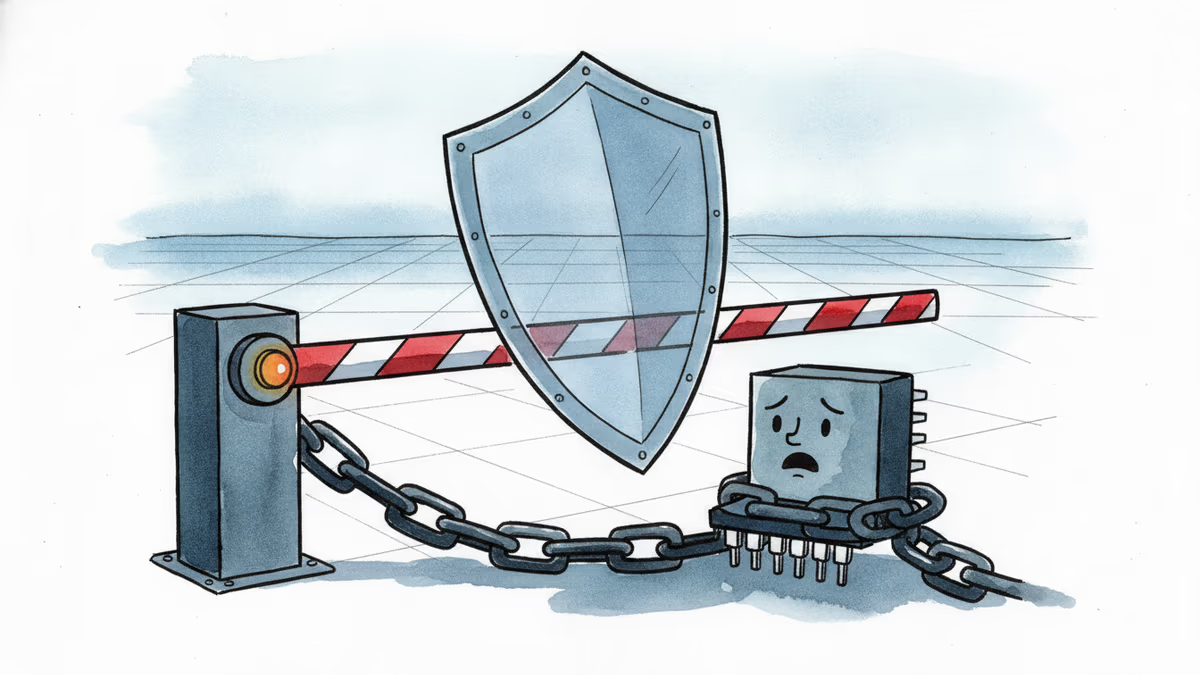
US AI-chip export controls split into three layers in the first half of 2026 — January easing, a May crackdown on circumvention, and a pending bill. Nvidia erased China from its guidance and still posted a record $81.6 billion quarter. A look at the export policy that both shields and cages it.

AMD's MI325X matches or beats Nvidia on memory and bandwidth — yet Nvidia's 86-92% share holds. The real moat is CUDA, 20 years in the making. Part 1 of 4.
Samsung Electronics' union branch revealed that 84% of survey respondents oppose the government's roughly $290 billion (₩400 trillion) semiconductor megaproject in Gwangju. Government, management, the union and shareholders are all reading the same national project in sharply different ways.
Nvidia shipped roughly a billion RISC-V cores in 2024, then announced it would run CUDA on the open standard. We break down how royalty-free instruction sets and open software stacks are trying to route around CUDA's lock-in. Part 2 of the Semiconductor Sovereignty series.
US AI-chip export controls split into three layers in the first half of 2026 — January easing, a May crackdown on circumvention, and a pending bill. Nvidia erased China from its guidance and still posted a record $81.6 billion quarter. A look at the export policy that both shields and cages it.
AMD's MI325X matches or beats Nvidia on memory and bandwidth — yet Nvidia's 86-92% share holds. The real moat is CUDA, 20 years in the making. Part 1 of 4.
Thoughts
Share your thoughts on this article
Sign in to join the conversation