
Ancient Humans, Not Glaciers, Hauled Stonehenge's Massive Stones
New chemical analysis reveals that Stonehenge's massive stones were deliberately transported by humans from Wales and Scotland, not moved by glaciers as previously thought.
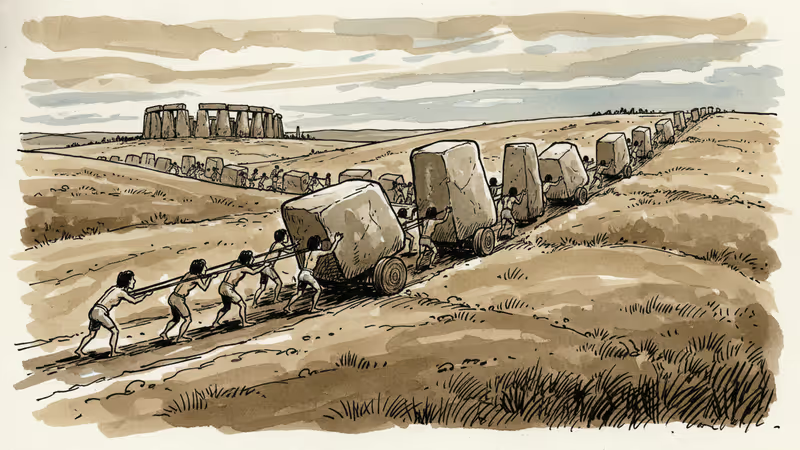
Imagine moving a 150-ton boulder across 240 kilometers of rough terrain using nothing but ropes, wooden rollers, and human muscle. That's exactly what our ancestors accomplished 5,000 years ago to build one of the world's most mysterious monuments.
The Glacier Theory Crumbles
For decades, scientists believed that Stonehenge's massive stones arrived at their current location courtesy of glacial transport during the last Ice Age. The theory seemed logical: enormous ice sheets could easily push giant boulders across the landscape, depositing them conveniently where ancient builders needed them.
But recent chemical analysis has shattered this comfortable explanation. The stones didn't just happen to be lying around Salisbury Plain. Instead, they were quarried from specific sites in Wales and northern Scotland, then deliberately transported across hundreds of miles of challenging terrain.
The evidence lies in the stones themselves. Chemical fingerprinting reveals precise matches with quarries far from Stonehenge, while the careful arrangement and processing marks on the stones point to intentional human engineering rather than random glacial dumping.
Engineering Marvel of the Stone Age
The logistics alone are staggering. The heaviest sarsen stones weigh up to 50 tons each, with some estimates reaching 150 tons. Even with modern cranes and trucks, moving such massive objects would be a complex undertaking. Yet Neolithic people accomplished this feat using only the materials and manpower available in 3000 BCE.

Archaeologists theorize that ancient engineers developed sophisticated transport systems involving wooden rollers, rope networks, and coordinated teams of hundreds of workers. But the exact methods remain tantalizingly unclear, leaving us to marvel at their ingenuity while scratching our heads at the how.
What's even more remarkable is that this wasn't just brute-force construction. Stonehenge demonstrates precise astronomical alignments and mathematical relationships that required advanced planning and scientific understanding.
Technology Unlocks Ancient Secrets
This breakthrough wouldn't have been possible without modern analytical techniques. Scientists can now examine the chemical composition of stones with extraordinary precision, creating unique "fingerprints" that reveal their geological origins. It's like CSI for archaeology, using 21st-century tools to solve 5,000-year-old mysteries.
The same technological revolution that's helping researchers hunt for Leonardo da Vinci's DNA in his artwork is transforming our understanding of prehistoric achievements. Each new analytical tool opens another window into the past, often revealing that our ancestors were far more capable than we previously imagined.
The Bigger Picture
This discovery joins a growing body of evidence that challenges our assumptions about prehistoric societies. From the Antikythera Mechanism's sophisticated gears to the precise engineering of the Egyptian pyramids, ancient civilizations repeatedly demonstrate capabilities that seem to exceed what we'd expect from their technological toolkit.
The Stonehenge revelation also raises questions about social organization in Neolithic Britain. Moving these stones required not just engineering know-how but also the ability to coordinate massive group efforts across vast distances and extended timeframes.
Authors
Related Articles
Archaeologists have discovered the world's oldest rock art in Indonesia, dated to 67,800 years ago. This hand stencil rewrites the history of human creativity and migration.
Samsung Electronics' union branch revealed that 84% of survey respondents oppose the government's roughly $290 billion (₩400 trillion) semiconductor megaproject in Gwangju. Government, management, the union and shareholders are all reading the same national project in sharply different ways.
Nvidia shipped roughly a billion RISC-V cores in 2024, then announced it would run CUDA on the open standard. We break down how royalty-free instruction sets and open software stacks are trying to route around CUDA's lock-in. Part 2 of the Semiconductor Sovereignty series.
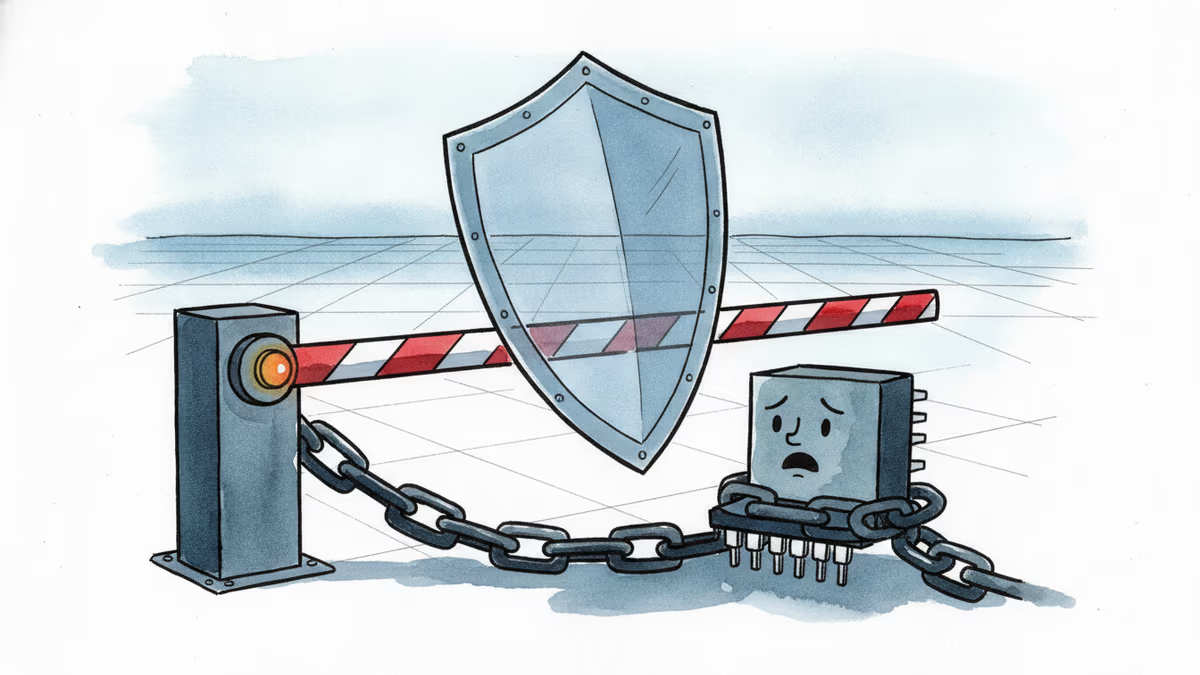
US AI-chip export controls split into three layers in the first half of 2026 — January easing, a May crackdown on circumvention, and a pending bill. Nvidia erased China from its guidance and still posted a record $81.6 billion quarter. A look at the export policy that both shields and cages it.
Archaeologists have discovered the world's oldest rock art in Indonesia, dated to 67,800 years ago. This hand stencil rewrites the history of human creativity and migration.
Samsung Electronics' union branch revealed that 84% of survey respondents oppose the government's roughly $290 billion (₩400 trillion) semiconductor megaproject in Gwangju. Government, management, the union and shareholders are all reading the same national project in sharply different ways.
Nvidia shipped roughly a billion RISC-V cores in 2024, then announced it would run CUDA on the open standard. We break down how royalty-free instruction sets and open software stacks are trying to route around CUDA's lock-in. Part 2 of the Semiconductor Sovereignty series.
US AI-chip export controls split into three layers in the first half of 2026 — January easing, a May crackdown on circumvention, and a pending bill. Nvidia erased China from its guidance and still posted a record $81.6 billion quarter. A look at the export policy that both shields and cages it.
Thoughts
1 thoughts
Share your thoughts on this article
Sign in to join the conversation