
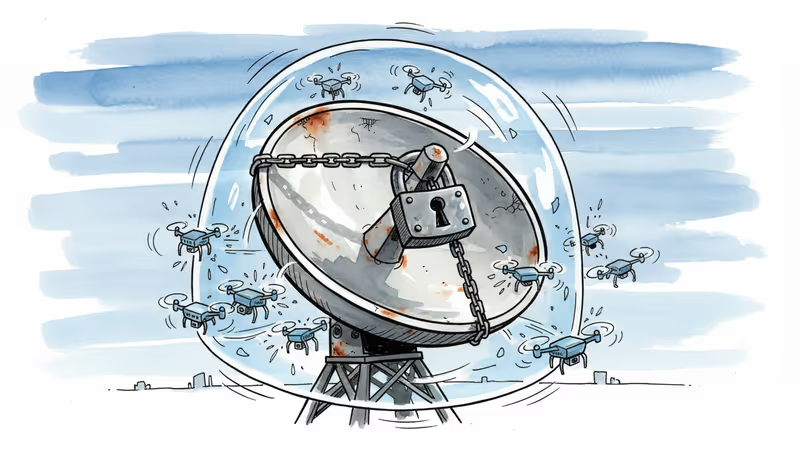
Why Starlink Just Introduced a Whitelist in a War Zone
Ukraine and SpaceX collaborate to stop Russian military from hijacking Starlink terminals for drone attacks. A terminal registration system reveals how satellite internet became a weapon of war.
When your enemy starts using your own internet against you, it's time to change the rules. Ukraine and SpaceX just announced they've caught Russian forces hijacking Starlink terminals to guide drone attacks—and they're fighting back with something that sounds mundane but isn't: a whitelist.
Russia Turned Starlink Into a Weapon
Ukraine's Ministry of Defense confirmed what many suspected but few could prove: Russian military units have been using unregistered Starlink terminals to coordinate drone strikes against Ukrainian targets. The revelation came alongside an announcement that Ukraine will soon require all Starlink users to register their terminals.
"Only verified and registered terminals will be allowed to operate in the country. All others will be disconnected," the ministry stated. Defense Minister Mykhailo Fedorov called it "a necessary step by the Government to save Ukrainian lives and protect critical energy infrastructure."
This isn't just a technical fix—it's a recognition that the internet itself has become a battlefield where your lifeline can be turned into your enemy's weapon.
Elon Musk's Nightmare Scenario
Starlink has been Ukraine's digital lifeline since the war began. When Russia destroyed terrestrial communications infrastructure, Elon Musk's satellite network kept Ukrainian forces and civilians connected to the outside world. It was hailed as technology serving humanity in its darkest hour.
But that same openness created a vulnerability. Satellite internet doesn't recognize borders the way fiber optic cables do. A terminal operating in Ukrainian territory could be controlled by anyone—including Russian forces who managed to acquire the hardware.

This puts Musk and SpaceX in an unprecedented position: a private company's infrastructure is being used by both sides of an active military conflict. The "tech neutrality" that Silicon Valley has long cherished becomes impossible when your satellites are facilitating both rescue operations and military strikes.
The Politics of Whitelisting
Creating a whitelist sounds simple—just register the good guys and block everyone else. But the implications run deeper than the technology.
First, SpaceX is now actively collaborating with one side of a geopolitical conflict. While the company has provided equipment to Ukraine before, this represents direct participation in military operations against Russian forces. That's a significant escalation for a private corporation.
Second, the effectiveness remains questionable. Russian forces could potentially use stolen Ukrainian identities to register terminals, or find other workarounds. The cat-and-mouse game between network security and military deception is just beginning.
The New Geography of War
This incident reveals how satellite internet is reshaping modern warfare. Traditional conflicts involved controlling physical infrastructure—destroy the radio towers, cut the cables, and you control communications. Satellite networks make that calculus obsolete.
For defense strategists worldwide, the lesson is clear: space-based communications are both incredibly resilient and incredibly difficult to control. The same characteristics that make satellite internet valuable for disaster relief and remote connectivity also make it a powerful tool for asymmetric warfare.
Other satellite internet providers, from Amazon's Project Kuiper to China's planned constellations, are undoubtedly taking notes. The precedent being set here will influence how these networks are designed, controlled, and regulated.
Authors
Related Articles
American Airlines just signed Starlink for 500+ aircraft. It's not just about faster inflight internet — it's a calculated move in the run-up to what could be the largest IPO in history.

SpaceX's upgraded Starship V3 completed its first test flight, deploying 20 Starlink simulators but losing the Super Heavy booster. With an IPO weeks away, the stakes just got higher.
SpaceX filed a nearly 400-page S-1 with the SEC, targeting an IPO as early as June 12. Here's what the filing reveals—and what it doesn't.
SpaceX has filed its S-1 with the SEC, targeting the Nasdaq under ticker SPCX. With $18.67B in revenue but a $4.9B loss, the IPO forces investors to answer one hard question.
American Airlines just signed Starlink for 500+ aircraft. It's not just about faster inflight internet — it's a calculated move in the run-up to what could be the largest IPO in history.
SpaceX's upgraded Starship V3 completed its first test flight, deploying 20 Starlink simulators but losing the Super Heavy booster. With an IPO weeks away, the stakes just got higher.
SpaceX filed a nearly 400-page S-1 with the SEC, targeting an IPO as early as June 12. Here's what the filing reveals—and what it doesn't.
SpaceX has filed its S-1 with the SEC, targeting the Nasdaq under ticker SPCX. With $18.67B in revenue but a $4.9B loss, the IPO forces investors to answer one hard question.
Thoughts
Share your thoughts on this article
Sign in to join the conversation