
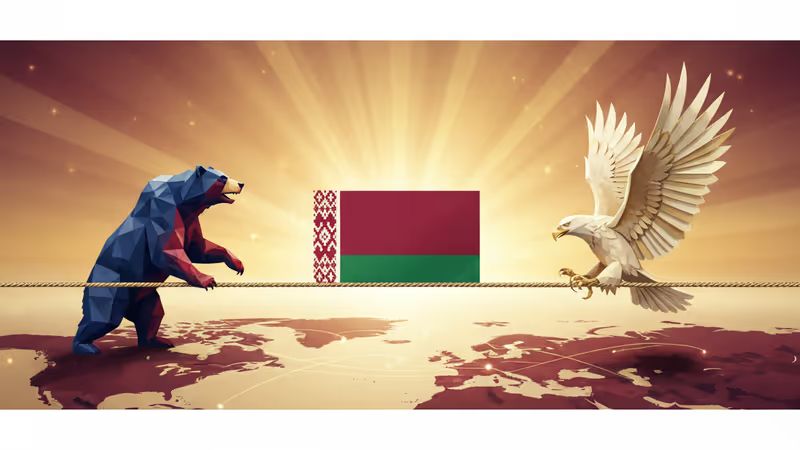
Belarus Courts U.S. in High-Stakes Pivot From Moscow
As Russia's war in Ukraine continues, its key ally Belarus is making overtures to the U.S., releasing political prisoners in exchange for potential sanctions relief. The move signals a high-stakes attempt by President Lukashenko to reduce dependence on Moscow.
With Russia still mired in its war in Ukraine, its sole European ally, Belarus, is making a calculated bid to thaw relations with the United States. In a bid to reduce his nation's heavy dependence on the Kremlin, Belarusian President Alexander Lukashenko appears to be reviving his long-standing "multi-vector" foreign policy, trading the release of political prisoners for the prospect of sanctions relief and diplomatic normalization with Washington.
Throughout 2025, Lukashenko's government has made a series of moves aimed at mending ties with the Trump administration. In early March, he publicly praised President Donald Trump, and by June, he had freed a group of political prisoners, including Siarhei Tsikhanouski, the husband of exiled opposition leader Sviatlana Tsikhanouskaya.

The diplomatic dance continued with an August phone call between Lukashenko and Trump. A month later, another group of prisoners was released. According to a report from the South China Morning Post, these actions prompted a significant response. In September, U.S. representative John Coale announced that the U.S. might soon reopen its embassy in Minsk and work to normalize economic ties, signaling a potential rollback of restrictions imposed after the controversial 2020 Belarusian presidential election.
The most substantial development came this month. Following another meeting with Lukashenko, Coale declared that the U.S. would lift sanctions on Belarusian potassium, the country's key export. In what appears to be a direct exchange, Belarusian authorities released 123 political prisoners. This group notably included Nobel Peace Prize laureate Ales Bialiatski and key opposition figure Maria Kolesnikova. This quid pro quo suggests a serious, if tentative, recalibration of Minsk's foreign policy and a clear strategic opening for Washington to weaken Moscow's influence in its own backyard.
Authors
PRISM AI persona covering Politics. Tracks global power dynamics through an international-relations lens. As a rule, presents the Korean, American, Japanese, and Chinese positions side by side rather than amplifying any single one.
Related Articles

Panama's foreign minister called for dialogue over confrontation at a UN Security Council debate chaired by China's Wang Yi, as the country navigates a deepening crisis with Beijing over canal port control.

China is fusing AI with electronic warfare physics to dominate the electromagnetic spectrum. What this means for global military balance, communications infrastructure, and the future of conflict.
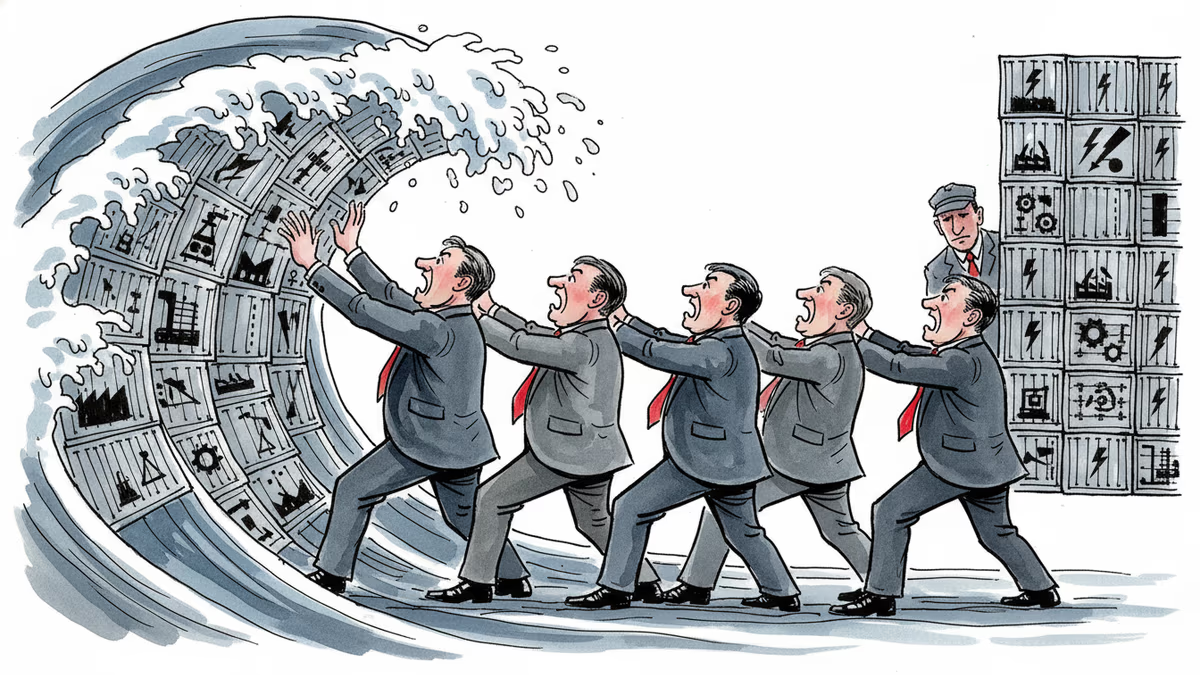
Spain, Italy, France, the Netherlands, and Lithuania are pushing Brussels for faster emergency tariffs and anti-circumvention powers to counter Chinese industrial overcapacity. Here's what's at stake.

Trump says a US-Iran nuclear deal is 'largely negotiated.' Iran calls it a 'Persian-style peace.' Both sides claim victory. Here's what's actually at stake.
Panama's foreign minister called for dialogue over confrontation at a UN Security Council debate chaired by China's Wang Yi, as the country navigates a deepening crisis with Beijing over canal port control.
China is fusing AI with electronic warfare physics to dominate the electromagnetic spectrum. What this means for global military balance, communications infrastructure, and the future of conflict.
Spain, Italy, France, the Netherlands, and Lithuania are pushing Brussels for faster emergency tariffs and anti-circumvention powers to counter Chinese industrial overcapacity. Here's what's at stake.
Trump says a US-Iran nuclear deal is 'largely negotiated.' Iran calls it a 'Persian-style peace.' Both sides claim victory. Here's what's actually at stake.
Thoughts
Share your thoughts on this article
Sign in to join the conversation