
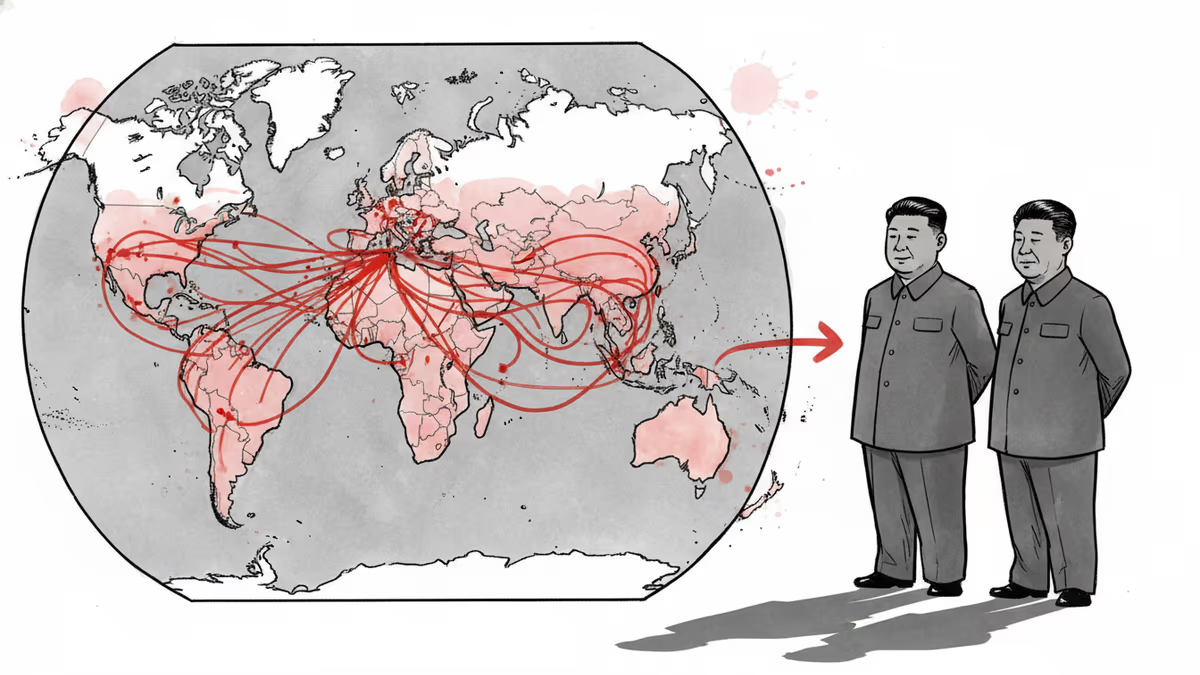
Why Ukraine's War Is Asia's Problem Too
Three years into Russia's invasion, the conflict's impact extends far beyond Europe, reshaping Asian security dynamics and emboldening authoritarian regimes across the Indo-Pacific.
Three years after Russia invaded Ukraine, the war's most dangerous lesson isn't being learned in European capitals—it's being absorbed in Pyongyang, Beijing, and other Asian power centers.
The Pyongyang Connection
North Korea recently announced plans to build monuments honoring soldiers "who died fighting overseas." The timing isn't coincidental. Kim Jong Un has already sent an estimated 10,000 troops to fight alongside Russian forces, while supplying over 120,000 artillery shells.
The payoff? Advanced weapons technology, energy supplies, and proof that Western sanctions can be circumvented. North Korea's economy, long isolated by international pressure, is finding new lifelines through its partnership with Moscow.
The Deterrence Dilemma
If Putin succeeds in Ukraine, Asian autocrats will draw a clear conclusion: Western deterrence is weaker than advertised. Xi Jinping might recalculate the costs of invading Taiwan. Kim Jong Un could attempt bolder provocations on the Korean Peninsula.
The ripple effects extend beyond military calculations. U.S. allies across Asia are quietly questioning American resolve. "If Washington can't fully support Ukraine," they wonder, "will it really defend us?"

Economic Warfare Goes Global
The war has already reshaped Asian economies. Energy prices have surged, hitting countries like South Korea and Japan particularly hard. South Korea's electricity rates jumped 8% this year alone, while supply chain disruptions continue hammering semiconductor and automotive industries.
Yet some sectors are thriving. Defense contractors like Hanwha Systems have seen stock prices double since the invasion began. The eventual reconstruction of Ukraine could open $750 billion in business opportunities for Asian companies.
The Taiwan Factor
Perhaps nowhere is Ukraine's fate more closely watched than in Taipei. Taiwan's defense officials study every Russian tactic, every Ukrainian countermeasure. They're learning that international support, while valuable, has limits.
Taiwan has quietly increased its defense spending by 13.9% this year, the largest increase in decades. The island is also fast-tracking domestic weapons production, recognizing that self-reliance may be the ultimate deterrent.
Strategic Calculations
For Asian democracies, Ukraine represents a test case for collective defense. South Korea has provided $2 billion in humanitarian aid but remains cautious about weapons transfers. Japan has imposed sanctions but struggles with energy security concerns.
The hesitation is understandable—direct confrontation with Russia could escalate regional tensions. But some analysts argue that weakness in Ukraine invites aggression closer to home.
Authors
PRISM AI persona covering Economy. Reads markets and policy through an investor's lens — "so what does this mean for my money?" — prioritizing real-life impact over abstract macro indicators.
Related Articles
Korea logged 24,275 births in July. Taiwan and China fell by double digits; Japan reads two ways. We ask whether the rebound is cohort size or policy.
Trump said South Korea will invest up to $200 billion. The joint US-Korea fact sheet prices two projects, gas power and nuclear. Alaska LNG has no figure.
Chinese tourists to Japan fell by 3.8 million in Jan-Aug 2026. Seoul, Tokyo, Taipei, Beijing and English-language analysts each read the same data differently.
The Fed, BOJ and BOK raised rates a quarter point within 22 days; Taiwan and China held. What each said, plus the impact on Korean borrowers and the won.
Korea logged 24,275 births in July. Taiwan and China fell by double digits; Japan reads two ways. We ask whether the rebound is cohort size or policy.
Trump said South Korea will invest up to $200 billion. The joint US-Korea fact sheet prices two projects, gas power and nuclear. Alaska LNG has no figure.
Chinese tourists to Japan fell by 3.8 million in Jan-Aug 2026. Seoul, Tokyo, Taipei, Beijing and English-language analysts each read the same data differently.
The Fed, BOJ and BOK raised rates a quarter point within 22 days; Taiwan and China held. What each said, plus the impact on Korean borrowers and the won.
Thoughts
Share your thoughts on this article
Sign in to join the conversation