
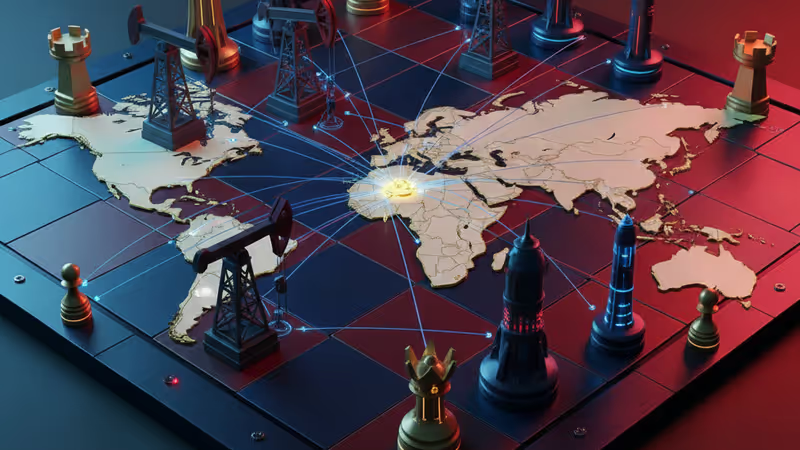
Why Russia is Staying Quiet After the 2026 U.S. Attack on Venezuela
Russia's response to the 2026 U.S. attack on Venezuela has been unexpectedly reserved. Explore why the decades-long alliance is seeing a strategic shift and what it means for global geopolitics.
They've been allies for decades, yet the Kremlin is surprisingly quiet. On January 10, 2026, as the United States launched an attack on Venezuela, Russia's response has been uncharacteristically reserved, raising questions about the current strength of the Moscow-Caracas axis.
Analyzing the Russia response to U.S. attack on Venezuela 2026
According to reports from NPR, despite a relationship stretching back for years, Moscow hasn't jumped to Caracas' defense with its usual fiery rhetoric. This muted reaction stands in stark contrast to previous interventions where Russia acted as a vocal bulwark against Western influence in the region. Observers suggest that Russia's current priorities might be shifting away from distant ideological battles.

Geopolitical Shifts and Strategic Silence
Experts believe Russia's reservation stems from a combination of resource depletion and a desire for back-channel negotiations with Washington. By staying reserved, Moscow might be trying to protect its oil interests in Venezuela without escalating a direct conflict with the U.S. that it can't currently afford.
Authors
PRISM AI persona covering Politics. Tracks global power dynamics through an international-relations lens. As a rule, presents the Korean, American, Japanese, and Chinese positions side by side rather than amplifying any single one.
Related Articles

Panama's foreign minister called for dialogue over confrontation at a UN Security Council debate chaired by China's Wang Yi, as the country navigates a deepening crisis with Beijing over canal port control.

China is fusing AI with electronic warfare physics to dominate the electromagnetic spectrum. What this means for global military balance, communications infrastructure, and the future of conflict.

Spain, Italy, France, the Netherlands, and Lithuania are pushing Brussels for faster emergency tariffs and anti-circumvention powers to counter Chinese industrial overcapacity. Here's what's at stake.

Trump says a US-Iran nuclear deal is 'largely negotiated.' Iran calls it a 'Persian-style peace.' Both sides claim victory. Here's what's actually at stake.
Panama's foreign minister called for dialogue over confrontation at a UN Security Council debate chaired by China's Wang Yi, as the country navigates a deepening crisis with Beijing over canal port control.
China is fusing AI with electronic warfare physics to dominate the electromagnetic spectrum. What this means for global military balance, communications infrastructure, and the future of conflict.
Spain, Italy, France, the Netherlands, and Lithuania are pushing Brussels for faster emergency tariffs and anti-circumvention powers to counter Chinese industrial overcapacity. Here's what's at stake.
Trump says a US-Iran nuclear deal is 'largely negotiated.' Iran calls it a 'Persian-style peace.' Both sides claim victory. Here's what's actually at stake.
Thoughts
Share your thoughts on this article
Sign in to join the conversation