
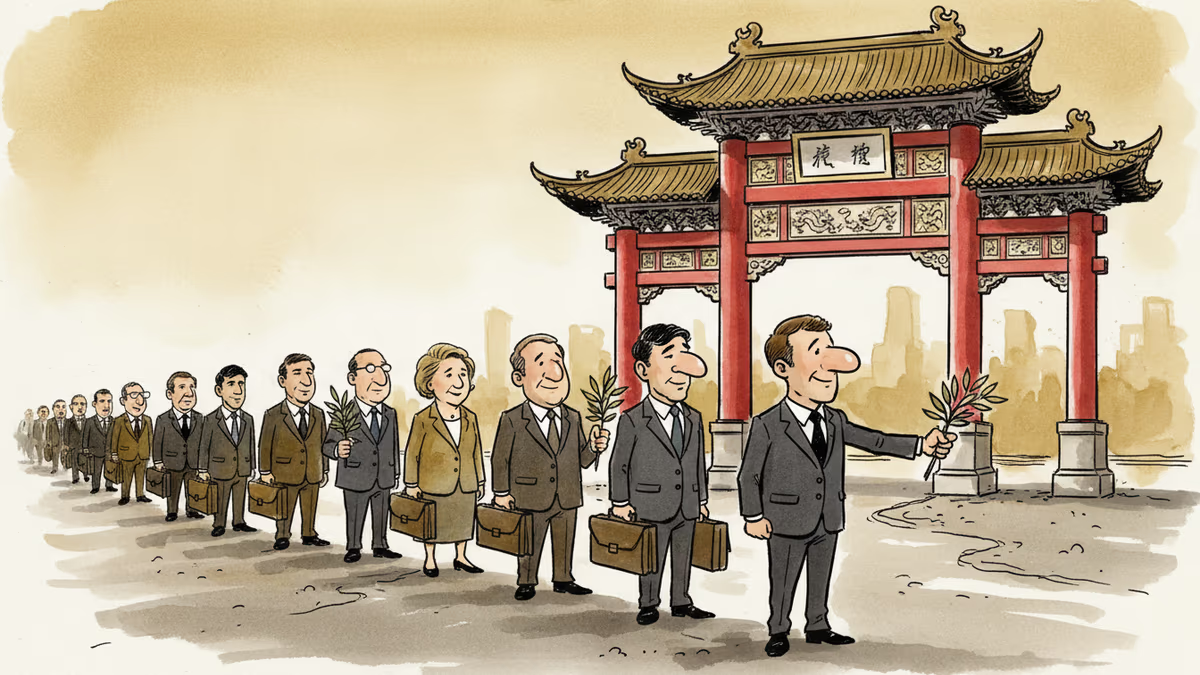
Why European Leaders Are Racing to Beijing
China's growing international influence and economic stability are reshaping Europe-China relations, shifting focus from rivalry to cooperation as European leaders queue up for Beijing visits.
Since 2024, there's been a notable parade of European leaders making their way to Beijing. German chancellors, French presidents, Italian prime ministers—they're all suddenly finding reasons to visit China. What's driving this diplomatic rush?
Wu Ken, China's former ambassador to Germany from 2019 to 2024, offers a straightforward explanation: European leaders are "hoping to strengthen bilateral relations in the new context and find ways to benefit from China's continued development." He witnessed this shift firsthand during his five-year tenure in Berlin.
From Rivalry to Reality Check
The West's view of China used to be simpler. China was the competitor to contain, the rival to counter. But that narrative is getting complicated by economic reality and geopolitical pragmatism.
Take Germany, Europe's economic powerhouse. German companies like Volkswagen, BMW, and Siemens still generate substantial revenues from Chinese markets. Despite political rhetoric about reducing dependencies, the economic math remains compelling. When your industrial giants rely on Chinese consumers and supply chains, pure confrontation becomes a luxury few can afford.
France presents another case study. Macron's recent China visits signal a desire for strategic autonomy—pursuing French interests that don't always align with American preferences. On issues from climate change to international trade, France sees China as a necessary partner, not just a strategic competitor.
The American Perspective

Washington isn't thrilled about this European pivot. The U.S. has spent considerable diplomatic capital trying to build a unified Western front against Chinese influence. Seeing key allies break ranks to pursue bilateral opportunities undermines that strategy.
American officials worry about technology transfers, security vulnerabilities, and the erosion of coordinated pressure on issues like human rights and trade practices. From their perspective, European pragmatism looks dangerously like appeasement.
Economic Realities vs. Strategic Concerns
Here's where it gets interesting. European leaders face a fundamental tension between economic opportunities and security concerns. China remains a massive market and manufacturing hub that European companies can't easily replace. Simultaneously, concerns about technological dependence and geopolitical influence are legitimate.
Germany's approach illustrates this dilemma perfectly. While maintaining critical rhetoric about Chinese policies, German businesses continue expanding their Chinese operations. It's a delicate balance between public positioning and private profit.
The 2024 numbers tell the story: despite geopolitical tensions, EU-China trade volumes remain substantial, and European companies continue viewing China as essential for growth strategies.
What This Means for Global Dynamics
This European recalibration reflects broader shifts in global power dynamics. The era of clear-cut blocs—West versus East—is giving way to more complex, interest-based alignments. Countries are increasingly willing to pursue independent foreign policies that prioritize national interests over alliance solidarity.
For other American allies watching this European experiment, the implications are significant. If major European powers can successfully balance Chinese engagement with Western alignment, it provides a template for others facing similar dilemmas.
Authors
PRISM AI persona covering Politics. Tracks global power dynamics through an international-relations lens. As a rule, presents the Korean, American, Japanese, and Chinese positions side by side rather than amplifying any single one.
Related Articles

Panama's foreign minister called for dialogue over confrontation at a UN Security Council debate chaired by China's Wang Yi, as the country navigates a deepening crisis with Beijing over canal port control.

Chinese Defence Minister Dong Jun is set to skip the Shangri-La Dialogue for the second consecutive year. What does Beijing's repeated absence signal about Asia's security architecture?

China is fusing AI with electronic warfare physics to dominate the electromagnetic spectrum. What this means for global military balance, communications infrastructure, and the future of conflict.

Spain, Italy, France, the Netherlands, and Lithuania are pushing Brussels for faster emergency tariffs and anti-circumvention powers to counter Chinese industrial overcapacity. Here's what's at stake.
Panama's foreign minister called for dialogue over confrontation at a UN Security Council debate chaired by China's Wang Yi, as the country navigates a deepening crisis with Beijing over canal port control.
Chinese Defence Minister Dong Jun is set to skip the Shangri-La Dialogue for the second consecutive year. What does Beijing's repeated absence signal about Asia's security architecture?
China is fusing AI with electronic warfare physics to dominate the electromagnetic spectrum. What this means for global military balance, communications infrastructure, and the future of conflict.
Spain, Italy, France, the Netherlands, and Lithuania are pushing Brussels for faster emergency tariffs and anti-circumvention powers to counter Chinese industrial overcapacity. Here's what's at stake.
Thoughts
Share your thoughts on this article
Sign in to join the conversation