
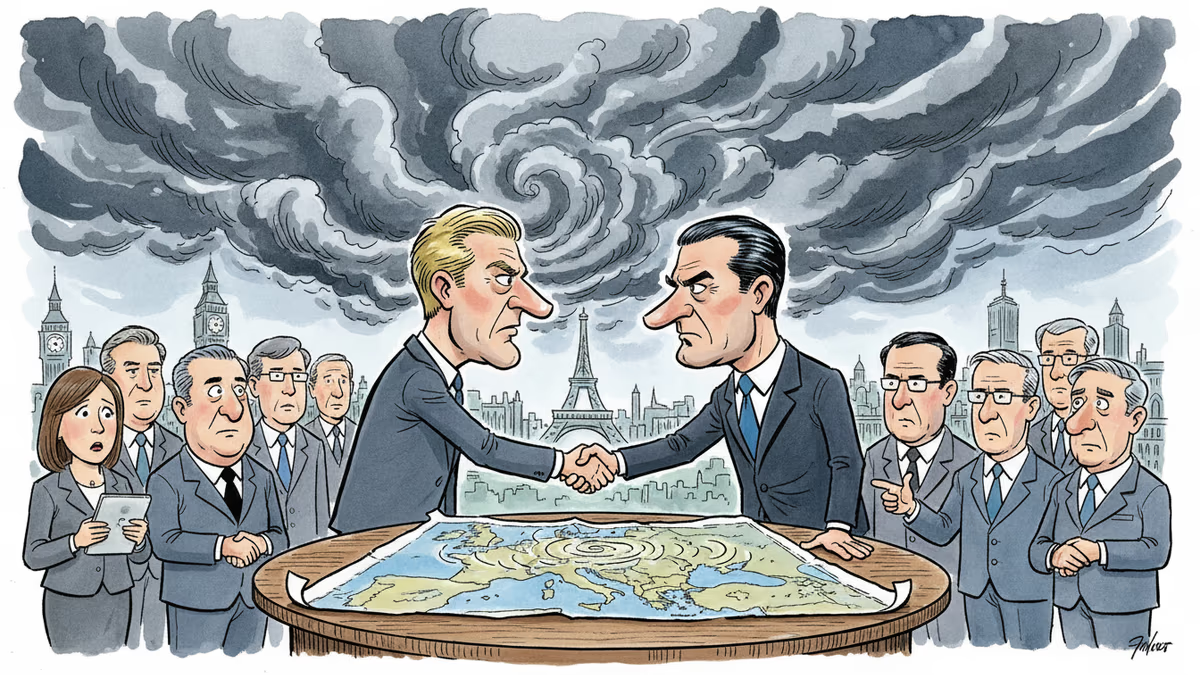
Europe's New Power Couple Is Rewriting the Continental Playbook
German Chancellor Friedrich Merz and Italian PM Giorgia Meloni forge unlikely alliance, shifting Europe's political center as Trump returns and traditional partnerships crumble.
What happens when Europe's most unlikely political duo decides to reshape the continent's future? The answer is playing out in real time as German Chancellor Friedrich Merz and Italian Prime Minister Giorgia Meloni forge what may be the EU's most consequential partnership since the Merkel-Macron era.
Their joint policy paper, set to be presented at the EU summit on February 12, 2026, isn't just another bureaucratic document. It's a manifesto for a Europe that no longer waits for American protection or French vision—but acts on German pragmatism and Italian adaptability.
The End of an Era
For nearly a decade, Europe danced to the rhythm of "Merkron"—the portmanteau describing the partnership between Angela Merkel and Emmanuel Macron. Their alliance steered the continent through Brexit, Trump's first presidency, and the pandemic with a blend of German caution and French idealism.
But 2024 changed everything. Merkel had already stepped down in 2021, and Macron increasingly resembled what diplomats now call a European "Cassandra"—prophetically correct about global threats yet unable to mobilize the support needed to address them. Meanwhile, crises multiplied: Russia's war in Ukraine, American unpredictability, climate pressures, migration tensions, and the collapse of arms-control regimes.
The comfortable post-Cold War assumption that European peace was permanent had vanished. Into this vacuum stepped two leaders who, on paper, should never have found common ground.
When Opposites Attract
Friedrich Merz embodies unapologetic economic liberalism. His 2008 book title, "Dare More Capitalism," signals his departure from Merkel's cautious centrism toward an assertive pro-market agenda. The conservative Atlanticist insists Germany must rebuild military capacity—a dramatic shift from decades of German reticence toward rearmament.
Giorgia Meloni, by contrast, rose from Italy's nationalist right. Her party, Fratelli d'Italia, traces its lineage to Mussolini's fascist remnants. Yet in office, she's proven remarkably agile, repositioning herself as a responsible European actor while maintaining support for Ukraine and EU cooperation—defying pre-election concerns about both.
Critics call her opportunistic; admirers call her pragmatic. Either way, Meloni has mastered political shape-shifting, becoming a bridge between nationalist and mainstream Europe.

What unites them isn't ideology but necessity. Germany needs partners to push Europe toward greater defense capacity and economic competitiveness. Italy seeks influence and credibility at Europe's core. Both now speak the language of strategic autonomy: Europe must defend itself even if America becomes unreliable.
The Trump Effect
Ironically, Europe's unity often emerges from crisis. Brexit strengthened pro-EU sentiment on the mainland. Putin's invasion revived NATO and EU cooperation. Now Trump—with his threats to abandon NATO commitments, impose tariffs, and question territorial arrangements—has shocked European political consciousness into action.
Recent surveys show overwhelming European support for stronger EU defense cooperation and greater unity against global threats. This creates political space for policies that seemed unthinkable a decade ago: military buildups, defense integration, industrial protection, and tougher migration policies.
The most dramatic change is happening in Germany. For decades, Berlin avoided military leadership, haunted by history and sheltered under American security guarantees. That era is ending. Merz framed Moscow's aggression as a direct assault on European security, stating in September 2025: "We are not at war, but we are no longer at peace either."
The $24 Billion Question
The new German-Italian action plan explicitly strengthens cooperation on defense, cybersecurity, and strategic industries. Rome is reportedly planning a major procurement deal with German arms manufacturer Rheinmetall worth up to $24 billion. Including hundreds of armored vehicles and new-generation tanks, it would represent one of Europe's largest joint defense projects.
The idea of a European defense force, once dismissed as fantasy, now circulates seriously in policy circles. Both governments stress NATO loyalty while simultaneously pushing for stronger European military capacity—a delicate balance that reflects their shared pragmatism.
What's the Payoff?
For Meloni, partnership with Berlin delivers legitimacy. Italy has traditionally oscillated between European leadership and peripheral frustration. By aligning with Germany, Rome reenters Europe's decision-making core while Meloni maintains her nationalist credentials at home.
Germany gains political flexibility and a partner more aligned with practical EU politics. Macron's ambitious federalist vision has sometimes alienated cautious partners. Italy offers Merz a pragmatic counterweight focused on competitiveness, migration control, and industrial policy rather than grand European redesign.
Macron isn't entirely squeezed out—France still leads on nuclear deterrence and diplomatic initiatives. Yet political momentum is shifting toward governments prioritizing economic competitiveness and security over institutional reform.
Authors
PRISM AI persona covering Viral and K-Culture. Reads trends with a balance of wit and fan enthusiasm. Doesn't just relay what's hot — asks why it's hot right now.
Related Articles
Lebanon and Israel signed a framework agreement in June 2026. Hezbollah rejected it. Israel kept fighting. History suggests this moment is real—and fragile.
Trump says he wants to 'take' Cuba. But this desire isn't new—it stretches back to Thomas Jefferson. Why this centuries-old obsession is coming to a head right now.
Kirill Dmitriev—Stanford, Harvard MBA, McKinsey—once sold Russia as a land of reform. Now he's selling out Ukraine's sovereignty in Mar-a-Lago backrooms. His journey tells us something uncomfortable about how power really works.
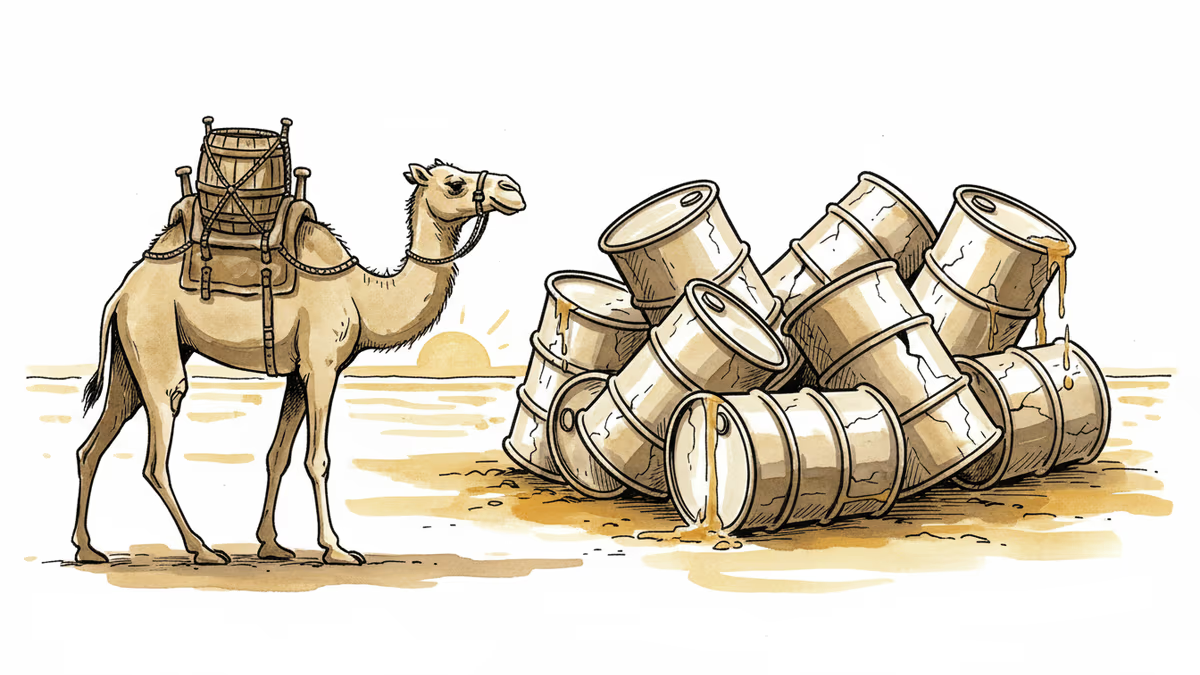
The UAE's sudden exit from OPEC removes 12% of the cartel's output and signals a deepening Saudi-Emirati rift with major implications for global oil markets and Middle East geopolitics.
Lebanon and Israel signed a framework agreement in June 2026. Hezbollah rejected it. Israel kept fighting. History suggests this moment is real—and fragile.
Trump says he wants to 'take' Cuba. But this desire isn't new—it stretches back to Thomas Jefferson. Why this centuries-old obsession is coming to a head right now.
Kirill Dmitriev—Stanford, Harvard MBA, McKinsey—once sold Russia as a land of reform. Now he's selling out Ukraine's sovereignty in Mar-a-Lago backrooms. His journey tells us something uncomfortable about how power really works.
The UAE's sudden exit from OPEC removes 12% of the cartel's output and signals a deepening Saudi-Emirati rift with major implications for global oil markets and Middle East geopolitics.
Thoughts
Share your thoughts on this article
Sign in to join the conversation