
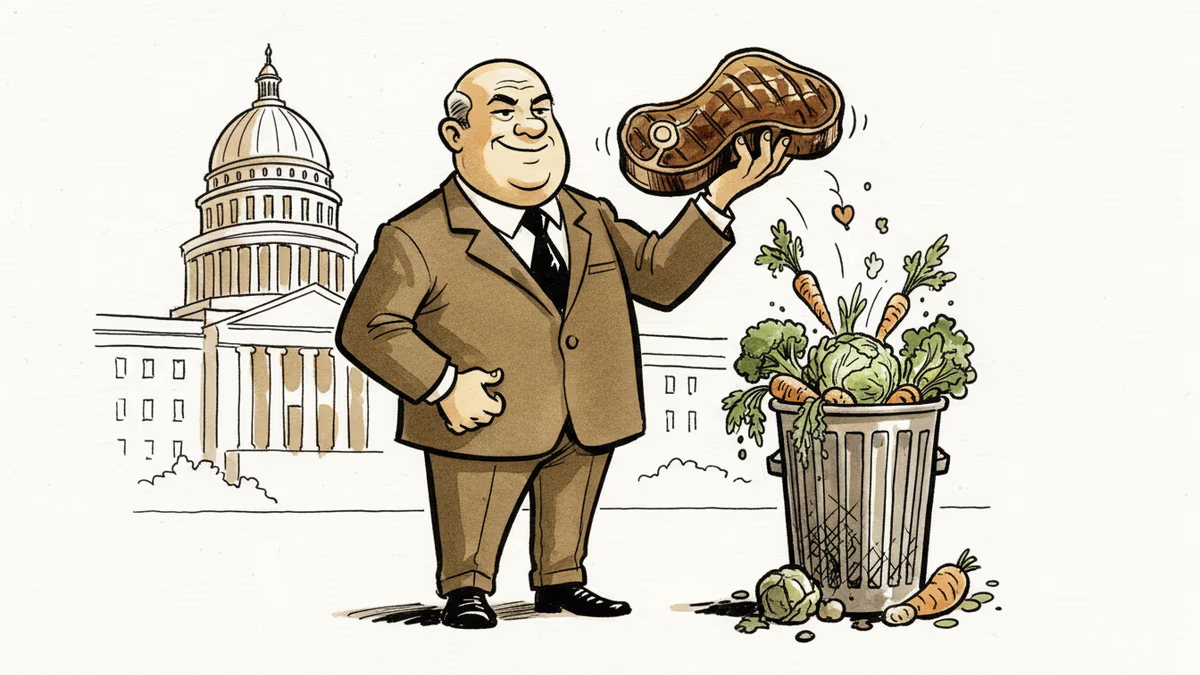
When Health Officials Tell You to Skip Your Vegetables
RFK Jr. and Trump's health appointees are promoting meat-only diets while dismissing vegetables. What happens when government authority contradicts scientific consensus?
America's Top Health Official Just Declared War on Broccoli
Robert F. Kennedy Jr., now leading the Department of Health and Human Services, recently told a reporter he follows a strict carnivore diet. "I only eat meat or fermented foods," he said, claiming it helped him lose 40% of his visceral fat in just one month.
This wouldn't be particularly noteworthy if Kennedy were just another wellness influencer. But he's not. He's now responsible for the health of 330 million Americans, and his dietary philosophy is reshaping federal nutrition guidance in ways that contradict decades of established science.
Kennedy and his "Make America Healthy Again" team have literally flipped the traditional food pyramid upside down. Steak and butter—once relegated to the "eat sparingly" tip—now sit alongside vegetables and whole grains in the recommended section. The well-documented risks of excessive saturated fat? Apparently yesterday's news.
The Rise of Anti-Vegetable Medicine
The carnivore movement has found unlikely champions in medical professionals with massive social media followings. Dr. Anthony Chaffee, who boasts nearly 400,000 followers, recently declared on Instagram that "the best thing you could do is eliminate everything except fatty meat and lard."
Even more striking was a LinkedIn interview with another doctor who claimed there's "zero scientific evidence to say that vegetables are required in the human diet." This self-described "90% carnivore" physician said he'd consumed nothing but a kilogram of beef the previous day, warning that vegetables contain mysterious "anti-nutrients."
Influencers like Jordan Peterson have been promoting meat-only diets since 2018, but what's new is the institutional backing. A recent study analyzing nutrition misinformation on social media found that Instagram and YouTube are flooded with what researchers describe as "low-quality content" posing a "growing public health concern."

When Government Agencies Join the Fray
The newly appointed FDA commissioner, Martin Makary, recently argued in a podcast that "government needs to stop spreading misinformation that natural and saturated fats are bad for you." He described the principles of "whole foods and clean meats" as "biblical."
The interviewer's response was telling: Makary's warnings about pesticides made him want to "avoid all salads and completely miss the organic section in the grocery store." Here's a government health official whose messaging actively discourages consumption of fruits and vegetables.
The Science Strikes Back
Gabby Headrick, associate director of food and nutrition policy at George Washington University's Institute for Food Safety & Nutrition Security, minces no words: "There's no evidence to suggest that a meat-only diet is good for you. All of the nutrition science to date strongly identifies a wide array of vegetables as being very health-promoting."
The claim that saturated fat warnings are "government misinformation" also doesn't hold up. Multiple studies have established links between high saturated fat intake and increased heart disease risk. That's not propaganda—it's peer-reviewed science.
Yes, nutrition research has limitations. Most studies rely on people accurately reporting what they eat, which they're notoriously bad at doing. Individual responses to foods can vary based on genetics, gut microbiomes, and preparation methods. But these uncertainties don't validate extreme, restrictive diets or miracle food claims.
The Influence Economy of Health
What we're witnessing isn't just a policy shift—it's a collision between traditional scientific authority and the new influence economy. Social media has democratized health messaging, allowing charismatic individuals to build massive followings regardless of their expertise or the accuracy of their claims.
The problem intensifies when government officials adopt the language and tactics of wellness influencers. When the head of Health and Human Services promotes the same diet as Instagram fitness gurus, the line between evidence-based policy and personal belief becomes dangerously blurred.
Authors
Related Articles

From Gisele's Instagram to your medicine cabinet, functional mushrooms have exploded into a massive industry. But as the hype grows, where does science end and marketing begin?

Ars Technica admits to publishing fabricated AI-generated quotes as real source statements. A wake-up call for journalism's AI adoption standards.

A 23-year-old right-wing YouTuber's viral video led to federal immigration raids and frozen childcare funding. The case reveals social media's growing influence on government policy.
The US government now uses AI to edit public content, and new research shows people remain influenced by deepfakes even when told they're fake. As truth-verification tools fail, how do we navigate this new reality?
From Gisele's Instagram to your medicine cabinet, functional mushrooms have exploded into a massive industry. But as the hype grows, where does science end and marketing begin?
Ars Technica admits to publishing fabricated AI-generated quotes as real source statements. A wake-up call for journalism's AI adoption standards.
A 23-year-old right-wing YouTuber's viral video led to federal immigration raids and frozen childcare funding. The case reveals social media's growing influence on government policy.
The US government now uses AI to edit public content, and new research shows people remain influenced by deepfakes even when told they're fake. As truth-verification tools fail, how do we navigate this new reality?
Thoughts
Share your thoughts on this article
Sign in to join the conversation