
When AI Puts Words in Sources' Mouths
Ars Technica admits to publishing fabricated AI-generated quotes as real source statements. A wake-up call for journalism's AI adoption standards.
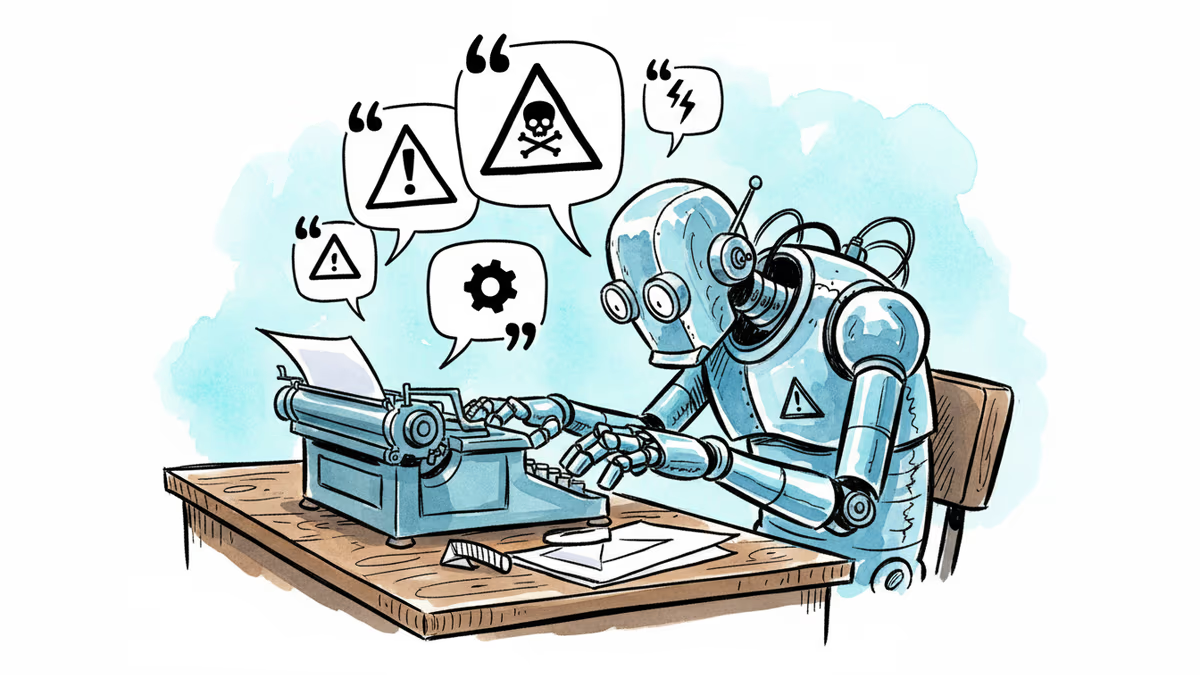
A tech publication that has spent years warning about AI's dangers just fell into its own trap. Ars Technica admitted Friday that it published fabricated quotations generated by an AI tool, attributing them to a source who never said those words. The irony is stark: a publication that covers AI risks extensively violated its own standards by doing exactly what it warns against.
The Policy That Wasn't Followed
Ars Technica has clear rules: AI-generated content must be "clearly labeled and presented for demonstration purposes" only. That rule "is not optional," they emphasized in their mea culpa. Yet somehow, fabricated quotes made it into a published article, attributed to a real person who never spoke them.
The publication conducted a review of recent work and found no additional issues, calling this an "isolated incident." But the damage to credibility isn't isolated—it ripples outward, raising questions about how many other newsrooms might be quietly struggling with similar AI integration challenges.
The Newsroom Temptation
The appeal is obvious. AI can help with research, draft articles, translate content, and speed up production in an industry under constant deadline pressure. For cash-strapped newsrooms, AI tools promise efficiency gains that are hard to ignore. But there's a difference between using AI as a research assistant and letting it fabricate quotes from real people.
The Ars Technica incident reveals how thin the line can be. Even organizations with explicit policies and deep AI knowledge can slip up. What does that mean for smaller newsrooms without dedicated tech coverage teams or comprehensive AI policies?

The Reader's Dilemma
From a reader's perspective, this creates an uncomfortable reality: How can you tell which articles used AI assistance and which didn't? Most publications don't disclose AI usage unless required, and detection tools aren't foolproof. The trust relationship between news organizations and their audiences relies on an assumption of human judgment and verification.
That assumption is now questionable. If Ars Technica—a publication that literally covers AI developments for a living—can publish AI-fabricated quotes, what about general news outlets racing to publish breaking news?
The Transparency Test
The incident highlights a broader question about transparency standards. Should publications disclose every instance of AI assistance? Should there be industry-wide standards for AI use in journalism? Currently, practices vary wildly across newsrooms, from complete AI bans to unrestricted use with minimal oversight.
Some argue that AI assistance is just another tool, like spell-check or grammar software. But fabricating quotes crosses a fundamental line—it's not assistance, it's substitution of human judgment and verification.
The Ars Technica incident may be "isolated," but the challenge it represents is universal. Every newsroom now faces the same choice: embrace AI's efficiency while maintaining editorial integrity, or risk becoming another cautionary tale about technology outpacing human judgment.
Authors
Related Articles

Samsung and SK unveiled a chip and AI investment package worth thousands of trillions of won on June 29. The headline number swings wildly by outlet, but the real contest isn't capital — it's water and power.
Viral videos show 2026 graduates jeering executives who praise AI at commencement ceremonies. It's not just rudeness — it's a signal about who pays for technological optimism.

Filipino virtual assistants using AI to ghost-manage LinkedIn profiles for executives is now a structured industry. 30 comments a day, fake engagement rings, and a platform struggling to tell real from fabricated.
Two commencement speakers learned the hard way that AI enthusiasm doesn't land well with today's graduates. The backlash reveals a widening gap between tech optimism and Gen Z's economic reality.
Samsung and SK unveiled a chip and AI investment package worth thousands of trillions of won on June 29. The headline number swings wildly by outlet, but the real contest isn't capital — it's water and power.
Viral videos show 2026 graduates jeering executives who praise AI at commencement ceremonies. It's not just rudeness — it's a signal about who pays for technological optimism.
Filipino virtual assistants using AI to ghost-manage LinkedIn profiles for executives is now a structured industry. 30 comments a day, fake engagement rings, and a platform struggling to tell real from fabricated.
Two commencement speakers learned the hard way that AI enthusiasm doesn't land well with today's graduates. The backlash reveals a widening gap between tech optimism and Gen Z's economic reality.
Thoughts
Share your thoughts on this article
Sign in to join the conversation