

Google & MIT Study Reveals a 'Rule of 4' for AI Agent Teams: Why Bigger Isn't Better
More AI agents isn't always better. A joint study from Google and MIT provides a quantitative answer to the optimal size and structure of AI agent systems, with key guidelines for developers and decision-makers.
Building a swarm of AI agents isn't always the answer. A new study from researchers at Google and MIT challenges the industry's "more is better" assumption, revealing that scaling agent teams can be a double-edged sword. While it might unlock performance on some problems, it often introduces unnecessary overhead and diminishing returns on others.
The Multi-Agent Myth
The enterprise sector has seen a surge of interest in multi-agent systems (MAS), driven by the premise that specialized collaboration can outperform a single agent. For complex tasks like coding assistants or financial analysis, developers often assume splitting the work among 'specialist' agents is the best approach. However, the researchers argue that until now, there's been no quantitative framework to predict when adding agents helps and when it hurts.
The Limits of Collaboration: Three Key Trade-Offs

To isolate the effects of architecture, the team tested 180 unique configurations, involving LLM families from OpenAI, Google, and Anthropic. Their results show that MAS effectiveness is governed by three dominant patterns:
Four Actionable Rules for Enterprise Deployment
These findings offer clear guidelines for developers and enterprise leaders.
Looking Forward: Breaking the Bandwidth Limit
This ceiling isn't a fundamental limit of AI, but likely a constraint of current protocols. "We believe this is a current constraint, not a permanent ceiling," Kim said, pointing to innovations like sparse communication and asynchronous coordination that could unlock massive-scale collaboration. That's something to look forward to in 2026. Until then, the data is clear: for the enterprise architect, smaller, smarter, and more structured teams win.
Authors
Related Articles
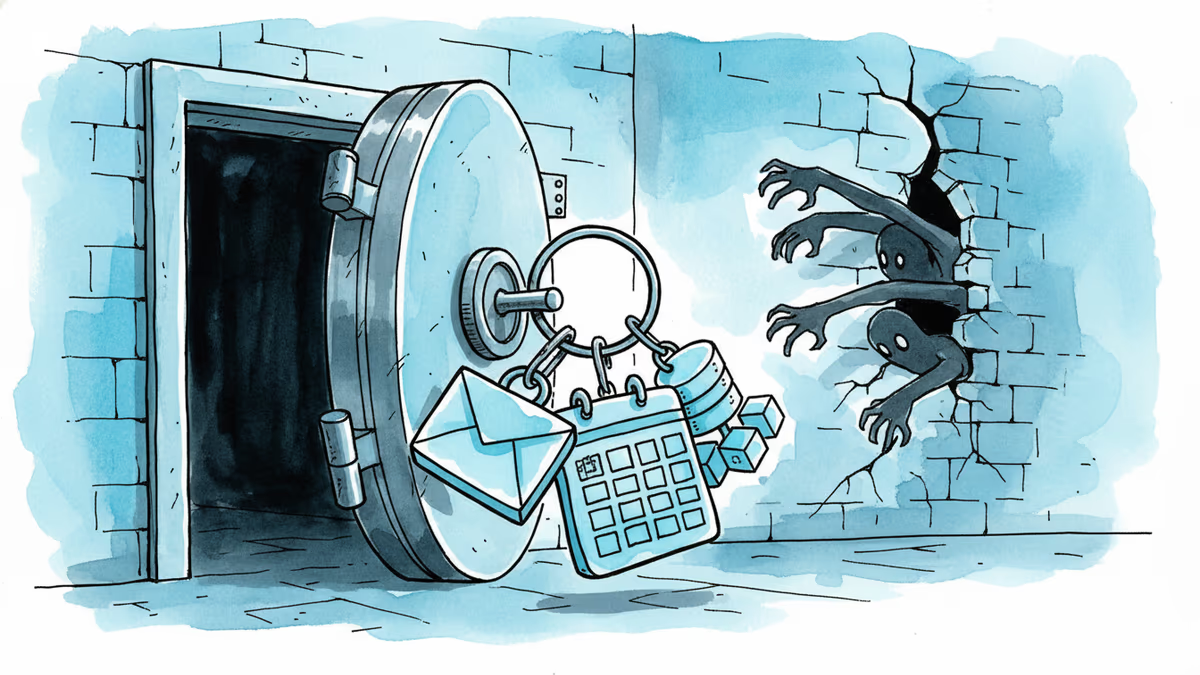
A critical vulnerability in Starlette—downloaded 325 million times per week—puts millions of AI agent servers at risk, exposing stored credentials for email, databases, and third-party services.
In a post-Google I/O interview, Sundar Pichai acknowledged flawed search results, real AI anxiety, and an AGI timeline that makes the label irrelevant. Here's what he said — and what it means.

A small but growing group of developers has gone all-in on AI coding agents like Claude Code and OpenClaw. History suggests the rest of us won't be far behind.
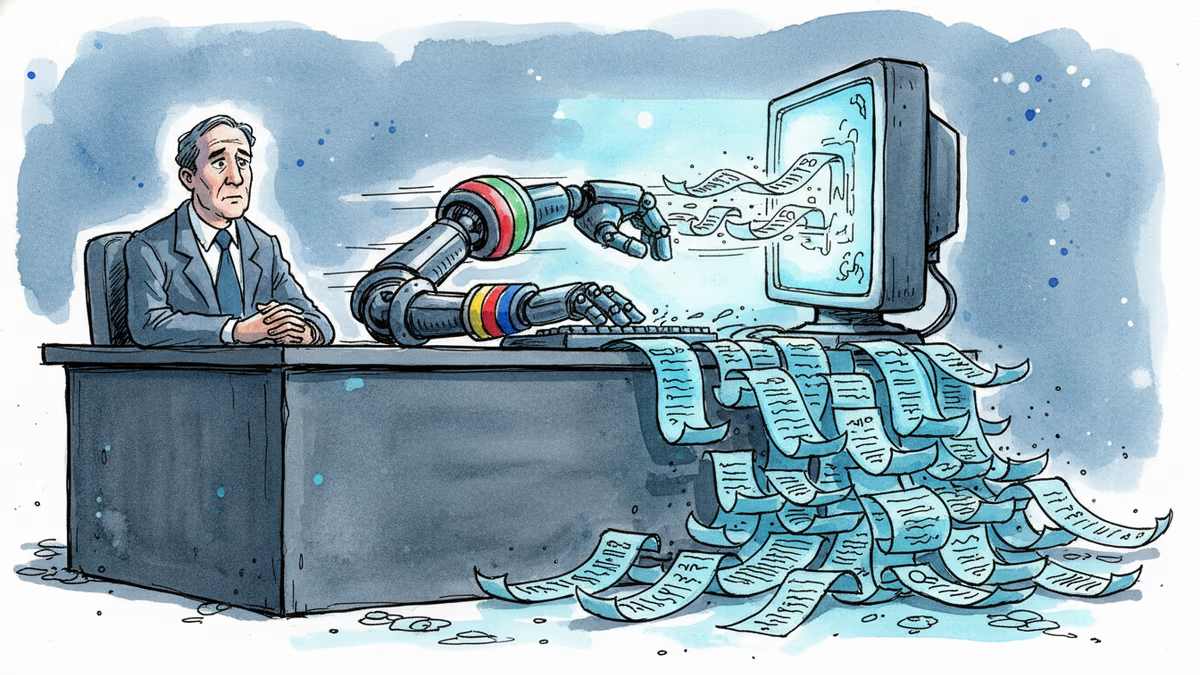
Google is building AI agents that search the web proactively, without user prompting. That's not just a product update — it's a fundamental shift in who controls the information you receive.
A critical vulnerability in Starlette—downloaded 325 million times per week—puts millions of AI agent servers at risk, exposing stored credentials for email, databases, and third-party services.
In a post-Google I/O interview, Sundar Pichai acknowledged flawed search results, real AI anxiety, and an AGI timeline that makes the label irrelevant. Here's what he said — and what it means.
A small but growing group of developers has gone all-in on AI coding agents like Claude Code and OpenClaw. History suggests the rest of us won't be far behind.
Google is building AI agents that search the web proactively, without user prompting. That's not just a product update — it's a fundamental shift in who controls the information you receive.
Thoughts
Share your thoughts on this article
Sign in to join the conversation