

India's $110B AI Infrastructure Bet Signals New Asian Tech Power Play
Mukesh Ambani unveils $110B AI infrastructure plan over 7 years. India's tech self-reliance push could reshape Asian AI competition dynamics.
$110 billion. That's how much India's richest man is betting on AI infrastructure over the next seven years. But Mukesh Ambani's massive pledge isn't just about building data centers—it's about reshaping the global AI power structure.
"India cannot afford to rent intelligence," Ambani declared at the India AI Impact Summit in New Delhi on Thursday. His words carry weight beyond business rhetoric. They signal India's ambition to break free from tech dependency and emerge as the third pole in AI competition, challenging the US-China duopoly.
The Reliance AI Empire Takes Shape
Ambani's blueprint is comprehensive: gigawatt-scale data centers, nationwide edge computing networks, and AI services integrated with Reliance's Jio telecom platform. The conglomerate has already broken ground on multi-gigawatt facilities in Jamnagar, Gujarat, with 120 megawatts expected online by late 2026.
The energy strategy is particularly clever. Reliance will power this AI infrastructure with 10 gigawatts of surplus solar capacity from projects in Gujarat and Andhra Pradesh. It's a play for both carbon neutrality and energy independence—two increasingly critical factors in the global AI race.
India's Corporate AI Rush
Reliance isn't alone in this sprint. Earlier this week, the Adani Group announced roughly $100 billion in AI data center investments. The Indian government projects over $200 billion in AI infrastructure spending over the next two years—a staggering sum that dwarfs many national tech budgets.
Global players are taking notice. OpenAI has partnered with the Tata Group to develop 100 megawatts of AI capacity, with plans to scale to 1 gigawatt. Google struck a deal with Jio last year to offer free Gemini AI Pro access to millions of Indian users.

The Cost Revolution Promise
Ambani's most audacious claim echoes his telecom playbook. Just as Jio dramatically slashed mobile data prices in India, he promises to make AI services radically more affordable. "The biggest constraint in AI today is not talent or imagination," he said. "It is scarcity and high cost of compute."
This isn't just corporate positioning—it's geopolitical strategy. By commoditizing AI compute, India could become the world's AI services hub, much like it became the global IT outsourcing center in the 1990s.
Challenging the Duopoly
The timing is strategic. As US-China tech tensions escalate, many countries seek alternatives to avoid getting caught in the crossfire. India offers a compelling third option: English-speaking, democratic, and increasingly tech-capable.
But challenges remain. Building AI infrastructure is one thing; creating the ecosystem of talent, research, and innovation is another. India's plan to develop AI capabilities in multiple Indian languages shows awareness of this challenge, but execution will be key.
The Broader Implications
For global investors, India's AI infrastructure push represents both opportunity and disruption. Traditional cloud providers like Amazon Web Services and Microsoft Azure may face new competition in price-sensitive markets. For enterprises, it could mean more choices and lower costs for AI services.
For other emerging markets, India's playbook offers a template: leverage domestic market size, energy resources, and regulatory autonomy to build independent tech capabilities.
Authors
Related Articles
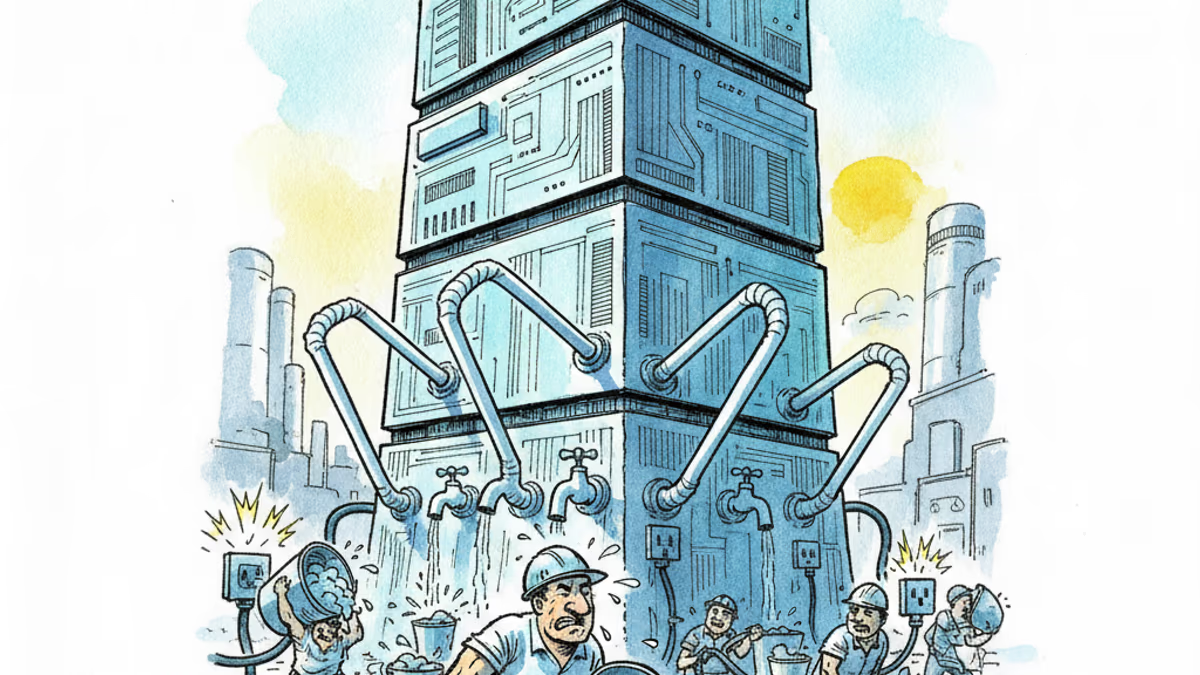
Samsung and SK unveiled a chip and AI investment package worth thousands of trillions of won on June 29. The headline number swings wildly by outlet, but the real contest isn't capital — it's water and power.

SolarSquare is raising $55-60M at a $450-500M valuation, more than doubling its worth in 18 months. Here's what's driving investor conviction in India's residential solar market.

Viral videos show 2026 graduates jeering executives who praise AI at commencement ceremonies. It's not just rudeness — it's a signal about who pays for technological optimism.

Filipino virtual assistants using AI to ghost-manage LinkedIn profiles for executives is now a structured industry. 30 comments a day, fake engagement rings, and a platform struggling to tell real from fabricated.
Samsung and SK unveiled a chip and AI investment package worth thousands of trillions of won on June 29. The headline number swings wildly by outlet, but the real contest isn't capital — it's water and power.
SolarSquare is raising $55-60M at a $450-500M valuation, more than doubling its worth in 18 months. Here's what's driving investor conviction in India's residential solar market.
Viral videos show 2026 graduates jeering executives who praise AI at commencement ceremonies. It's not just rudeness — it's a signal about who pays for technological optimism.
Filipino virtual assistants using AI to ghost-manage LinkedIn profiles for executives is now a structured industry. 30 comments a day, fake engagement rings, and a platform struggling to tell real from fabricated.
Thoughts
Share your thoughts on this article
Sign in to join the conversation