
Why Real Heists Look Nothing Like the Movies
Real thieves use angle grinders and insiders instead of high-tech gadgets. The Louvre's €88 million theft reveals why simplicity beats sophistication in actual crime.
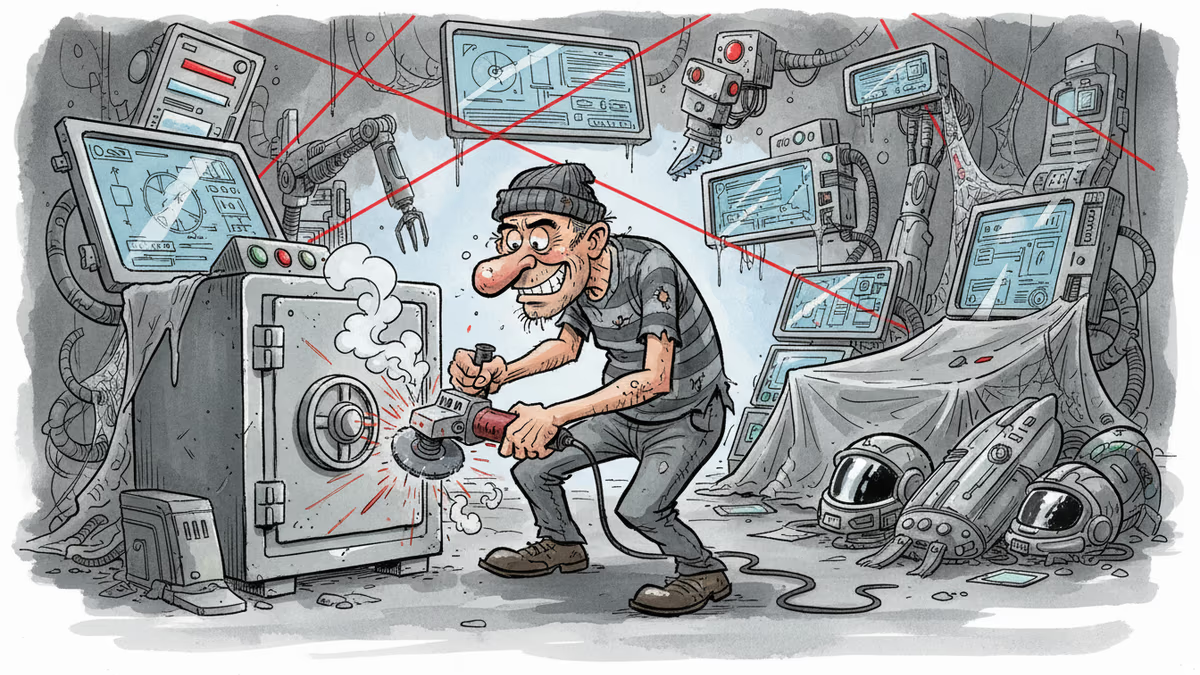
€88 million worth of antique jewelry vanished from the Louvre last year. The sophisticated technology used? An angle grinder.
Steven Soderbergh once said making a movie is like pulling off a heist. You devise a creative angle, assemble specialists, overcome technical challenges, rehearse with Swiss-watch precision, and—if done right—redistribute some wealth. That description fits both the plot and production of Ocean's Eleven.
But real heists? They're nothing like the movies.
The Mundane Reality of Million-Dollar Theft
Forget surveillance camera hacks or laser-dodging acrobatics. In reality, the biggest obstacle is usually a literal one: a door. The most common criminal strategy isn't electromagnetic pulse generators—it's corrupting, tricking, or threatening an insider.
This isn't speculation. In 2014, nuclear weapons researchers at Sandia National Laboratories took an unusual detour into crime analysis. Worried someone might steal a nuke from the US arsenal, they compiled a 100-page report called "The Perfect Heist: Recipes from Around the World."
Their "Heist Methods and Characteristics Database" analyzed 23 high-value robberies from 1972 to 2012. The pattern was clear: successful thieves invested massive amounts of money and time in planning and practice—sometimes more than 100 rehearsals. They used brute force (tunneling through sewers for months, like the 1976 Société Générale bank heist in Nice) or pure guile (police costumes to fool guards, like the 1990 Gardner Museum job in Boston).
But nobody was shutting down Vegas's electrical grid with fancy gadgets. The most successful robbers got to the goods unseen and escaped fast.
Technology Advances, Crime Stays Simple

Fast-forward to today, and the situation hasn't changed. Spanish researchers studying art crimes from 1990 to 2022 found that low-tech methods remain most successful. "High-tech technology doesn't work so well," says Erin L. Thompson, an art historian at John Jay College who studies art crime.
Speed and practice trump sophisticated systems and alarms. Even that Louvre robbery was fundamentally a minutes-long smash-and-grab.
This emphasis on speed doesn't eliminate skill—quite the opposite. As the saying goes: amateurs talk strategy, professionals study logistics. Even without gadgets, heists require an engineer's mindset.
Why We Root for the Bad Guys
Anna Kornbluh, an English professor at the University of Illinois at Chicago, offers a fascinating explanation for our heist fascination. Heist movies "absolutely celebrate deep-dive nerdery," she says—the mentality of "I'm going to know everything I can about the power grid, about this kind of stone and drill, about Chicago at night."
This reflects Old Hollywood's collective art-making approach. Meanwhile, modern streaming shows about grifters like WeWork or con artist Anna Delvey mirror today's lone-wolf, disrupt-and-scale startup mindset.
But why do law-abiding citizens cheer for people who'd steal crowns from the Louvre or $100,000 worth of escargot from a Champagne farm (as happened weeks after the jewelry theft)? Kornbluh argues heists represent "anti-oligarch praxis."
"Everybody wants to know how to be in a competent collective. Everybody wants there to be better logistics," she explains. "We need a better state. We need a better society. We need a better world."
The Human Element Remains
The research reveals something profound about security in any era. Technical countermeasures rarely matter; high-tech gadgets rarely solve problems. The vulnerability isn't in the system—it's in the people operating it.
This pattern extends beyond physical theft. In cybersecurity, the most sophisticated hacks often pale beside simple phishing emails that exploit human psychology rather than technical flaws.
Authors
Related Articles

FAA closes El Paso International Airport and surrounding airspace for 10 days citing only 'Special Security Reasons' with no further explanation

Five stories from late September, traced to where the paper trail stops: Korea's export record, Nvidia's Hugging Face 8-K, a US-China AI channel, the UN on AI, and rising births.

Huawei's CANN is open source under a license barring software for non-Ascend chips. Inside China's second CUDA, and the two links still outside it: pre-training compute and 5nm capacity.
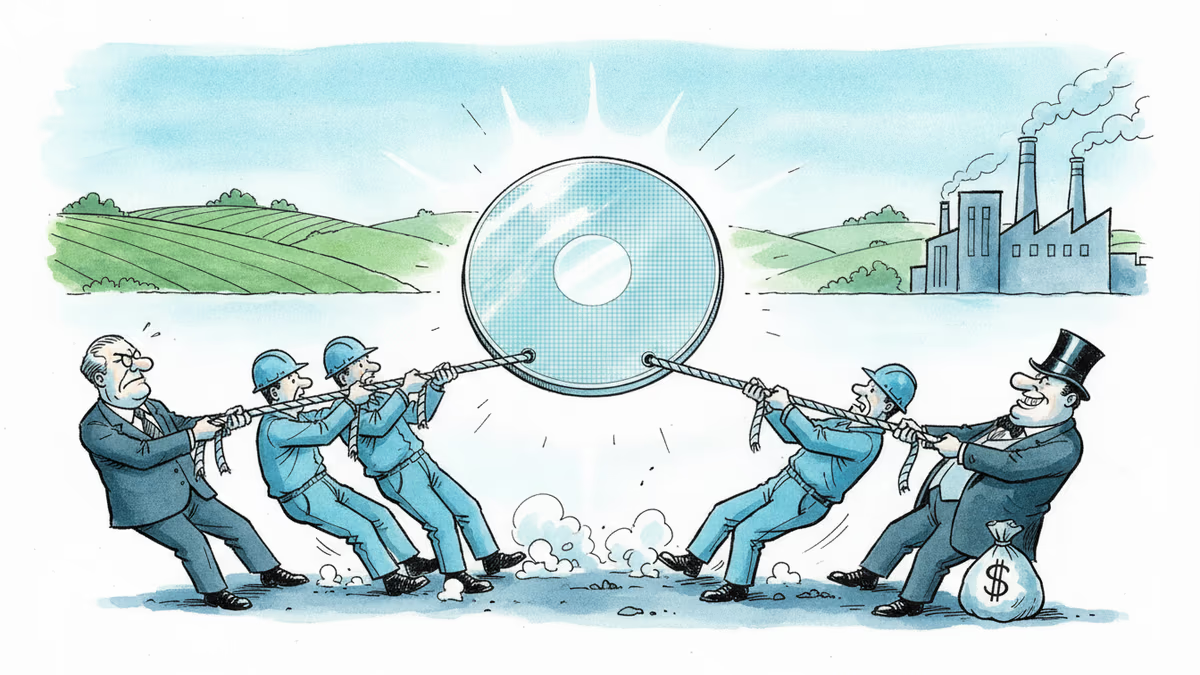
Samsung Electronics' union branch revealed that 84% of survey respondents oppose the government's roughly $290 billion (₩400 trillion) semiconductor megaproject in Gwangju. Government, management, the union and shareholders are all reading the same national project in sharply different ways.
FAA closes El Paso International Airport and surrounding airspace for 10 days citing only 'Special Security Reasons' with no further explanation
Five stories from late September, traced to where the paper trail stops: Korea's export record, Nvidia's Hugging Face 8-K, a US-China AI channel, the UN on AI, and rising births.
Huawei's CANN is open source under a license barring software for non-Ascend chips. Inside China's second CUDA, and the two links still outside it: pre-training compute and 5nm capacity.
Samsung Electronics' union branch revealed that 84% of survey respondents oppose the government's roughly $290 billion (₩400 trillion) semiconductor megaproject in Gwangju. Government, management, the union and shareholders are all reading the same national project in sharply different ways.
Thoughts
Share your thoughts on this article
Sign in to join the conversation