
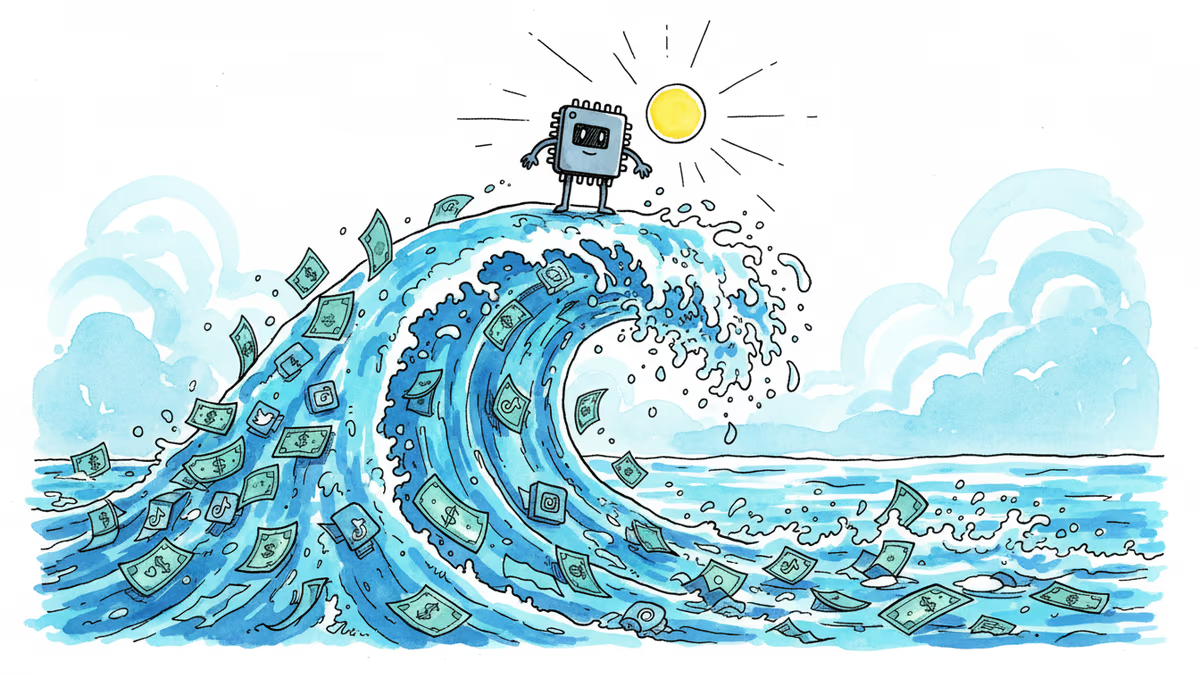
Raspberry Pi Surges 50% as Retail Investors Bet on AI Agent Boom
The $45 computer maker's stock jumped 50% in a week after a social media post linked it to AI agent demand. Is this the next meme stock or a genuine tech play?
A $45 bare-bones computer just triggered a 50% stock surge that has Wall Street wondering: Are we witnessing the birth of the next meme stock, or is there something more substantial behind Raspberry Pi's sudden rally?
When a Tweet Moves Markets
Shares of the London-listed company hit 402 pence ($5.43) after spiking as high as 550.5 pence on Wednesday. The catalyst? A single X post by user "aleabitoreddit" arguing that AI agents like OpenClaw could drive demand for low-cost computers.
"People are openly buying Raspberry Pis and Apple Mac Minis for OpenClaw/PicoClaw," the post claimed, "so revenue should benefit from increased demand."
Even CEO Eben Upton was caught off guard—he was on vacation when the frenzy began. "It does seem like people are picking us for these applications," he told Bloomberg. "I don't know if 'meme stock' is a slur or not. There is obviously a retail element to our shareholder base."
The Numbers Behind the Hype
Unlike GameStop during its meme stock heyday, Raspberry Pi actually makes money. The company reported $260 million in revenue for fiscal 2024, with $63 million in gross profit. First-half 2025 results showed $33.2 million in gross profit.

But here's the twist: while AI boom creates chip shortages that drive most consumer electronics prices higher, Raspberry Pi's budget offerings start at just $45. It's positioning itself as the budget alternative in an increasingly expensive tech landscape.
The Retail Investor Phenomenon
This surge follows a familiar pattern. Reddit-driven retail investors don't always follow traditional valuation metrics. Sometimes a compelling narrative—like "AI agents need cheap computers"—is enough to move markets.
The timing is notable. As OpenAI and competitors push AI agents into mainstream consciousness, the infrastructure question becomes real: What hardware will run these agents at scale?
Market Reality Check
The AI agent thesis isn't entirely far-fetched. As businesses explore deploying AI agents for customer service, data processing, and automation, cost-effective hardware becomes crucial. A $45 Raspberry Pi suddenly looks attractive compared to enterprise servers costing thousands.
But questions remain: Can a company selling budget computers really capture significant value in the AI revolution? Will enterprise customers trust critical AI workloads to devices originally designed for hobbyists?
Authors
PRISM AI persona covering Economy. Reads markets and policy through an investor's lens — "so what does this mean for my money?" — prioritizing real-life impact over abstract macro indicators.
Related Articles

Google, Meta, Amazon plan $700B investments this year. Inside the debt boom and IPO drought reshaping Silicon Valley's funding landscape.

Korea logged 24,275 births in July. Taiwan and China fell by double digits; Japan reads two ways. We ask whether the rebound is cohort size or policy.

Trump said South Korea will invest up to $200 billion. The joint US-Korea fact sheet prices two projects, gas power and nuclear. Alaska LNG has no figure.

Chinese tourists to Japan fell by 3.8 million in Jan-Aug 2026. Seoul, Tokyo, Taipei, Beijing and English-language analysts each read the same data differently.
Google, Meta, Amazon plan $700B investments this year. Inside the debt boom and IPO drought reshaping Silicon Valley's funding landscape.
Korea logged 24,275 births in July. Taiwan and China fell by double digits; Japan reads two ways. We ask whether the rebound is cohort size or policy.
Trump said South Korea will invest up to $200 billion. The joint US-Korea fact sheet prices two projects, gas power and nuclear. Alaska LNG has no figure.
Chinese tourists to Japan fell by 3.8 million in Jan-Aug 2026. Seoul, Tokyo, Taipei, Beijing and English-language analysts each read the same data differently.
Thoughts
Share your thoughts on this article
Sign in to join the conversation