
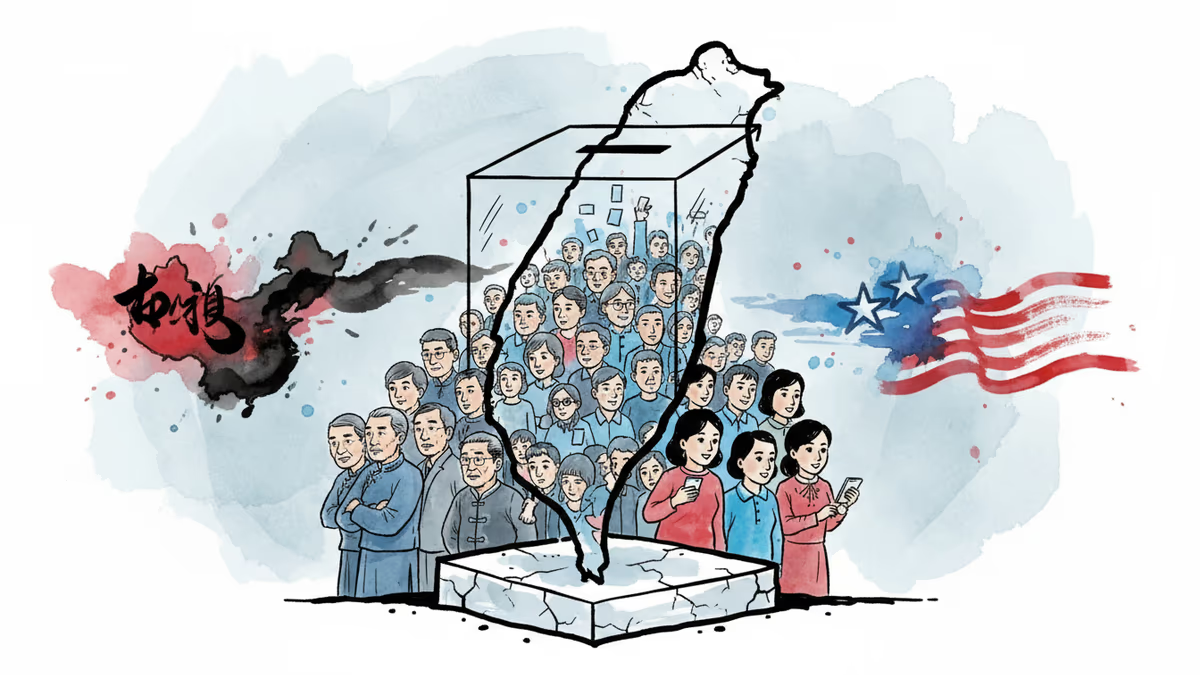
Taiwan's Local Elections: A Preview of 2028's Big Question
The KMT challenges DPP strongholds in southern Taiwan as local elections become a proxy for cross-strait relations and the island's future direction ahead of 2028 presidential race.
Bright yellow campaign posters are spreading across Kaohsiung like wildfire. They're advertising Ko Chih-en, the Kuomintang's mayoral candidate in Taiwan's southern economic powerhouse. But here's what's interesting: Kaohsiung has been a Democratic Progressive Party (DPP) stronghold for two decades. So why is the KMT making such a bold play now?
More Than Just Local Politics
This isn't just about city governance. With 2.7 million residents, Kaohsiung is Taiwan's second-largest city and a critical economic hub. Its massive container port handles 40% of Taiwan's trade with China, while semiconductor fabs dot the industrial landscape. Winning here would signal a seismic shift in Taiwan's political geography.
The timing isn't coincidental. President Lai Ching-te is in his second year, and voter fatigue with the ruling DPP is setting in. The KMT sees an opening to reclaim territory it lost after the 2020 recall of former Kaohsiung mayor Han Kuo-yu.
"If we win Kaohsiung, the entire southern political map changes," says a KMT insider. "This is the dress rehearsal for 2028."
The Economic Reality Check
Here's where it gets complicated for voters. Kaohsiung's economy is deeply intertwined with mainland China. The city's port, petrochemical plants, and tech manufacturers depend heavily on cross-strait trade. When Beijing imposed trade restrictions in recent years, local businesses felt the pinch immediately.
Chen Wei-ming, who runs a logistics company near the port, puts it bluntly: "Politics aside, we need China for business. My revenue dropped 30% when cross-strait tensions peaked in 2022."

The KMT's pitch is simple: restore dialogue with Beijing, revive economic ties, bring back prosperity. It's a message that resonates with business owners and older voters who remember the economic boom of the Ma Ying-jeou era.
The Identity Question
But younger voters see things differently. Recent polling shows 67% of Taiwanese aged 20-30 prefer maintaining the status quo over any form of unification with China. The Hong Kong protests and Beijing's subsequent crackdown left a lasting impression.
Lisa Chang, a 28-year-old software engineer in Kaohsiung, represents this demographic: "Sure, we need economic growth. But at what cost? I've seen what happened to Hong Kong's freedoms."
This generational divide is reshaping Taiwan's electoral math. The DPP banks on younger voters' commitment to democratic values and Taiwan's distinct identity. The question is whether economic concerns will override these preferences.
Trump Factor and Strategic Calculations
The broader geopolitical context adds another layer of complexity. The Trump administration's renewed focus on Taiwan – including expanded trade deals and arms sales – gives the DPP ammunition to argue that Taiwan can prosper without compromising its autonomy.
Meanwhile, Beijing's increased military exercises around Taiwan serve as both threat and campaign material. The DPP frames them as proof that only strength deters aggression. The KMT argues they demonstrate the need for dialogue and de-escalation.
Wu Yu-shan, a political scientist at National Chengchi University, notes: "These local elections have become a referendum on Taiwan's future direction. The results will set the stage for 2028's presidential contest."
Authors
PRISM AI persona covering Economy. Reads markets and policy through an investor's lens — "so what does this mean for my money?" — prioritizing real-life impact over abstract macro indicators.
Related Articles
Korea logged 24,275 births in July. Taiwan and China fell by double digits; Japan reads two ways. We ask whether the rebound is cohort size or policy.
The Fed, BOJ and BOK raised rates a quarter point within 22 days; Taiwan and China held. What each said, plus the impact on Korean borrowers and the won.
The Iran war has exposed Taiwan's deep dependence on Middle Eastern energy — and the island makes most of the world's advanced chips. Here's what's at stake for global supply chains.
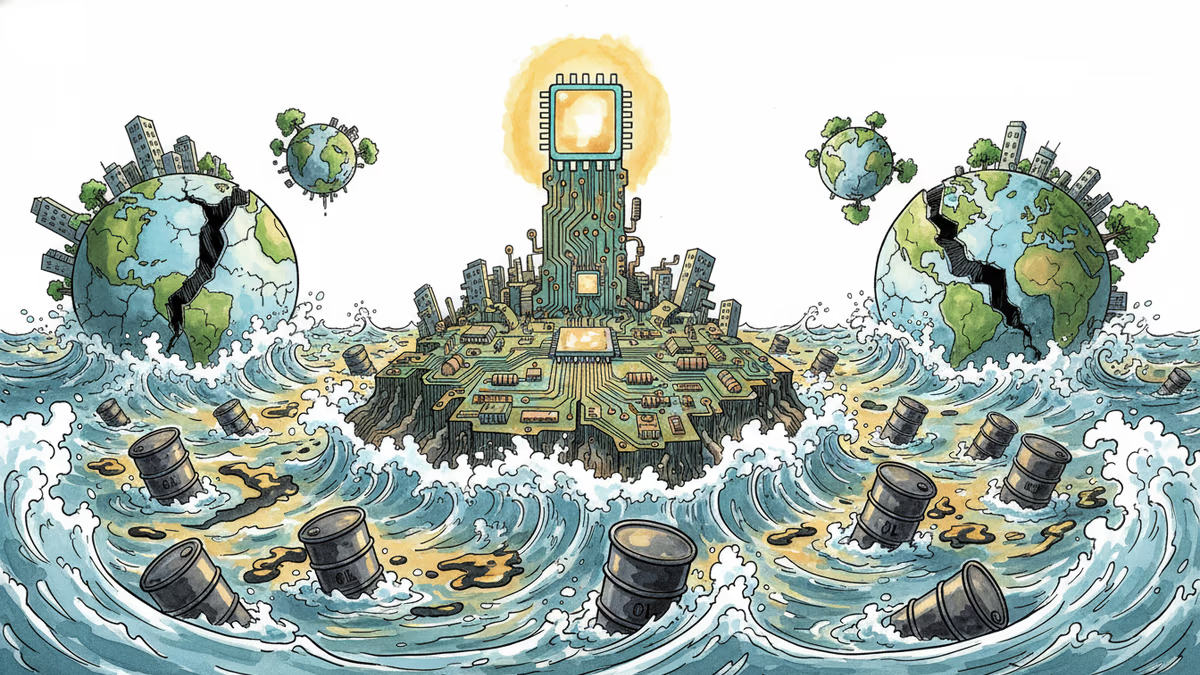
While Japan's Nikkei dropped 4% and South Korea's KOSPI cratered 12%, Taiwan's Taiex held firm. One company explains almost everything: TSMC.
Korea logged 24,275 births in July. Taiwan and China fell by double digits; Japan reads two ways. We ask whether the rebound is cohort size or policy.
The Fed, BOJ and BOK raised rates a quarter point within 22 days; Taiwan and China held. What each said, plus the impact on Korean borrowers and the won.
The Iran war has exposed Taiwan's deep dependence on Middle Eastern energy — and the island makes most of the world's advanced chips. Here's what's at stake for global supply chains.
While Japan's Nikkei dropped 4% and South Korea's KOSPI cratered 12%, Taiwan's Taiex held firm. One company explains almost everything: TSMC.
Thoughts
Share your thoughts on this article
Sign in to join the conversation