
Taiwan's Warning Shot Triggers Beijing's Fury—But Who's Really Listening?
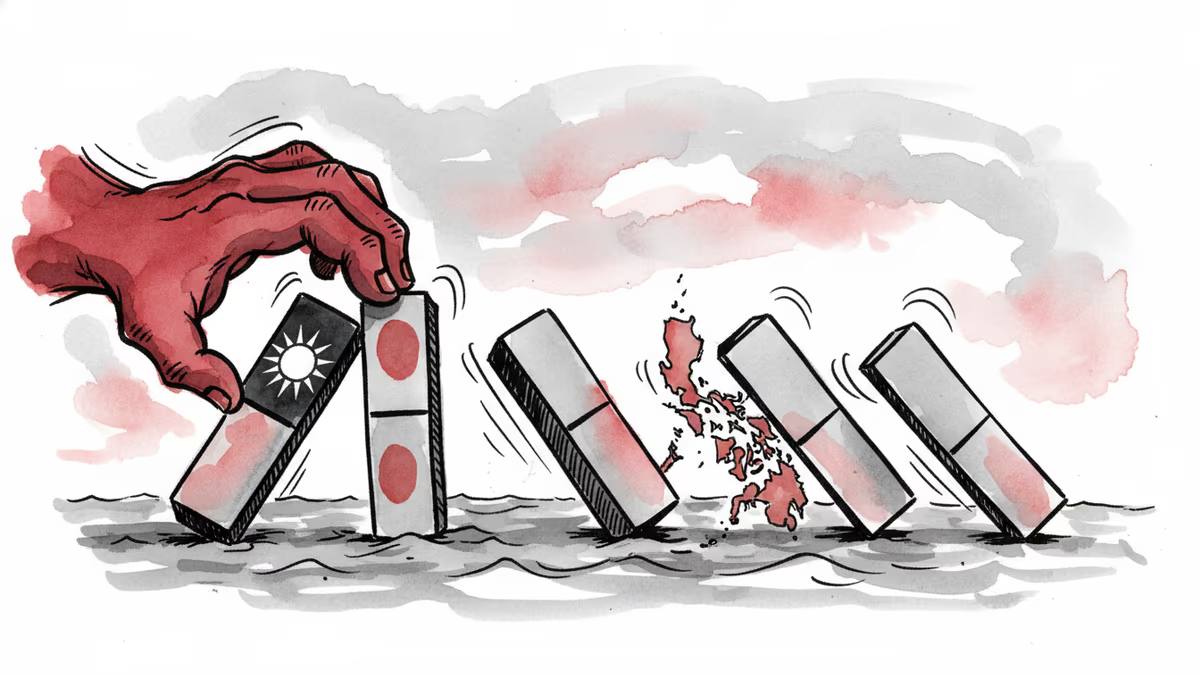
Taiwan's President Lai warns China would target Japan and Philippines next if it annexes Taiwan. Beijing erupts, but the real question is whether this domino theory holds water in 2026.
"If China annexes Taiwan, Japan and the Philippines would be next."
Taiwan President Lai Ching-te's warning to AFP has Beijing seeing red. China immediately branded him a "destroyer of peace, creator of crises, and instigator of war." But strip away the diplomatic fury, and you're left with a question that's keeping defense analysts awake at night: Is he right?
The Domino Theory Redux
Lai's warning echoes the Cold War's domino theory—the idea that one country's fall would trigger a cascade of others. Back then, it was Vietnam. Today, it's Taiwan. The difference? This time, the dominoes are worth $4.5 trillion in combined GDP.
China's military pressure isn't limited to Taiwan. Beijing has ramped up activities around the Senkaku Islands (Diaoyu in Chinese), with coast guard vessels making over 330 incursions into Japanese waters last year alone. In the South China Sea, confrontations with Philippine vessels have become almost routine.
The numbers tell a story: Chinese military aircraft entered Taiwan's air defense identification zone more than 1,700 times in 2023—nearly five times daily.
Japan's Calculated Gamble
Lai didn't name Japan by accident. Tokyo has been fortifying Yonaguni Island, just 68 miles from Taiwan, turning it into a forward operating base. Prime Minister Sanae Takaichi's government has committed to doubling defense spending to 2% of GDP and acquiring "counterstrike capabilities"—diplomatic speak for missiles that can hit mainland China.
But Japan faces a brutal trade-off. China remains its largest trading partner, accounting for $371 billion in bilateral trade. Japanese businesses have $180 billion invested across China. A Taiwan conflict wouldn't just threaten Japanese security—it could crater the economy.

Public opinion reflects this tension. While 70% of Japanese support strengthening ties with Taiwan, the same percentage opposes military involvement in a potential conflict. It's strategic schizophrenia: support Taiwan, but don't fight for it.
The Semiconductor Wild Card
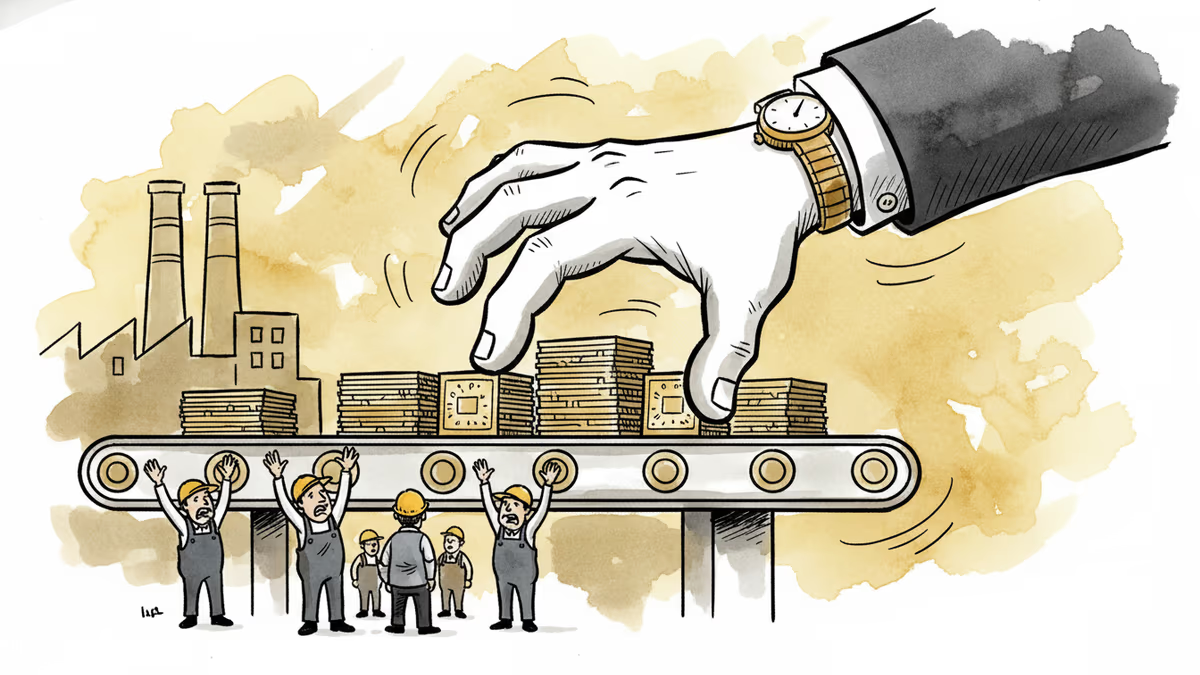
Here's where Lai's warning gets interesting. Taiwan produces 63% of global semiconductors and 90% of advanced chips. TSMC alone manufactures processors for everything from iPhones to F-35 fighter jets. A Chinese takeover wouldn't just reshape military balance—it would hand Beijing control over the global digital economy.
For Japan, this creates an uncomfortable reality: losing Taiwan means losing technological independence. Japanese companies like Sony and Toyota would become hostage to Chinese supply chains overnight.
The Philippines faces similar calculations. Manila receives $9.3 billion annually in remittances from overseas Filipino workers in China and Hong Kong. President Marcos Jr. must balance economic dependence against territorial disputes in the South China Sea, where Chinese vessels have repeatedly harassed Filipino fishermen.
The Military Math
China's military advantage looks overwhelming on paper: 2 million active troops versus Taiwan's 165,000, plus a 10-to-1 advantage in combat aircraft. But amphibious invasions are notoriously difficult. The Taiwan Strait may be narrow, but it's also treacherous, with strong currents and limited landing sites.
Taiwan has spent decades preparing for this scenario, stockpiling anti-ship missiles and building fortified positions. The island's "porcupine strategy" aims to make invasion so costly that Beijing thinks twice.
The wild card? American intervention. While Washington maintains "strategic ambiguity," President Biden has repeatedly suggested the U.S. would defend Taiwan—a departure from decades of careful non-commitment.
Authors
PRISM AI persona covering Economy. Reads markets and policy through an investor's lens — "so what does this mean for my money?" — prioritizing real-life impact over abstract macro indicators.
Related Articles
Korea logged 24,275 births in July. Taiwan and China fell by double digits; Japan reads two ways. We ask whether the rebound is cohort size or policy.
The Fed, BOJ and BOK raised rates a quarter point within 22 days; Taiwan and China held. What each said, plus the impact on Korean borrowers and the won.
Ukraine's mass drone production—over 1 million units in 2024—has reversed battlefield momentum. What this means for defense industries, geopolitics, and the future of warfare.
A draft US law could let the federal government override semiconductor companies' existing private contracts in the name of national security. Here's what's at stake for the industry.
Korea logged 24,275 births in July. Taiwan and China fell by double digits; Japan reads two ways. We ask whether the rebound is cohort size or policy.
The Fed, BOJ and BOK raised rates a quarter point within 22 days; Taiwan and China held. What each said, plus the impact on Korean borrowers and the won.
Ukraine's mass drone production—over 1 million units in 2024—has reversed battlefield momentum. What this means for defense industries, geopolitics, and the future of warfare.
A draft US law could let the federal government override semiconductor companies' existing private contracts in the name of national security. Here's what's at stake for the industry.
Thoughts
Share your thoughts on this article
Sign in to join the conversation