
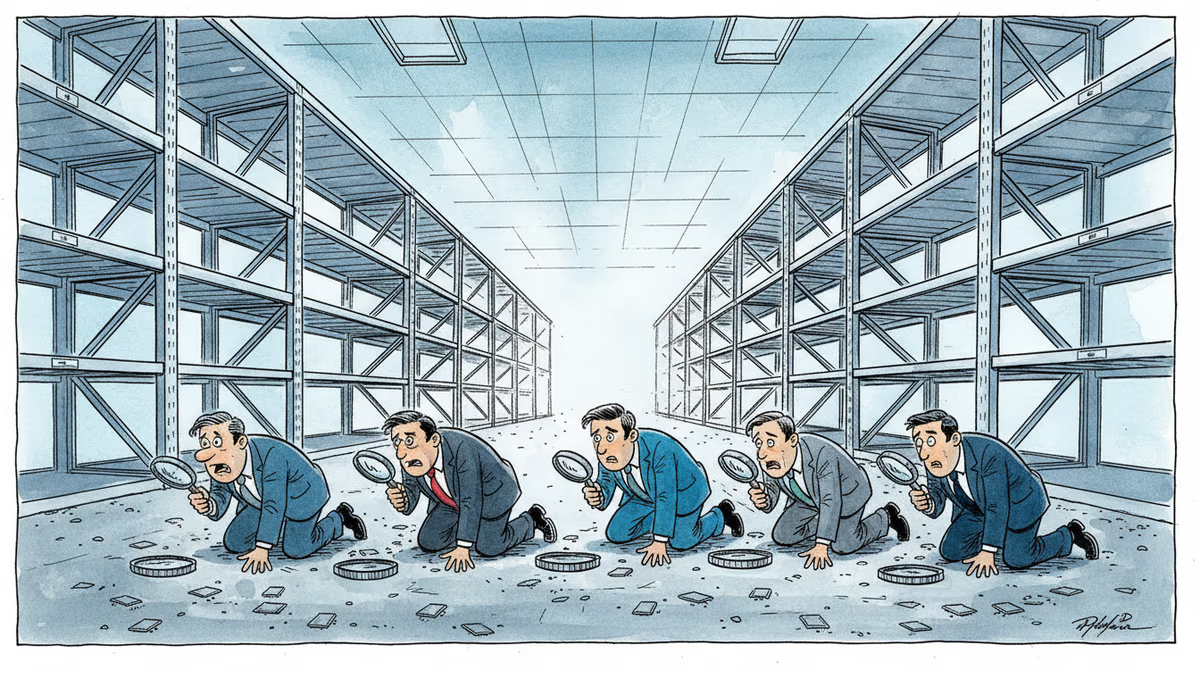
The RAM Shortage That Could Kill Companies
Phison CEO warns of severe memory chip shortage in late 2026 that could force product cuts and company closures across tech industry
47% of global RAM production relies on just three companies. Now, one of the industry's most connected insiders is sounding the alarm about what happens when that fragile supply chain breaks.
Pua Khein-Seng, CEO of Phison—a major controller chip maker for SSDs and flash memory—delivered a stark warning in a recent Taiwanese TV interview: companies will need to slash product lines by late 2026, and some won't survive at all.
The Controller Chip Oracle
Phison isn't a household name, but it's the hidden backbone of your digital life. The company's controller chips manage data flow in SSDs across laptops, smartphones, and data centers worldwide. When Pua speaks about memory shortages, the industry listens—his company sits at the intersection of every major memory supply chain.
His warning comes as global tech companies are already feeling the squeeze. Memory prices have climbed 23% since October 2025, and lead times for specialized chips now stretch 16-20 weeks compared to the typical 8-12 weeks.
But Pua's prediction goes beyond typical supply-demand imbalances. He's describing an existential threat: companies forced to abandon entire product categories or shut down operations entirely.
The Perfect Storm Building
Three converging forces are creating this crisis. First, AI demand has exploded memory consumption far beyond industry forecasts. ChatGPT-5 alone requires 40% more memory per query than its predecessor, while autonomous vehicles need 500GB of high-speed memory per vehicle.

Second, geopolitical tensions have fragmented supply chains. China's push for memory independence means $200 billion in new fab construction, but those facilities won't reach full capacity until 2027-2028. Meanwhile, Western sanctions limit equipment exports to existing Chinese fabs.
Third, the physics of memory manufacturing are hitting walls. Each new generation requires exponentially more precise equipment and longer development cycles. What used to take 18 months now takes 30+ months from design to production.
Winners, Losers, and Survivors
Not everyone faces the same fate. Apple and Microsoft have locked in multi-year supply contracts at premium prices—a strategy that looked expensive in 2024 but appears prescient now. Smaller hardware makers without similar leverage will compete for scraps.
The automotive industry faces particular vulnerability. Electric vehicles require 10-20 times more memory than traditional cars, but auto suppliers typically operate on razor-thin margins with limited ability to absorb price shocks. Tesla's vertical integration advantage becomes even more pronounced.
Consumer electronics could see dramatic consolidation. Budget smartphone makers might exit entirely, while premium brands raise prices to secure components. The $200 smartphone could become extinct by 2027.
The Adaptation Playbook
Smart companies are already pivoting. Some are redesigning products to use less memory-intensive architectures. Others are exploring alternative technologies like MRAM or ReRAM that could substitute for traditional memory in specific applications.
Intel and AMD are betting heavily on processing-in-memory technologies that reduce memory bandwidth requirements. If successful, these could ease pressure on traditional memory supplies while improving performance.
But the most intriguing response might come from software. Google has quietly assembled teams working on "memory-frugal AI"—algorithms that deliver similar performance with 60-70% less memory usage. If they crack this code, the entire shortage dynamic changes.
Authors
Related Articles
Samsung Electronics' union branch revealed that 84% of survey respondents oppose the government's roughly $290 billion (₩400 trillion) semiconductor megaproject in Gwangju. Government, management, the union and shareholders are all reading the same national project in sharply different ways.
IBM has unveiled 'nanostack,' the world's first sub-1nm (0.7nm) chip research. Some say it adds a decade to Moore's Law; others say a lab demo is a long way from a fab. Either way, mass production isn't IBM's job.
Samsung and SK unveiled a chip and AI investment package worth thousands of trillions of won on June 29. The headline number swings wildly by outlet, but the real contest isn't capital — it's water and power.
As Trump and Xi meet in Beijing, five tech flashpoints—chips, AI rivalry, supply chains, EVs, and rare earths—will quietly shape the global economy more than any diplomatic communiqué.
Samsung Electronics' union branch revealed that 84% of survey respondents oppose the government's roughly $290 billion (₩400 trillion) semiconductor megaproject in Gwangju. Government, management, the union and shareholders are all reading the same national project in sharply different ways.
IBM has unveiled 'nanostack,' the world's first sub-1nm (0.7nm) chip research. Some say it adds a decade to Moore's Law; others say a lab demo is a long way from a fab. Either way, mass production isn't IBM's job.
Samsung and SK unveiled a chip and AI investment package worth thousands of trillions of won on June 29. The headline number swings wildly by outlet, but the real contest isn't capital — it's water and power.
As Trump and Xi meet in Beijing, five tech flashpoints—chips, AI rivalry, supply chains, EVs, and rare earths—will quietly shape the global economy more than any diplomatic communiqué.
Thoughts
Share your thoughts on this article
Sign in to join the conversation