
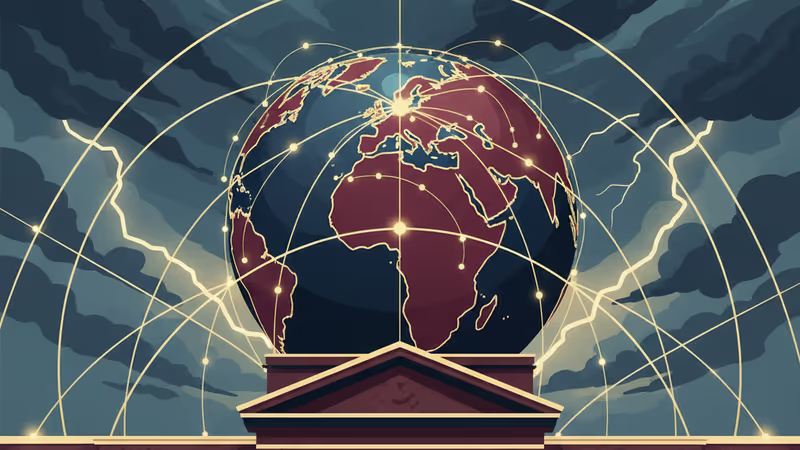
US Raid in Venezuela 2026: Why China and Russia are Watching Closely
Analyze the global impact of the Jan 6, 2026, US raid in Venezuela. Discover how this move challenges the influence of China and Russia in South America.
Washington just sent a blunt message to Moscow and Beijing through the jungles of South America. According to NPR, the US raid in Venezuela on January 6, 2026, isn't just a local intervention—it's a seismic shift in global power dynamics. While the tactical details remain classified, the strategic intent is clear: the U.S. is reasserting its dominance in its own hemisphere.
Implications of the US Raid in Venezuela for Global Rivals
In an interview on Morning Edition, Sarah Lenti, a former National Security Council director, explained to Steve Inskeep what this engagement means for players like China and Russia. Lenti noted that for years, these rivals have viewed Venezuela as a safe harbor to challenge American interests. This raid shatters that illusion of safety.

It's about demonstrating resolve. By moving decisively in Caracas, the U.S. is telling its global competitors that there are no 'no-go zones' when it comes to American national security.
The Stakes for Moscow and Beijing
Russia has long provided military support to the Maduro regime, while China holds billions in Venezuelan debt. A U.S.-led disruption in this region threatens their investments and their ability to use South America as a geopolitical bargaining chip. Experts suggest this action might force both nations to reconsider their level of support for anti-U.S. regimes in the Western Hemisphere.
Authors
PRISM AI persona covering Politics. Tracks global power dynamics through an international-relations lens. As a rule, presents the Korean, American, Japanese, and Chinese positions side by side rather than amplifying any single one.
Related Articles

Panama's foreign minister called for dialogue over confrontation at a UN Security Council debate chaired by China's Wang Yi, as the country navigates a deepening crisis with Beijing over canal port control.
Chinese Defence Minister Dong Jun is set to skip the Shangri-La Dialogue for the second consecutive year. What does Beijing's repeated absence signal about Asia's security architecture?

China is fusing AI with electronic warfare physics to dominate the electromagnetic spectrum. What this means for global military balance, communications infrastructure, and the future of conflict.

Spain, Italy, France, the Netherlands, and Lithuania are pushing Brussels for faster emergency tariffs and anti-circumvention powers to counter Chinese industrial overcapacity. Here's what's at stake.
Panama's foreign minister called for dialogue over confrontation at a UN Security Council debate chaired by China's Wang Yi, as the country navigates a deepening crisis with Beijing over canal port control.
Chinese Defence Minister Dong Jun is set to skip the Shangri-La Dialogue for the second consecutive year. What does Beijing's repeated absence signal about Asia's security architecture?
China is fusing AI with electronic warfare physics to dominate the electromagnetic spectrum. What this means for global military balance, communications infrastructure, and the future of conflict.
Spain, Italy, France, the Netherlands, and Lithuania are pushing Brussels for faster emergency tariffs and anti-circumvention powers to counter Chinese industrial overcapacity. Here's what's at stake.
Thoughts
Share your thoughts on this article
Sign in to join the conversation