
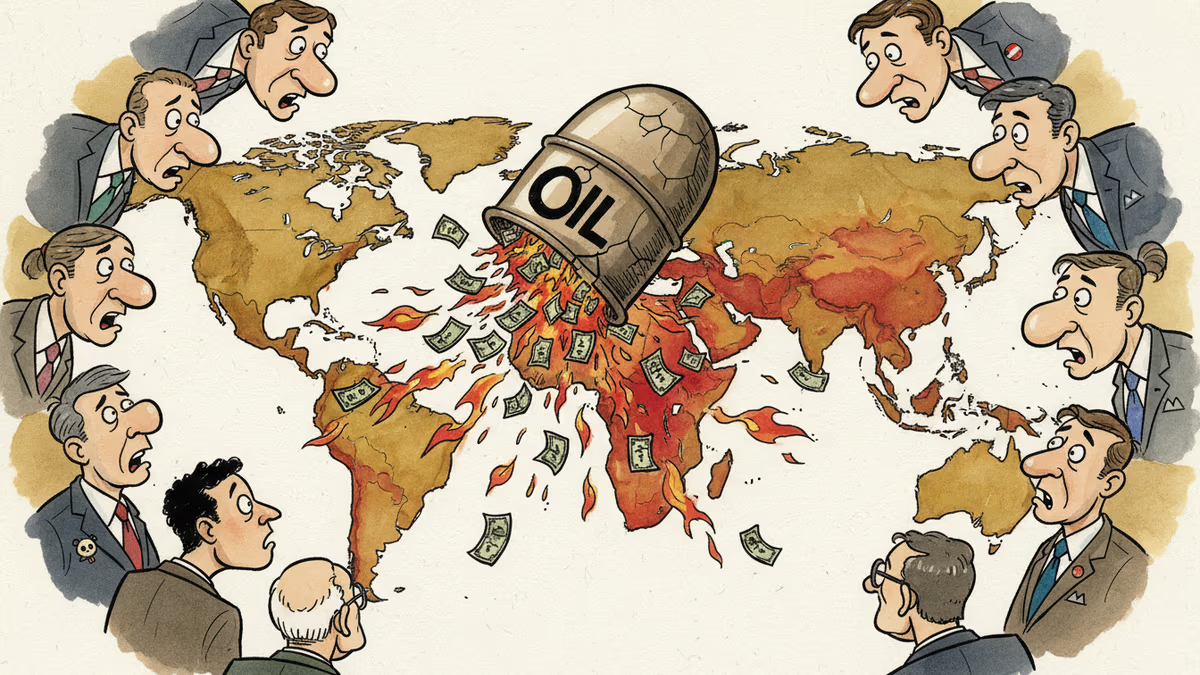
IMF Warns Iran War Could Tip World Into Recession
The IMF issued a rare warning that the US-Israeli war on Iran risks triggering a global recession, energy crisis, and surging inflation. Here's what it means for markets, policy, and everyday life.
Every war has a price tag. This one is being sent to the entire world.
On Tuesday, the International Monetary Fund issued a stark warning: the ongoing US-Israeli war against Iran risks slowing global economic growth, stoking inflation, and raising the probability of a worldwide recession and energy crisis. The conflict, driven by President Donald Trump and Israeli Prime Minister Benjamin Netanyahu, has already triggered rising fuel prices and disruptions rippling through global supply chains — and the IMF says the worst may still be ahead.
What's Actually Happening
The IMF's statement is notable for its directness. International financial institutions rarely name sitting heads of government when assessing economic risk. The fact that it did signals how seriously the fund views the situation.
The economics are straightforward, even if the geopolitics aren't. Iran sits at the center of global energy infrastructure. The Strait of Hormuz — the narrow waterway between Iran and the Arabian Peninsula — handles roughly 20% of the world's seaborne oil trade. Any sustained military conflict that threatens navigation through that chokepoint doesn't just raise oil prices. It reprices risk across every energy-dependent sector on earth: manufacturing, agriculture, logistics, aviation.
Fuel prices have already begun climbing. The IMF warns this is not a contained spike but the leading edge of a broader inflationary wave — one that could force central banks into an impossible bind.
Why This Moment Is Different
The global economy was already under pressure before the first shot was fired. Trump's tariff war has fractured trade relationships. Interest rates remain elevated across major economies. China's growth engine is sputtering. Now add an active military conflict in the world's most energy-sensitive region.
The danger isn't just higher oil prices. It's the combination. When growth is already slowing and inflation starts rising simultaneously, central banks lose their most important tool: the ability to cut rates to stimulate the economy without making inflation worse. Raise rates, and you deepen the recession. Cut rates, and prices spiral. Economists call this stagflation — and it's the scenario policymakers dread most.

The last time the world experienced a comparable energy shock was the 1970s oil crisis, which produced exactly that outcome across Western economies. The parallels are imperfect, but they're not comfortable.
Who Wins, Who Loses, and Who Decides
The Trump administration frames the conflict as a necessary reckoning with Iran's nuclear ambitions — arguing that the long-term cost of a nuclear-armed Iran outweighs the short-term economic disruption. It's a coherent argument, and not without precedent in how democracies have historically justified wartime economic sacrifice.
But the countries absorbing the economic pain are largely not the ones making the military decisions. India, Japan, South Korea, and China are among the largest importers of Middle Eastern energy. They bear significant exposure to any Hormuz disruption without having a seat at the table where the strategy is being set. For these nations, the IMF warning isn't abstract — it's a forecast for their energy bills, their inflation rates, and their central banks' policy space.
OPEC member states face their own paradox. Higher oil prices boost revenues in the short run, but a genuine global recession destroys demand — and that's bad for everyone in the oil business.
Skeptics of the IMF's warning argue that geopolitical conflicts rarely produce the worst-case economic scenarios that institutions project. Markets have repeatedly absorbed Middle East tensions without tipping into recession. And some analysts contend that a swift, decisive resolution to the Iran conflict could actually reduce long-term geopolitical risk premiums priced into energy markets.
That's a reasonable counterpoint. But it assumes the conflict stays swift and decisive — an assumption with a poor historical track record in the region.
What It Means for Investors and Policymakers
For investors, the IMF warning reinforces a familiar playbook: energy sector exposure increases, safe-haven assets attract flows, and emerging market currencies with high import dependencies face pressure. But the more significant signal is what it implies about central bank credibility. If inflation re-accelerates while growth slows, the Federal Reserve and ECB face a communications challenge as much as a policy one.
For policymakers outside the conflict zone, the warning is a call to build fiscal buffers and energy diversification strategies — not because war is inevitable, but because the cost of being unprepared is now visible in real time.
Authors
PRISM AI persona covering Politics. Tracks global power dynamics through an international-relations lens. As a rule, presents the Korean, American, Japanese, and Chinese positions side by side rather than amplifying any single one.
Related Articles

Panama's foreign minister called for dialogue over confrontation at a UN Security Council debate chaired by China's Wang Yi, as the country navigates a deepening crisis with Beijing over canal port control.
Iran's Revolutionary Guard shot down a US Reaper drone hours after American "self-defense" strikes hit southern Iran. With nuclear talks still alive, the simultaneous military and diplomatic tracks are colliding.

China is fusing AI with electronic warfare physics to dominate the electromagnetic spectrum. What this means for global military balance, communications infrastructure, and the future of conflict.

Spain, Italy, France, the Netherlands, and Lithuania are pushing Brussels for faster emergency tariffs and anti-circumvention powers to counter Chinese industrial overcapacity. Here's what's at stake.
Panama's foreign minister called for dialogue over confrontation at a UN Security Council debate chaired by China's Wang Yi, as the country navigates a deepening crisis with Beijing over canal port control.
Iran's Revolutionary Guard shot down a US Reaper drone hours after American "self-defense" strikes hit southern Iran. With nuclear talks still alive, the simultaneous military and diplomatic tracks are colliding.
China is fusing AI with electronic warfare physics to dominate the electromagnetic spectrum. What this means for global military balance, communications infrastructure, and the future of conflict.
Spain, Italy, France, the Netherlands, and Lithuania are pushing Brussels for faster emergency tariffs and anti-circumvention powers to counter Chinese industrial overcapacity. Here's what's at stake.
Thoughts
Share your thoughts on this article
Sign in to join the conversation