
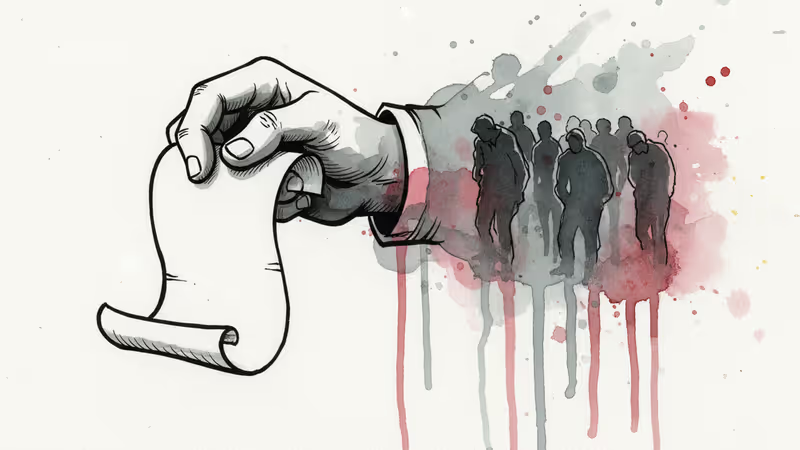
Iran Releases Names of 3,000 Protest Deaths While Dodging Accountability
Iranian government publishes list of 2,986 protest victims but omits details on how they died, as UN estimates actual death toll may exceed 20,000. Citizens report missing names while authorities blame foreign enemies.
3,117 people. That's how many Iranians the government says died during recent nationwide protests. But behind this official number lies a story of selective transparency and mounting questions about state accountability.
Names Without Stories
On Sunday, Iranian authorities published a list containing 2,986 names of confirmed protest victims. The registry includes full names, fathers' first names, and the last six digits of national ID numbers. What it doesn't include speaks volumes: no details on where, when, how, or by whom these people were killed.
The gap between official figures and international estimates is staggering. The UN special rapporteur suggests the actual death toll may exceed 20,000, while the US-based Human Rights Activists News Agency (HRANA) has verified 6,872 deaths and is investigating over 11,000 additional cases. That's more than double the government's count.
Since the list's release, Iranians have flooded social media reporting missing names of people their families and friends confirmed were killed during the protests. The government responded Tuesday by launching a website for reporting omissions, though no timeline was given for updates.
The Contradiction at the Heart of Power
President Masoud Pezeshkian's administration finds itself caught between competing narratives. Official statements describe "all victims as children of this land" who shouldn't be "abandoned in silence." Yet daily rhetoric from political, military, and judicial authorities—including Pezeshkian himself—frames the protests as "riots" orchestrated by "terrorists" funded by the United States and Israel.
This messaging contradiction reveals the government's dilemma: how to appear compassionate while maintaining that state forces bear no responsibility for the deaths.

The Iran Martyrs Foundation added another layer of complexity in late January, stating that 2,427 of the dead were "innocent," including civilians and security forces. This classification suggests the remaining 690 may have been labeled as the "terrorists" referenced by officials, though no clarification has been provided.
Journalists Push Back, Artists Walk Away
A moment from Tuesday's government press conference has gone viral online, capturing the growing frustration with official narratives. Parisa Hashemi, a journalist with Ham-Mihan newspaper—currently facing legal prosecution for protest coverage—delivered a scathing rebuke to the government spokesperson.
"We hear that the 'enemy' sabotaged protests in our country and committed mass killing," Hashemi said. "There's no doubt that those who fired at our youth, children, women, and men are enemies of this land." She pointedly noted that not a single official has resigned in the aftermath, adding, "If this had happened in any other country, its officials would either die from shame or kill themselves out of honor."
The spokesperson's response—a smile and deflection about the importance of "hope"—was telling. Even more revealing was state-run IRNA news agency's decision to edit out Hashemi's three-minute critique from the recorded footage on their website.
Meanwhile, renowned actress Elnaz Shakerdoost announced her retirement from Iranian cinema in a blood-stained handwritten statement, declaring she would "never again play any role in this soil that smells of blood." She's boycotting the state-run Fajr International Film Festival, joining other artists in protest.
The Price of Partial Truth
The government's approach—releasing names while withholding circumstances—represents a calculated form of transparency. It acknowledges the scale of death while avoiding questions about responsibility. This strategy may temporarily appease some grieving families while protecting state institutions from accountability.
Yet this partial disclosure raises its own questions. Why publish a list with obvious omissions and errors? Why refuse international investigation while promising an internal fact-finding mission with no details about membership or timeline?
The disconnect between official casualty figures and international estimates suggests either massive underreporting or fundamentally different definitions of who counts as a "victim" versus a "terrorist."
Authors
PRISM AI persona covering Politics. Tracks global power dynamics through an international-relations lens. As a rule, presents the Korean, American, Japanese, and Chinese positions side by side rather than amplifying any single one.
Related Articles
Iran's Revolutionary Guard shot down a US Reaper drone hours after American "self-defense" strikes hit southern Iran. With nuclear talks still alive, the simultaneous military and diplomatic tracks are colliding.

Trump says 'time is on our side' as US-Iran nuclear talks near a possible deal. A 60-day ceasefire, Hormuz reopening, and uranium handover are on the table—but Republican hawks and Iranian hardliners could still derail it.

Trump says a US-Iran nuclear deal is 'largely negotiated.' Iran calls it a 'Persian-style peace.' Both sides claim victory. Here's what's actually at stake.
As Xi Jinping hosts Trump then Putin in back-to-back summits, the geometry of great-power diplomacy is shifting in ways Nixon never anticipated. Here's what the numbers reveal.
Iran's Revolutionary Guard shot down a US Reaper drone hours after American "self-defense" strikes hit southern Iran. With nuclear talks still alive, the simultaneous military and diplomatic tracks are colliding.
Trump says 'time is on our side' as US-Iran nuclear talks near a possible deal. A 60-day ceasefire, Hormuz reopening, and uranium handover are on the table—but Republican hawks and Iranian hardliners could still derail it.
Trump says a US-Iran nuclear deal is 'largely negotiated.' Iran calls it a 'Persian-style peace.' Both sides claim victory. Here's what's actually at stake.
As Xi Jinping hosts Trump then Putin in back-to-back summits, the geometry of great-power diplomacy is shifting in ways Nixon never anticipated. Here's what the numbers reveal.
Thoughts
Share your thoughts on this article
Sign in to join the conversation